


 Kristina Markovic
  06.01.2026
Professional work in the UAE has always lived in a different light especially for anyone obtaining a professional license in the UAE. While factories reshape land and farms coax life from the desert, it is human expertise — the architect’s hand, the consultant’s insight, the engineer’s calculation, the designer’s instinct — that gives the country its sharper edges. The UAE treats professional talent not as a casual commodity but as an essential part of its economic identity. A professional license here is far more than a formality; it’s the country’s way of saying, If you’re going to offer your skills on our soil, do it with clarity, competence, and intention.
People abroad often imagine the Emirates as a place built purely on capital and construction, yet anyone who has lived or worked here knows the truth: the real machinery is intellectual. Advisory firms steer corporations, medical professionals shape public well-being, auditors protect financial integrity, engineers maintain the country’s ambitions, and designers influence how the region sees itself. The professional license sits at the center of all this — discreet, strict, quietly powerful.
Those entering this world quickly realize that the UAE evaluates professional services differently from any other category. You are not selling a product. You are selling judgment, precision, and the ability to solve problems that matter. Regulators want to know who you are, what experience you carry, and how your work will affect clients, institutions, and in many cases, public trust. This is why professional licensing moves with a certain gravity. Expertise can build futures — or break them — and the country treats that responsibility with care.
Once you understand that the license is the foundation of your reputation, not a bureaucratic hoop, the process takes on a different shape. It becomes the architecture of accountability — a pact between you, your skillset, and the nation that allows you to practice it.
The Mind at Work: How the UAE Builds Its Professional Licensing Landscape
Professional services in the UAE don’t float in the air like abstract concepts; they anchor themselves inside a system built on precision, credibility, and stability — a system that anyone getting a professional license in the UAE must learn to navigate. The country understands that expertise is one of the few resources that grows sharper with use, not consumption, and it treats that resource with a kind of structured respect. This is why the professional landscape here feels engineered rather than improvised. Every consultant, advisor, designer, analyst, engineer, auditor, therapist, or strategist plugs into an economy built to reward clarity and punish guesswork.
The UAE doesn’t allow professional services to evolve chaotically. It shapes them deliberately — through licensing standards, qualification checks, regulatory bodies, and alignment with international norms. A business offering professional work becomes part of a national interface: the layer where citizens, corporations, and institutions seek trusted expertise. The government wants to ensure that anyone stepping into that role is qualified, accountable, and capable of delivering work that meets the country’s expectations for accuracy and integrity.
This is why the professional ecosystem is one of the most controlled, yet also one of the most empowering. If you bring real skill — whether academic, technical, or creative — the system is designed to let you operate cleanly, build trust quickly, and scale without friction. But if you arrive with ambiguity, inflated claims, or a business model that hides inconsistencies, the licensing channels close just as quickly.
Professional work influences decisions that ripple outward: financial audits that impact shareholders, architectural plans that shape skylines, therapy sessions that affect well-being, legal advice that guides disputes, engineering that supports safety. The UAE respects the weight of these outcomes, and it expects those who hold specialized knowledge to handle it with the same seriousness.
Understanding a Professional License in the UAE
Exploring Activities Covered When Getting a Professional License in the UAE
A professional license in the UAE isn’t a generic permission to “offer services.” It is a precise authorization that defines the exact intellectual or technical skill you may practice. Consulting, engineering, architecture, auditing, design, therapy, translation, legal advisory, IT development, marketing strategy, coaching, medical support services, and dozens of other specializations each live in their own regulatory lane. The UAE separates these activities intentionally because each one influences people, companies, or public systems in a different way. The license carves out your territory: what you may advise on, what you may design, what you may calculate, and what responsibilities your work carries.
Navigating Boundaries Within the Professional License System in the UAE
The country doesn’t allow professional companies to blend unrelated services into a single license. An engineering consultancy cannot suddenly offer psychological counseling. A legal advisory firm cannot expand into architectural design. A therapist cannot offer financial advice under the same entity. The system uses strict classifications to protect clients, maintain competence standards, and ensure that every service provider is operating within the field they are actually trained to navigate.

Want to learn more about UAE business setup services?
Why Securing a Professional License in the UAE Involves Deeper Scrutiny
Professional work is personal. It touches people’s decisions, finances, health, planning, or stability. Because of this, regulators look closely at professional operators: qualifications, experience, business models, intended activities, and in some cases, the personal background of practitioners. The scrutiny isn’t meant to slow you down — it’s meant to guarantee that your expertise is real and that the services you offer will not endanger clients or institutions.
When you choose the right professional activity, the system aligns seamlessly. Choose poorly, and the entire structure resists — amendments, delays, or outright rejection.

Meeting Integrity Standards When Applying for a Professional License in the UAE
Naming Rules for Professional Entities
Professional companies in the UAE must choose names that reflect clarity, credibility, and the nature of their expertise. No implied government affiliation, no misleading claims, no references to restricted fields, and no imitation of existing firms. A name that suggests engineering must belong to an engineering consultancy; a name hinting at psychology must reflect licensed therapeutic work. Regulators expect the name to match the service because professional work relies on public trust, and trust begins with transparency.
Activity Selection: Expertise in Defined Categories
Professional services in the UAE come with sharply defined boundaries. Management consulting, engineering design, legal advisory, accounting, architecture, therapy, IT consultancy, and other specializations each sit in specific regulatory pockets. Choosing the wrong activity can block approvals, restrict what services you may legally offer, or force costly amendments later. The UAE wants precision: the activity must align with your qualifications, your experience, and the service you intend to deliver.
Office, Workspace, and Practical Footprint
Even knowledge-based businesses need a physical or semi-physical base. Mainland professional entities require a verified office space that meets the emirate’s standards. What matters is that your workspace supports the nature of your service — a consultancy must have meeting space, a design studio must have project tools, and a regulated profession must meet privacy and security standards.
Documentation and Skill-Based Approvals
The paperwork for professional licenses is simple but strict: passports, corporate documents, UBO declarations, experience evidence, and — for certain professions — diplomas, certifications, or regulatory permits. A mismatch between your declared activity and your qualifications will halt approvals immediately.
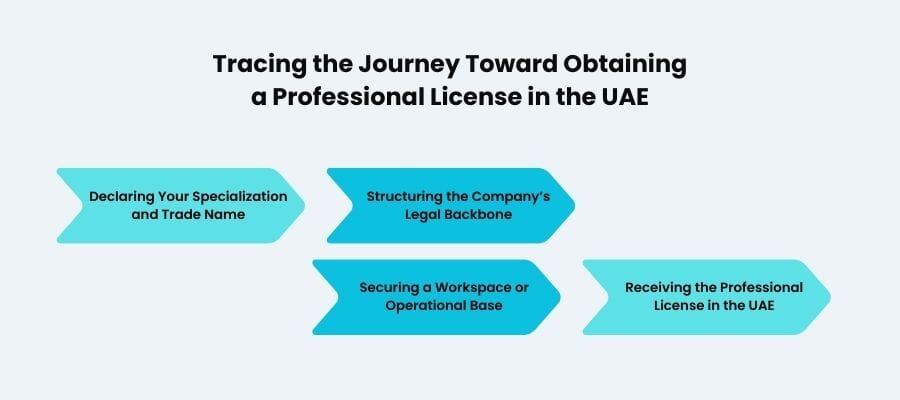
Tracing the Journey Toward Obtaining a Professional License in the UAE
Declaring Your Specialization and Trade Name
The journey begins with a clear declaration of who you are professionally. Are you a consultant? An architect? A financial advisor? A therapist? A designer? A strategist? Authorities study your proposed activity to ensure it reflects a real skillset, not a vague promise. Your trade name must echo that identity: clean, compliant, and aligned with what you intend to offer. This first step is where your credibility takes shape.
Structuring the Company’s Legal Backbone
Once your direction is confirmed, you formalize your entity by signing the MOA or AOA. This document defines ownership, capital distribution, governance, and how decisions are made. Professional licenses rely heavily on clean, transparent structures because service businesses often handle sensitive data and client relationships.
Securing a Workspace or Operational Base
A professional license can’t exist without a verifiable base of operations. Mainland companies require tenancy contracts approved by local authorities. Your workspace must suit the nature of your service — meeting rooms for consultants, creative areas for designers, private spaces for regulated professions.
Receiving the Professional License in the UAE
Once the approvals, documents, and workspace align, the authority issues your professional license in the UAE. In that moment, your expertise becomes officially recognized within the UAE’s economic system.
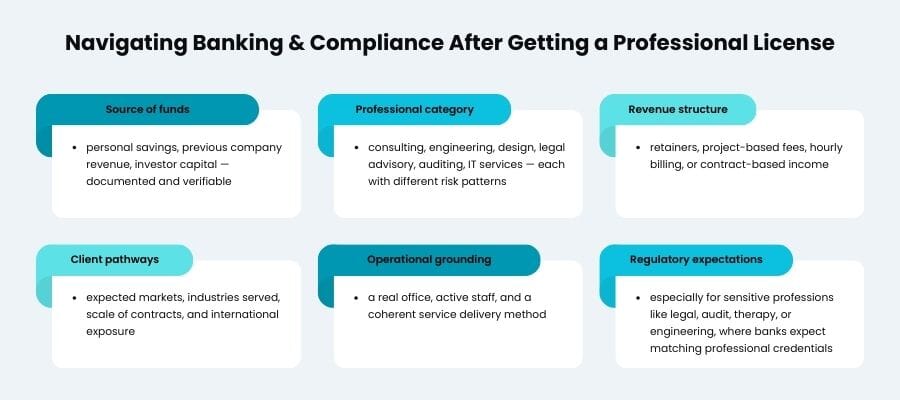
Navigating Banking & Compliance After Getting a Professional License in the UAE
Banks in the UAE read professional service companies with a different lens than they apply to traders or manufacturers. Professional work revolves around intellect, fees, retainers, advisory relationships, and intangible value — which means banks must understand the logic behind how you turn expertise into revenue especially if you’re getting a professional license in the UAE and preparing to operate in a regulated environment. They are not impressed by portfolios, websites, or polished branding. They want a financial narrative that stands on solid ground.
Professional companies often have low overhead but high responsibility, and that combination attracts scrutiny. Banks need to know that your qualifications match your declared activity, that your clients are real, and that your business model can sustain clean, predictable financial flows. A consultancy with unclear revenue paths or a legal advisor with vague client pipelines will struggle. Meanwhile, firms with structured retainers, service contracts, documented experience, and clear value propositions pass smoothly.
Banks focus on several key points:
- Source of funds: personal savings, previous company revenue, investor capital — documented and verifiable.
- Professional category: consulting, engineering, design, legal advisory, auditing, IT services — each with different risk patterns.
- Revenue structure: retainers, project-based fees, hourly billing, or contract-based income.
- Client pathways: expected markets, industries served, scale of contracts, and international exposure.
- Operational grounding: a real office, active staff, and a coherent service delivery method.
- Regulatory expectations: especially for sensitive professions like legal, audit, therapy, or engineering, where banks expect matching professional credentials.
Professional services are approved easily when financial behavior matches the business model — steady income streams, transparent contracts, realistic projections. When the story aligns, onboarding is fast. When inconsistencies appear, the file goes silent.
The UAE’s Final Word: Advancing With a Professional License in the UAE
A professional license in the UAE is not the last page of a procedure — it’s the moment your knowledge finally earns a seat at the country’s table, the point at which obtaining a professional license in the UAE becomes less about paperwork and more about being trusted to shape part of the country’s intellectual landscape. You aren’t opening a shop or assembling machinery. You’re stepping into a landscape where thinking itself is a craft, and where skill becomes something the country folds into its larger ambitions. Professional work in the Emirates has a way of echoing farther than you expect. A single decision, a single blueprint, a single advisory note can shape companies, influence policies, or guide people through situations that matter. The license recognizes that weight, and it treats your expertise with the seriousness it deserves.
When that license lands in your hands, it carries an unspoken message:
Your mind is now part of this place. Use it well.
The UAE doesn’t demand perfection from professionals. It asks for clarity, dignity in practice, and a respect for the trust people place in your hands. It asks you to build a reputation that can stand without decoration — one grounded in the quality of your work, not the volume of your promises. And in exchange, the country offers something rare: a stable environment where expertise actually matters. A place where architects can shape skylines, consultants can reshape companies, analysts can sharpen decision-making, designers can influence culture, therapists can strengthen well-being, and engineers can make the impossible feel routine.
Once your immigration file is active, your bank relationship is clear, and your workspace has taken shape, the UAE stops being just a market. It becomes a collaborator — a nation that believes professional talent is part of its long-term architecture, especially for those seeking a professional license in the UAE as the foundation of their work.
And when your first client walks through the door, when your first proposal leaves your desk, when your first project takes flight, you feel what the license was trying to say from the beginning:
You are not merely working in the Emirates — you are becoming part of how the Emirates thinks, builds, and evolves.

