


 Calen Voss
  04.07.2025
 Buying property in Dubai opens direct access to one of the most transparent and highly digitalized capital markets. The emirate draws investors in with a structured system of ownership records, a strong rental sector, and real options for securing investment visas. Foreign buyers can only acquire property within designated freehold zones. Legal protection of the investment begins only after the ownership record is officially entered into the Dubai Land Department register — that’s when your rights are fully secured, not just agreed on paper.
This material explains how to approach buying property in Dubai without making procedural mistakes, keeping things clear and grounded. It covers both completed properties and units still under construction. You’ll see how a proper legal check is carried out, what tax obligations come into play, and how visa outcomes connect to the deal. The focus stays on structuring ownership in a way that protects international investors in practice, not just in theory.
Regulatory Framework for Acquiring Property in Dubai
Buying property in Dubai falls under emirate-level regulation, with the Dubai Land Department acting as the central authority. DLD manages the property rights register, processes sales, records title transfers, registers mortgages, issues property maps, and generates the electronic title document that confirms ownership.
Real estate transactions in Dubai cannot be evaluated based only on an agreement between buyer and seller. Under property registration law, any transfer or disposal of rights must comply with DLD requirements. Agreements that ignore or attempt to bypass these rules are considered invalid. This is why securing property ownership in Dubai depends not just on signing a contract, but on aligning every step with the official system.
The regulatory framework includes several legal acts, each addressing a specific transaction risk:
-
the real estate registration law in Dubai defines the general registry system, ownership rights, and restrictions for non-citizens;
-
the regulation on ownership zones for foreign individuals sets the areas where foreign buyers can obtain full ownership, long-term usage rights, or leasehold up to 99 years;
-
the escrow law for development projects protects payments made by buyers of off-plan properties;
-
the law on the interim property register applies to construction-stage assets and Oqood registration;
-
the mortgage law regulates pledges on property registered with DLD;
-
joint ownership rules cover service charges, building management, and shared expenses.
These laws connect property registration, buyer status, and future use of the asset into one system. For a completed apartment or villa, the key document after the deal is the electronic title deed. For properties under construction, temporary registration in the Oqood system is used. If a mortgage is involved, the transaction requires checking the pledge, obtaining bank consent, and ensuring proper release of the encumbrance. For buildings with shared areas, service fees and management rules must also be reviewed.
RERA oversees transaction security-affecting market players in DLD. This framework regulates brokers, developers, advertising, escrow accounts, service costs, and joint ownership. This layer controls the market and makes Dubai real estate regulations predictable.
Ownership of property in Dubai is distinguished by the law for international buyers. Foreign investors are restricted to areas designated by the emirate governor. Buyers of long-term usage rights or tenure agreements for up to 99 years experience stability; however, they are subject to a distinct legal framework compared to those who acquire complete ownership.
Buying Property in Dubai as a Foreigner: Where Ownership Is Allowed and What Rights the Buyer Gets
Not everyone in Dubai has the same regulations about owning property. The law makes it clear that local citizens, residents from Gulf nations, and investors from other countries are all independent groups. If you are coming from another country, you can only buy property in certain locations. Only those places that the emirate's ruler has formally allowed are open to foreign ownership. It's not about limiting access; it's about keeping the system under control and predictable.
When a foreigner steps into buying property in Dubai as a non-resident, the process revolves around one key authority — the Dubai Land Department. But registration does not happen automatically. Two things must line up. The property itself must be located in an approved zone, and its legal status must allow the transfer of ownership into the buyer’s name. This applies whether a person purchases privately or acts through a company. In the case of a business structure, the scrutiny becomes more detailed: licensing, internal documents, ownership chain, signing authority, and even how the company is linked to its country of registration are all carefully reviewed before approval is granted.
The range of rights depends on who exactly is making the purchase:
-
a private foreign buyer can hold property personally, but only within zones where such ownership is permitted;
-
an overseas company may acquire property if its documents and internal structure pass the authority’s review;
-
citizens of the UAE and Gulf countries operate under fewer restrictions and are not tied to the same geographic limits;
-
companies fully owned by local or GCC nationals follow a separate legal path with broader access;
-
if someone acts through a representative, additional checks focus on verifying authority and identity before anything moves forward.
In practice, most deals involving foreign investors fall into one of three legal formats. Freehold means full ownership with no time boundary, but only within certain districts. Leasehold offers long-term use, often stretching close to a century, while technically remaining a form of extended tenancy. It may not be as clear at first glance, but usufruct gives you the right to use and gain from the property for a set amount of time. The exact terms depend on how the land is registered. It's not just the law that you have to choose between these formats; you also need to know about property rights in Dubai if you want to spend.
For anyone putting money into real estate here, these distinctions shape the future of the asset. The type of right attached to the property affects how easily it can be sold later, whether financing is possible, how inheritance is handled, and whether rental income can be generated without complications. Even residency options can depend on this structure, which makes the choice far from technical — it’s strategic.
Before any agreement turns into a completed transaction, a detailed verification process takes place. The plot identification, land classification, ownership format, data from the digital title record, and developer information all come under review. It is also essential to confirm that the selected buyer — whether an individual or a company — can legally be recorded as the owner. Many expect the process to revolve around signing a contract and placing a deposit, but in reality, registering property ownership in Dubai depends on what is officially recorded, not on what the parties intended.
Investment decisions here also demand a grounded view of pricing and rental demand. A buyer should clearly understand the location of the property, the type of ownership being transferred, any limits on its use, and whether the official register allows the asset to be placed under their name or chosen structure. Without this clarity, even a promising deal can quietly turn into a complicated one.

Types of Properties and Titles: Buying an Apartment in Dubai, a Villa, Commercial Premises, and an Off-Plan Project
A studio in a tower, a beach villa, a small office, a hotel-format unit, an unfinished apartment from a developer — in Dubai these are handled differently from the legal side. The category of property changes the registration process, the document package, future expenses, and even the way ownership is recorded. When dealing with completed housing, the final proof of rights comes from the electronic title issued through Dubai Land Department.
A finished unit passes through a formal ownership transfer inside the DLD system. Only after registration does the buyer appear as the official owner. Because of this, buying an apartment in Dubai without checking the title information is dangerous. Booking confirmations, receipts, or promotional brochures do not legally confirm ownership, even if the money has already been paid.
Buying a villa in Dubai usually requires extra checking beyond the house itself. The plot boundaries, technical map, community obligations, and shared area payments matter too. Inside private residential compounds, owners often face maintenance fees, façade rules, and restrictions connected with rebuilding or exterior changes. Some communities regulate even small modifications.
The situation looks different with off-plan property in Dubai. Here, the buyer purchases rights connected to a future unit that still has not been completed physically. Instead of the final title deed, temporary registration is used. Such projects must appear in the official register, operate through a protected escrow account, and pass registration through Oqood.
Dubai rules also limit how developers receive money. Payments for construction-stage projects should move into the project escrow account, not to random company accounts. Buying property in Dubai from a developer normally includes checking the construction status, installment structure, delivery terms, cancellation clauses, and conditions linked to possible changes in apartment size after handover.
Buying apartments in Dubai for rental income or visa purposes also depends on the building format. Serviced residences and hotel apartments sometimes work under separate operational rules. Commercial property in Dubai brings additional tax details as well, including 5% VAT, possible tax registration, ownership structuring, and rental income reporting.
Legal Review Before Buying Property in Dubai: Checking the Developer and Secondary Market Property
Checking property in Dubai starts with a basic but important question: can this asset legally be transferred to the buyer at all? Many people think the process works automatically because Dubai has a centralized registration system. In reality, transactions stop all the time because of unresolved debts, blocked titles, old mortgages, mistakes in plot details, invalid powers of attorney, or payment methods that do not meet DLD rules.
When dealing with resale property, attention usually goes first to the owner and the title record. Buying secondary market property in Dubai means comparing the electronic title with DLD registry data, seller documents, and the actual unit details. If another person signs on behalf of the owner, the power of attorney must also be checked separately. Expired authorization, missing legalization, or incorrect wording may prevent registration completely.
Most disputes around completed units appear because of obligations already attached to the property. Before the final transfer, buyers normally review whether the apartment has an active mortgage, court restriction, arrest order, tenant registration, unpaid service fees, or unresolved claims from the developer or management company. The developer’s NOC also matters. Without this approval, the transfer usually cannot pass through the registration office.
Legal review for resale property in Dubai often includes:
-
checking DLD ownership records;
-
verifying the seller’s identity;
-
reviewing mortgages, freezes, court restrictions, or claims;
-
checking unpaid maintenance charges;
-
reviewing NOC status from the developer;
-
checking tenancy contracts and Ejari registration;
-
confirming the broker holds an active RERA license;
-
reviewing powers of attorney used in the deal;
-
checking how deposits and final payments are transferred.
Developer-sold Dubai property operates differently. Focus switches to the project. Buyers frequently verify the developer and project in official registries, the escrow account, and Dubai REST or DLD construction progress.
The contract becomes a major risk. Payment phases, handover timing, cancelation regulations, defect compensation, and unit size terms can safeguard the buyer. Off-plan sales require project payments to enter the development's registered escrow account, making developer checks in Dubai crucial.
Verification of off-plan property in Dubai also includes temporary Oqood registration. DLD rules require registration within 90 days after signing the agreement. If construction slows down, the finished size changes, or defects appear after delivery, the wording of the contract starts playing a major role. Because of this, due diligence for Dubai property usually includes much more than title review alone. Buyers also study construction documents, payment structure, developer status, and legal protection mechanisms written into the agreement itself.
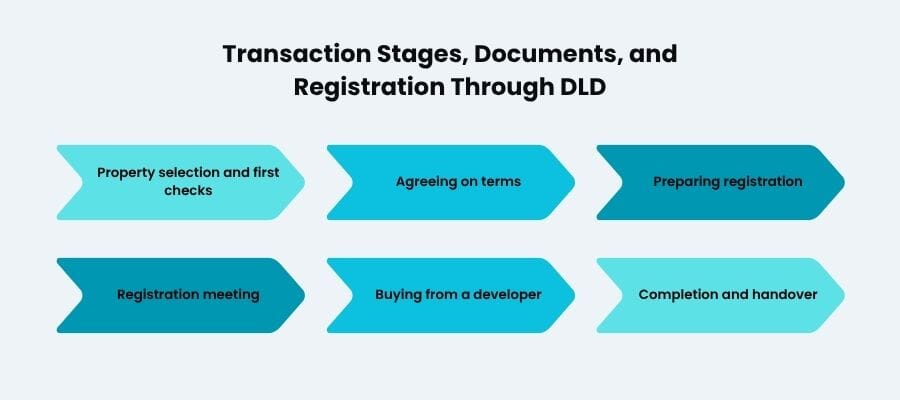
Process of Buying Property in Dubai: Transaction Stages, Documents, and Registration Through DLD
There are different ways to buy property in Dubai based on the deal. A resale apartment takes a set of steps. A developer then builds another off-plan house. The title record ends up going through the Dubai Land Department in both cases.
Stage 1. Property selection and first checks. Buyers first consider the neighborhood, building quality, ownership format, maintenance fees, rental situation, and if foreigners can register the unit. Dubai property purchase documents differ. Individuals usually present a passport or Emirates ID. Companies provide licensing, incorporation, shareholder, and signing authority documentation.
Stage 2. Agreeing on terms. For completed property, the parties discuss the price, payment structure, transfer date, deposit, furniture, tenant status, and NOC procedure. A property sale in Dubai is usually fixed through a standard market form. After signing, the buyer commonly transfers a deposit, often around 10%.
Main difference between ready and off-plan property:
-
Ready property:
-
transfer through DLD;
-
electronic title deed issued after registration;
-
full payment during transfer;
-
developer NOC required.
-
-
Off-plan property:
-
temporary Oqood registration;
-
temporary certificate instead of title;
-
installment payments;
-
escrow account required.
-
Stage 3. Preparing registration. For resale deals, the developer issues the NOC after checking unpaid service charges. Property registration in Dubai also requires payment preparation, DLD fee settlement, and arranging the registration appointment.
Stage 4. Registration meeting. At the registration office, officials review IDs, title documents, powers of attorney, and payment papers. After verification, the transfer enters the DLD system. Property transfer in Dubai ends with issuance of the electronic title deed.
Stage 5. Buying from a developer. For off-plan property in Dubai, the buyer signs a booking form, pays the reservation fee, and then signs the sales agreement. After that, the transaction is recorded in the Oqood register. Payments are transferred to the project escrow account in accordance with the specified timetable.
Stage 6. Completion and handover. The buyer tracks construction progress through Dubai REST and DLD systems, follows payment deadlines, and reviews handover conditions. After completion, the property passes inspection and temporary registration converts into a full ownership title.

Want to learn more about UAE business setup services?
Costs and Taxes When Buying Real Estate in Dubai
A Dubai apartment's stated price is almost never the actual price that a buyer pays. Upon initiation of the procedure, supplementary fees emerge: registration payments, processing expenses, banking formalities, document issuance, and occasionally tax liabilities associated with the nature of the premises.
The central payment goes to the land registration authority in Dubai. The standard state charge equals four percent of the property value. Inside the formal system, the amount is split equally between the two sides of the transaction. Two percent is assigned to the seller and another two percent to the buyer. Still, many contracts rearrange this balance privately.
There is also a separate processing fee collected by the registration center. Expensive units fall into the higher category. Real estate priced from 500,000 dirhams and above requires a payment of 4,000 dirhams plus value-added tax. Less expensive properties are processed under a reduced amount — 2,000 dirhams plus VAT.
The ownership document itself is not free either. Issuing the title certificate requires another payment.
Usual expenses connected with buying property in Dubai include:
-
four percent registration payment based on the property value;
-
seller share under the official distribution model — two percent;
-
buyer share under the official distribution model — two percent;
-
registration center charge for property above 500,000 dirhams — 4,000 dirhams plus VAT;
-
registration center charge below 500,000 dirhams — 2,000 dirhams plus VAT;
-
issuance of the ownership certificate — 250 dirhams;
-
map of the land plot for completed construction property — 225 dirhams;
-
unified map for villas, apartments, and similar units — 250 dirhams;
-
land map outside the Dubai Municipality zone — 100 dirhams;
-
villa or apartment map — 250 dirhams;
-
Knowledge fee — 10 dirhams;
-
Innovation fee — 10 dirhams.
The final property purchase cost in Dubai changes from deal to deal. Mortgage financing adds bank-related procedures and extra registration spending. Residential towers with management companies may carry unpaid maintenance invoices, cooling charges, reserve fund obligations, or utility balances that must be checked before transfer.
That is why buyers usually calculate expenses individually instead of relying on one average estimate.
The tax side also depends on what exactly is being purchased. The Emirates do not use the classic yearly property ownership tax common in many countries. At the same time, some real estate transactions still trigger VAT consequences.
Guidance published by the Federal Tax Authority explains that residential property is usually exempt from value-added tax. There is, however, a separate rule for newly completed housing. The first sale or lease completed within three years after construction falls under a zero-rate system.
VAT on property in Dubai becomes much more visible when the transaction involves commercial space. Offices, retail premises, warehouses, and similar units normally fall under the standard five percent rate applied to both lease and sale operations.
Business owners also monitor VAT registration thresholds carefully. Mandatory registration begins once taxable turnover and imports exceed 375,000 dirhams. Voluntary registration becomes available after crossing 187,500 dirhams.
Property tax in Dubai for private individuals follows another logic entirely. Income earned from ordinary investment ownership is generally not treated as entrepreneurial activity for corporate taxation purposes. Companies operate under a different model. A nine percent corporate tax rate applies to taxable profit above 375,000 dirhams, although the final calculation depends on ownership structure, free zone position, rental format, and deductible operating costs.
Buyer Protection During a Property Transaction in Dubai
Buying property in Dubai from a developer requires checking much more than the district or the asking price. Buyers usually review the construction project registration, escrow arrangement, payment structure, temporary Oqood record, and the developer’s legal status before moving forward.
Real protection appears only after the transaction is registered correctly, funds move through approved channels, and the procedure follows the rules established by Dubai authorities.


