

 Manish Kulkarni
  12.12.2025
 The UAE has never treated industry as an afterthought, and obtaining an industrial license in the UAE reflects that. Long before the cranes traced their silhouettes across Dubai’s horizon, the country understood that real strength comes from what a nation can build with its own hands. An industrial license in the Emirates is not a slip of paper tucked into a folder; it is the moment the country looks at you and asks, Are you ready to shape something tangible here? Factories, workshops, production lines — they’re not simply businesses. They are commitments made of steel, sand, labour, and energy, and the UAE expects anyone who joins that landscape to match its pace and its discipline.
People often imagine the Emirates as a kingdom of commerce and glittering towers, but industry is the quieter engine beneath all that shine. Every manufactured product, every processed material, every packaged good moving through the ports carries the weight of a system designed for control, safety, and long-term growth. That’s why the industrial license carries an intensity the trading license never fully captures. Manufacturing changes the ground beneath it — literally — and the UAE doesn’t gamble with that kind of influence.
The process looks smooth from a distance, because the country invested decades into making the machinery of licensing efficient. Yet behind those polished portals sit layers of regulators, engineers, inspectors, and federal bodies who must confirm that your project won’t strain the land, the grid, the environment, or the people working inside your walls. None of that exists to slow you down; it exists to make sure your foundation doesn’t crack the moment production begins.
This guide isn’t folklore or motivational fluff. It’s the operating manual the UAE expects industrial entrepreneurs to understand before they lift a single beam. If you plan to build, assemble, refine, or produce within the Emirates, this is the terrain you must walk — step by precise step.
Forging a Future in the Emirates: Obtaining an Industrial License in the UAE
Building something industrial in the UAE is never just about machines or metal; it’s about stepping into a country that treats production as a long-term pact. Obtaining an industrial license in the UAE isn’t a casual permit stamped between errands — it’s the state’s way of saying, If you’re going to build, build with intention. The Emirates don’t hand out permission to manufacture the way some places hand out flyers. They scrutinize, they measure, they make sure your factory will live comfortably inside the rhythm of their economic design.
The UAE grew used to being seen as a land of skyscrapers and trading hubs, but underneath that glass façade lives a deep commitment to making things — real things, goods with weight, products that end up on shelves far beyond the region. That’s why the industrial license holds a gravity the commercial one never fully carries. Manufacturing shapes landscapes, alters energy grids, and influences entire cities; the country treats it with the seriousness it deserves.
Anyone arriving expecting a frictionless checklist quickly learns that getting an industrial license in the UAE moves to a different beat. More hands come into play: safety inspectors, environmental authorities, municipal engineers, federal ministries — each one checking that your operation belongs inside the country’s industrial rhythm. Not because the UAE wants to complicate your dream, but because factories outlive paperwork; they are physical statements of intent.
Once you understand that your license is the foundation stone — not the afterthought — the process stops feeling like bureaucracy and starts feeling like the architecture of something lasting.
The Pulse of Production: How the UAE Shapes Its Industrial Landscape Through Obtaining an Industrial License
The UAE didn’t drift into industrial ambition by accident; it built it the same way it builds everything else that matters — through deliberate planning and a refusal to settle for half-measures. When the country speaks about “diversification,” it isn’t using the word as a slogan. It’s pointing to an industrial sector that has been handcrafted over decades, tuned to withstand global competition, energy demands, and the steady pressure of international standards. Obtaining an industrial license in the UAE is one of the ways businesses enter this ecosystem with clarity and purpose.
Factories here don’t rise randomly. They grow inside zones designed for them, on land mapped for utilities, transportation links, storage clusters, and export pathways. The Emirates treat manufacturing as a strategic pillar, not a secondary economic flavor. Production facilities shape cities, dictate transport flows, influence port expansion, and determine how energy grids evolve. Because of that, the government approaches every industrial project with a long view — as something that will sit on the land for years, maybe decades, and must coexist with the country’s wider economic rhythm.
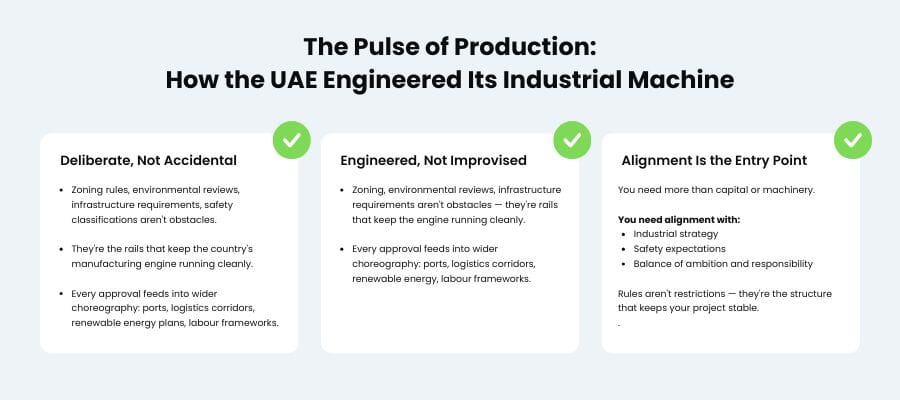
This is why the industrial landscape in the UAE feels engineered rather than improvised. Zoning rules, environmental reviews, infrastructure requirements, and safety classifications aren’t obstacles; they’re the rails that keep the country’s manufacturing engine running cleanly. Every approval feeds into a wider choreography involving ports, logistics corridors, renewable energy plans, and labour management frameworks. When your factory connects to that system, it becomes part of a national machine designed to run fast without losing control.
To operate in this environment, you don’t just need capital or machinery. You need alignment — with the country’s industrial strategy, with its safety expectations, with the way it balances ambition and responsibility. Once you understand how intentionally the UAE has shaped its production ecosystem, the rules stop looking like restrictions and start looking like the structure that will keep your project stable long after the first machine switches on which is exactly why getting an industrial license in the UAE demands precision rather than hurry.
What an Industrial License in the UAE Truly Grants You
An industrial license in the UAE isn’t a generic badge that simply says you may operate; it is the country’s formal acknowledgment that you are about to create something with real physical impact. Manufacturing has weight — literal weight — and the license defines exactly what kind of weight you’re allowed to place on the land, the grid, and the supply chain. Every industrial activity in the Emirates lives inside a detailed classification system: processing, fabrication, assembly, packaging, refining, and dozens of sub-categories that dictate what your operation may produce and how.
This precision is not bureaucratic pedantry; it is the UAE’s way of protecting its industrial rhythm. A factory that produces metal components cannot suddenly expand into chemical processing just because it “seems related.” A plant assembling electronics cannot import hazardous materials without an activity that explicitly permits it. The license draws a clear perimeter around your operation, and inside that perimeter, everything must be declared, documented, and approved.
What the license grants, then, is not vague permission — it is a defined industrial identity. It tells regulators what machinery you’ll install, tells customs what your cargo will look like, tells environmental authorities what risks to monitor, and tells banks what level of capital intensity to expect. The UAE likes order, and order begins with knowing exactly what a factory is supposed to do.
Choose the wrong industrial activity, and the consequences arrive fast: denied machinery clearance, blocked import shipments, halted construction, or the need for costly amendments. Choose correctly, and the entire system aligns — regulators cooperate, ports streamline your flows, and banks treat you as a coherent, credible industrial operator.
Core Requirements for Obtaining an Industrial License in the UAE
Getting an industrial license in the UAE means proving that your factory isn’t just an idea but a fully thought-out production ecosystem. Authorities want clarity: what you’ll build, how you’ll build it, where you’ll build it, and how safely the entire operation will run. Industrial projects carry weight—machines, raw materials, heat, chemicals, workers—and the UAE expects every part of that weight to be accounted for from the start.
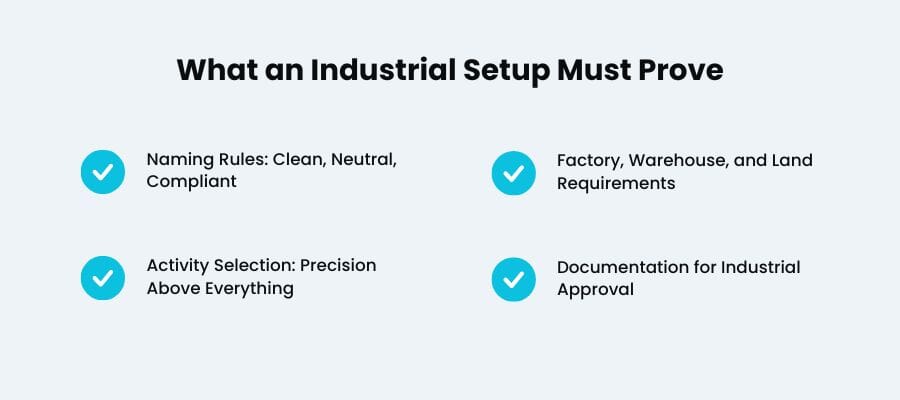
Naming Rules for Obtaining an Industrial License in the UAE: Clean, Neutral, Compliant
Company names follow the same strict code nationwide: no political terms, no religious references, no country names, no misleading claims, no brand imitation. Industrial companies often choose functional names because regulators prefer clarity over creativity. Your name must align with your activity and pass automated checks before anything else moves.
Activity Selection for an Industrial License in the UAE: Precision Above Everything
Industrial activity selection is brutally specific. Authorities need to know if you’ll be assembling components, fabricating metal, processing food, packaging goods, producing chemicals, refining materials, or operating heavy machinery. Each activity has its own approval track, its own risk level, and often its own environmental expectations. Choose the wrong activity and you may lose access to the machinery you need, face import blocks, or fail site inspections. Activity accuracy determines whether your project is seen as a controlled industrial operation or an undefined risk.
Factory, Warehouse, and Land Requirements for an Industrial License in the UAE
No industrial license moves forward without a proper site. Mainland factories must secure zoned industrial land, approved layouts, environmental clearance, fire-safety compliance, and utility capacity matching production needs. Regulators want to see where machinery will sit, where workers will move, how heat and waste will be handled, and whether the building can support your processes without risk.
Documentation Required for Obtaining an Industrial License in the UAE
The paperwork is simple but unforgiving: passport copies, corporate documents, attested resolutions, UBO declarations, plus industrial-specific requirements like machinery lists, process descriptions, factory layouts, raw-material data, and safety plans. If any document is incomplete, approvals freeze.

Want to learn more about UAE business setup services?
The Licensing Path: How an Industrial License in the UAE Gets Approved
Getting an industrial license in the UAE isn’t a straight hallway; it’s a sequence of tightly locked doors, each one checking whether your factory belongs inside the country’s industrial rhythm. The process is fast only when every detail is accurate. Miss one step, and the system stops moving.
Activity & Trade Name Approval
Authorities begin by verifying whether your chosen industrial activity matches what you intend to build. They check if your process involves assembly, fabrication, processing, packaging, or energy-heavy machinery. At the same time, your trade name must pass compliance filters — neutral, clean, and aligned with your activity. This first approval decides the entire direction of your project.
Signing the Company’s Constitutional Documents
Once pre-approvals move, you sign your MOA or AOA — the constitutional documents that define ownership, capital, and how your industrial entity will be governed. These papers anchor the legal spine of the company. Nothing operational begins before they are in place.
Final Approvals, Fees, and License Issuance
After the land, documents, and clearances align, authorities calculate the final fees. Once paid, your industrial license is issued — the moment your project officially enters the UAE’s manufacturing map.
Banking and Compliance for Industrial License Holders in the UAE
Banks in the UAE look at industrial companies with a different lens. Manufacturing is capital-heavy, risk-sensitive, and tied to global supply chains, so financial institutions want proof that your operation is real, structured, and economically coherent — which is why obtaining an industrial license in the UAE is only the beginning of their scrutiny. They don’t care about your machinery until they understand the money behind it.
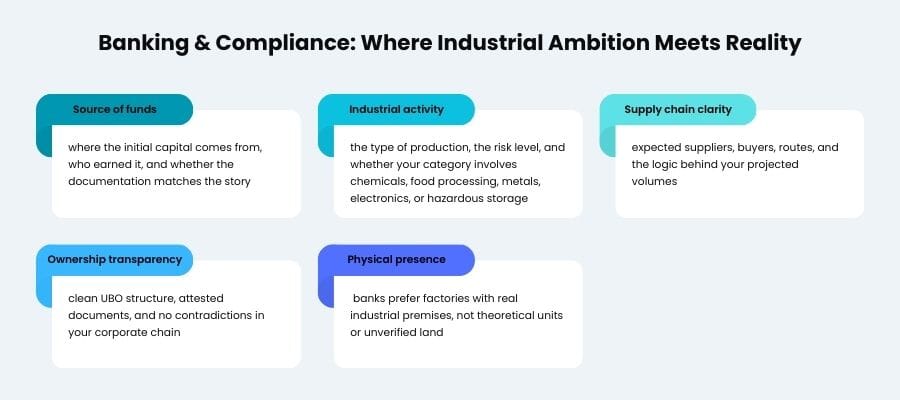
Banks immediately evaluate:
- Source of funds: where the initial capital comes from, who earned it, and whether the documentation matches the story.
- Industrial activity: the type of production, the risk level, and whether your category involves chemicals, food processing, metals, electronics, or hazardous storage.
- Supply chain clarity: expected suppliers, buyers, routes, and the logic behind your projected volumes.
- Ownership transparency: clean UBO structure, attested documents, and no contradictions in your corporate chain.
- Physical presence: banks prefer factories with real industrial premises, not theoretical units or unverified land.
Industrial companies also face stricter onboarding if they deal with imported raw materials, export flows, or high-value machinery. Banks want consistency: a business model that matches your industrial license, your capital, and your operational plan. When those three align, accounts open smoothly — when they don’t, the file dies quietly, a reality every investor learns quickly when getting an industrial license in the UAE.
Final Reflection: Obtaining an Industrial License as the UAE’s Invitation to Build
An industrial license in the UAE is more than a regulatory milestone; it’s an invitation to place something tangible on the country’s canvas — something you only grasp once you obtain an industrial license in the UAE. Factories aren’t quiet guests — they arrive with engines, heat, workers, and rhythm — and the UAE only welcomes those who build with intention. When the license is issued, it signals that your project has earned its place within a landscape shaped by strategy instead of chance.
The Emirates don’t ask you to promise perfection. They ask for clarity: what you’ll create, how you’ll protect the people who work for you, how the land will carry your machinery, and how your production will fit into the wider industrial pulse. That clarity is why industrial companies thrive here. They enter a system that demands structure but rewards ambition with stability, infrastructure, and a long runway for growth.
Once the immigration layer is active and the bank nods in your direction, the UAE becomes more than a location; it becomes part of your machinery. Roads, ports, energy grids, logistics clusters — the country is built like an operating partner. And when your production line finally hums for the first time, you feel exactly what the license was meant to signal from the beginning:you’re not just operating in the Emirates — you are contributing to what the Emirates is becoming.


