


 Kristina Markovic
  05.12.2025
 If you’ve ever tried scaling a business, entering a new market, or bidding for a government contract, you already know how often companies ask one question: “Are you ISO certified?” That’s why understanding ISO certification in Dubai isn't just “nice to know” — it’s a real competitive advantage. For many UAE businesses, it’s the moment your company stops looking like a startup experiment and starts being treated as a serious, reliable operation.
In this guide, you’ll get a clear, human explanation of what ISO certification is, why it matters in the UAE, and exactly how your company can get certified without drowning in jargon or endless paperwork.
What Is ISO Certification in Dubai and the UAE?
ISO certification Dubai is basically the opposite of “just trust us.” It’s proof that your company doesn’t wing it — you follow clear, agreed standards for how things are done. When someone in the UAE asks if you’re ISO certified, what they really mean is, “Do you have your processes under control, or are you improvising?” The standards themselves are created by the International Organization for Standardization, but here they’re baked into how serious companies, government entities, and even free zones judge whether a business is reliable enough to work with.
For businesses in Dubai, this certification acts as a quality framework rather than a formality. It tells clients, suppliers, and partners that your company doesn’t run on random habits — it runs on documented procedures, real accountability, and ongoing improvement. From manufacturing to tech startups, ISO certification in the UAE helps you stand out in a crowded market and meet requirements that many larger clients now expect by default.
Why Get ISO Certification in Dubai and the UAE?
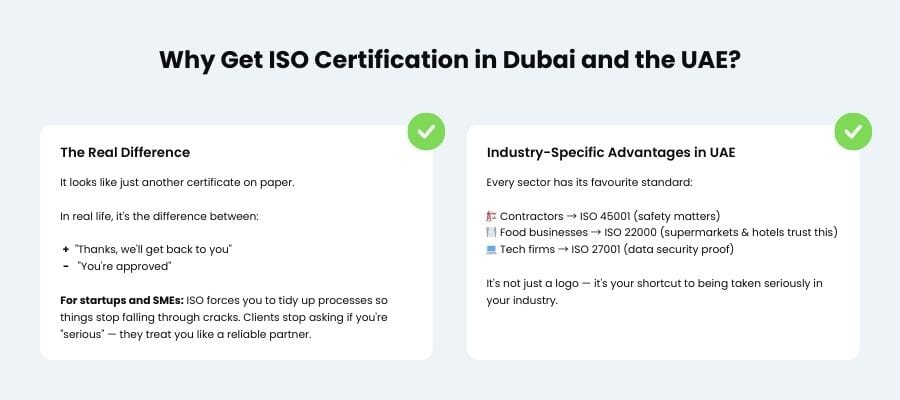
It looks like just another certificate on paper. In real life, it's often the difference between "Thanks, we'll get back to you" and "You're approved."
Benefits for Companies, Startups, and SMEs
For smaller teams, ISO looks scary until you realise what it actually does: it forces you to tidy up your processes so things stop falling through the cracks. Clients stop asking if you’re “serious” and start treating you like a reliable partner. For many startups and SMEs, the first ISO certificate is the moment big customers finally say yes.
ISO Certification UAE: Industry-Specific Advantages
In the ISO certification UAE world, every sector has its favourite standard. Contractors lean on ISO 45001 to show they care about safety; food businesses depend on ISO 22000 to get taken seriously by supermarkets and hotels; tech firms use ISO 27001 to calm everyone’s nerves about data security. It’s not just a logo — it’s your shortcut to being taken seriously in that industry.

Want to learn more about UAE business setup services?
Most Common Types of ISO Certification in the UAE
Before you start comparing certification bodies or timelines, it helps to know which ISO standards actually matter in the UAE market. Not all of them are relevant to your business, and not all of them are equally recognised by clients. The ones you’ll hear about most — the ones that show up in tenders, supplier onboarding, and government requirements — fall into a handful of practical categories.
The most common is ISO 9001 (Quality Management), the one nearly every serious company ends up getting because it proves your operations aren’t chaotic. Then there’s ISO 14001 for environmental responsibility and ISO 45001 for health and safety, which many construction, industrial, and logistics firms rely on. Tech companies often go after ISO 27001 to show that they take information security seriously, while food companies go after ISO 22000 to show that they handle safety properly. In the UAE, these standards act like a shared language — they help clients know exactly what to expect from you before they ever sign a contract.
How to Get ISO Certification in Dubai and the UAE Step by Step
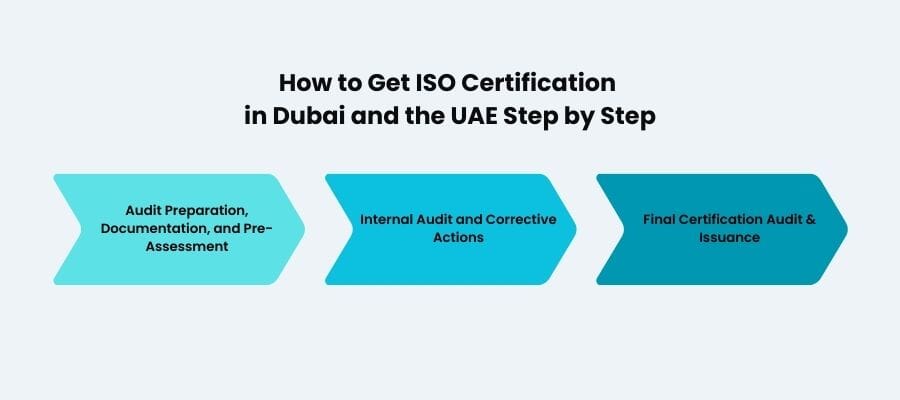
Getting ISO certified isn’t about impressing auditors — it’s about proving your company works in a clean, organised, repeatable way. The process is the same whether you’re in a Dubai free zone, mainland, or another emirate: you prepare, you audit yourself, and then an external auditor checks that everything you claim is actually happening. Once you see the steps laid out, it feels much less mysterious.
Audit Preparation, Documentation, and Pre-Assessment
This is where most of the work happens. You map out how your company operates today, clean up anything that doesn’t make sense, and document the processes you want to follow going forward. Policies, procedures, responsibilities — all of it goes into a system that actually works for your team, not a dusty manual no one ever reads. Many companies do a pre-assessment to catch obvious gaps before the real audits begin.
Internal Audit and Corrective Actions
Next, you audit yourself. It's not about blaming someone; it's about catching the little things that an outside auditor would absolutely see. You examine to see if the team is really following the written procedures and if those procedures make sense in the real world. Any issues you find become “corrective actions,” which you fix and close out before moving forward.
Final Certification Audit & Issuance
Finally, a certification body steps in for the official audit. They look at your documents, talk to your team, and observe how your operations run day to day. If everything lines up, you receive your ISO certificate — the document clients and partners will ask for again and again.
If you’d rather not deal with the admin, Consulting.ae can manage the entire workflow from preparation to certification.
How to Maintain and Renew ISO Certification in the UAE
ISO isn’t a trophy you hang on the wall and forget about. Once you’re certified, the real work is keeping your ISO certification in UAE alive and honest. That involves utilising the steps you wrote, making modifications to them when your business evolves, and not acting like everything is "fine" when you know a process isn't working.
Every year or so, an external auditor comes back for surveillance visits, then a bigger renewal audit usually happens around the three-year mark. If you’ve been fixing issues as you go, these visits feel like a check-up, not an exam. If you haven’t… they’re stressful. If you’d rather not leave it to last-minute panic, Consulting.ae can help you stay audit-ready all the time.
Conclusion
ISO certification only looks complicated from the outside — once you break it down, it’s simply a structured way to prove your company delivers what it promises. And in a competitive market like Dubai, that clarity matters. Whether you’re chasing bigger clients, cleaner operations, or industry recognition, ISO certification in Dubai and across the UAE gives you a real edge. If you want guidance, support, or someone to walk you through the entire process of ISO certification UAE, Consulting.ae can step in and make the path a lot easier.
How long does ISO certification take in the UAE?
Most companies finish in about two to three months, but the truth is simple: the cleaner your operations are, the faster it goes. If your processes are messy, you’ll spend extra time fixing them. If you want a real estimate for ISO certification in Dubai, Consulting.ae can take a quick look and tell you honestly.
Do small businesses in Dubai need ISO certification?
No, it’s not mandatory — plenty of small companies operate without it. But when you do get ISO certification UAE level, bigger clients suddenly take you more seriously and doors open that were closed before. If you’re trying to move from “small supplier” to “reliable partner,” it can be a smart step.
Which ISO certification is best for my business?
It depends on what you actually do. ISO 9001 fits most companies, while safety-heavy businesses look at 45001, tech and data firms at 27001, and food-related companies at 22000. If you’re unsure, tell us how you work and we’ll help match the right ISO certification in Dubai to your business.
How often do I need to renew ISO certification?


