


 Kristina Markovic
  09.07.2025
Opening a company in Ras Al Khaimah is something foreign investors turn to when they want a UAE jurisdiction with a calmer entry cost than Dubai, yet still enough flexibility to build something real. This emirate doesn’t lock you into one path — it gives you options. There’s the mainland route through RAK DED, the business-friendly environment of RAKEZ, and the international structure offered by RAK ICC. Because of that, the setup isn’t one-size-fits-all — it’s shaped around your market, your activity, how you plan to work with banks, and where you stand from a tax angle.
This material walks through how registering a company in Ras Al Khaimah through mainland, RAKEZ, or RAK ICC unfolds. It touches on the legal framework, the types of companies you can form, what founders are expected to provide, and how documentation is handled. You’ll also see how licensing works, how taxes are applied, what stands behind UBO transparency, and why AML/KYC checks are more than just a formality. On top of that, there’s the practical side — choosing between a physical office or working through a registered agent, and opening a corporate bank account.
Taking this route helps you not only understand the formal steps of incorporation, but also feel where the real friction points may appear — usually after the license is already in your hands.
Legal Architecture of the UAE When Registering a Business in Ras Al Khaimah
The legal setup behind doing business in Ras Al Khaimah rests on two layers that constantly interact — federal rules and local regulation. At the federal level, the country defines the backbone: how companies exist, how registers are maintained, how taxes and VAT are handled, and how ownership transparency and compliance actually work. On the ground, Ras Al Khaimah authorities shape the practical side — licensing procedures, choosing business activities, submitting documents, and supervising companies within each specific regime.
The Federal Commercial Companies Law sets the tone. It outlines which corporate forms are allowed and how they function in real life. This law applies directly to mainland structures and quietly influences how limited liability companies, branches, partnerships, and joint-stock entities are built and managed.
Legal framework and control mechanisms when setting up a business in Ras Al Khaimah:
|
Regulatory framework |
Scope of application |
What it means for an investor |
|
Corporate legislation framework |
Defines permitted business structures and outlines founders’ responsibilities. Establishes general management principles. |
Shapes the choice of legal form and determines how ownership shares are distributed. |
|
Company register regulations |
Requires recording key company data and updating any structural changes without delay. |
Ensures transparency and clarity around business information. |
|
Trade activity regulation |
Sets the rules for entering into commercial transactions and defines the role of market participants. |
Applies to any ongoing entrepreneurial activity. |
|
Corporate profit taxation |
Governs how company income is monitored and taxed. |
A 0% rate applies up to AED 375,000. Income above that is taxed at 9%. |
|
Value Added Tax (VAT) |
Indirect tax applied to goods and services. |
Mandatory registration starts at AED 375,000 turnover; voluntary registration is allowed from AED 187,500. |
|
Beneficial ownership disclosure rules |
Focuses on identifying individuals who ultimately benefit from the business. |
Requires timely UBO filings and keeping internal records up to date. |
|
Anti-money laundering standards |
Designed to prevent illegal financial flows and terrorist financing. |
Banks and institutions must verify partners, clients, and certain business activities. |
For an investor planning opening a company in Ras Al Khaimah, this federal layer goes far beyond picking a company type. It defines how taxes are calculated, how ownership must be disclosed, how beneficiaries are reported, and how banks approach compliance. In reality, a bank doesn’t look at your license as a standalone paper — it studies the entire structure: who owns the business, what it does, where the money comes from, and whether the operations make economic sense.
Locally, the system breaks into three ways. RAK DED grants commercial, professional, industrial, and tourism permits to mainland firms. RAKEZ licenses firms and constructions in the economic zone and outside. The international corporate registry, utilized for holding setups, special purpose vehicles, and asset ownership structures, is maintained by RAK ICC.
When an individual opts to create a company in Ras Al Khaimah, the primary inquiry pertains not to taxation, but rather to the entity that grants the authorization to function. One entity provides access to the mainland market, another confines you within a free zone environment, and the third establishes an international corporate structure.
At the same time, setting up a business here is tightly linked to UBO and AML/KYC rules. The ultimate beneficial owner is usually identified through ownership or control, often starting from a 25% threshold in shares or voting rights.
RAK ICC follows its own internal rulebook — including the Business Companies Regulations and Registered Agent Regulations. This format fits international structuring, holding strategies, and restructuring projects. But it’s important to feel the boundary: it doesn’t replace a standard trading license if your goal is to operate directly on the UAE market.
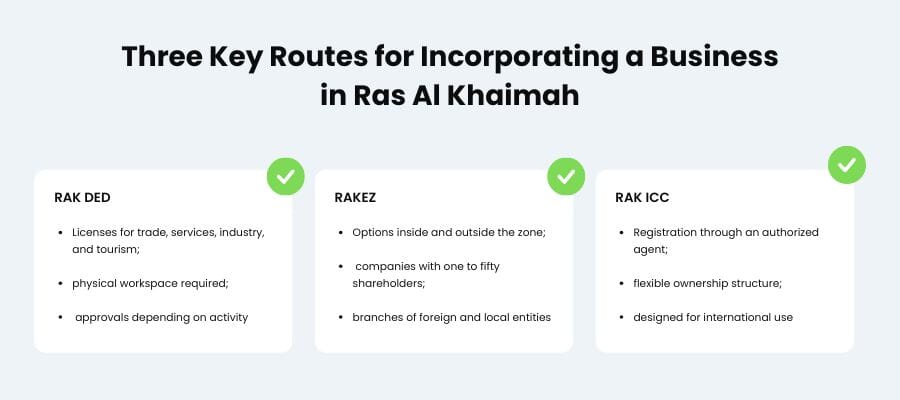
Breaking Down Three Key Routes for Incorporating a Business in Ras Al Khaimah
When someone starts setting up a company in Ras Al Khaimah, the decision doesn’t begin with documents or corporate forms. It begins earlier — with choosing the path of registration itself. In this emirate, there are three directions to move in: a mainland setup handled by the local economic department, a structure inside the RAKEZ zone, or an international company created through RAK ICC. Each route quietly shapes what the business can actually do — where it operates, what licenses it can hold, how easy it is to deal with banks, and even how income is treated later on.
If the intention is to work directly in the UAE, the mainland option is usually initially considered. This style is appropriate for enterprises who deal with clients on the ground – stores, service providers, tourism projects, or organizations executing contracts within the country. In this scenario, the Ras Al Khaimah Economic Department serves as the licensing authority. The process follows a logical progression: defining the activity, gaining a business name, obtaining initial approval, gathering further approvals as needed, establishing a physical space, and eventually receiving the license.
The authority issues several types of permissions — for trading, services, production, and tourism-related work. Foreign founders are often allowed to keep full ownership, but this is not automatic. Everything depends on what exactly the business plans to do. Before moving forward, it’s common to examine future deals, expected clients, and how goods or services will move. That early clarity makes registering a company in Ras Al Khaimah much smoother later.
Three ways to establish a business in Ras Al Khaimah:
|
Route |
Purpose |
Key characteristics |
|
RAK DED |
Activity inside the UAE market |
Licenses for trade, services, industry, and tourism; physical workspace required; approvals depending on activity |
|
RAKEZ |
International trade, services, export, digital business, manufacturing |
Options inside and outside the zone; companies with one to fifty shareholders; branches of foreign and local entities |
|
RAK ICC |
Holding structures, asset ownership, special purpose entities |
Registration through an authorized agent; flexible ownership structure; designed for international use |
RAKEZ becomes a natural fit when the business is linked to the UAE but doesn’t rely entirely on the local market. This is often the case for export-driven projects, online services, or companies working with clients across borders. Establishing a company in this zone creates a clear operational structure without unnecessary complications. It also opens access to resident visas, provided the selected package supports it, which adds a practical layer to building a business presence in Ras Al Khaimah.
Corporate Structures for Registering a Legal Entity in Ras Al Khaimah
Before choosing a company format, the real question usually sounds simpler: where will the business live and how will it operate? In Ras Al Khaimah, this answer quietly shapes the legal form. One path fits trading on the local market, another works inside designated zones, and a separate layer exists for holding assets or managing cross-border ownership.
People usually think of the limited liability model initially. It operates in a simple way: the business is its own legal entity, and the owners only risk what they put into it. This format can be found on the mainland and in some settings that are linked to RAKEZ but are not part of the standard zone structure. But you can't just grab a template off the shelf. The final shape relies on the law that governs businesses, the activity that was chosen, and what the authority that looks over the application expects.
The number of participants also changes depending on the setup. In one version linked to RAKEZ outside the zone, at least two participants are required, with an upper limit of fifty. Inside the zone, a more flexible model allows even a single founder, while keeping the same maximum. Because of this, older naming habits don’t always reflect reality anymore — the current registration rules matter far more than outdated labels.
When deciding how to choosing a company structure in Ras Al Khaimah, most founders circle around a few key points:
- where the company will actually operate — within the Emirates, inside a zone, or beyond the country;
- whether a separate legal entity with limited risk is necessary;
- if residency permits are needed for owners or employees;
- what kind of physical setup is planned — from a simple workspace to a warehouse or production site;
- who stands behind the business — individuals, another company, or an overseas parent structure.
There is also a simpler format designed for one person — often used for professional activity or small independent work. It may look convenient at first glance, but it comes with a different level of responsibility. In certain situations, obligations are not separated from the owner, which means personal assets can come into play. Because of that, the nature of the activity, possible risks, and even how financial institutions might view the setup are usually considered in advance.
Another route appears when a business already exists elsewhere. Instead of starting from zero, it can enter Ras Al Khaimah through a branch. This option allows operations under the name of the parent company. At the same time, it does not create a fully independent entity — the connection to the main company remains, both legally and financially.
For more complex goals, such as holding assets or structuring ownership across borders, a different type of entity is used under the international corporate registry of the emirate. These companies come in several legal variations, each designed for specific purposes. They are commonly used in group structures, special projects, or reorganizations. At the same time, they are not meant for everyday trading inside the UAE — their role is more about managing ownership than running operational business activities.
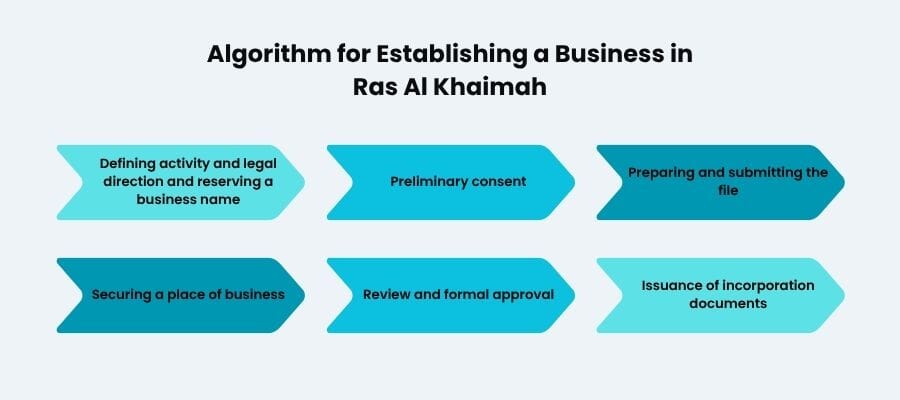
Algorithm for Establishing a Business in Ras Al Khaimah and Required Documents
Everything starts before the paperwork. Not with forms — with a decision. The founder defines where the business will exist: within the local market under the economic authority, inside the RAKEZ environment, or through the international registry system used for cross-border structures. That choice quietly sets the tone for everything that follows.
The pace of launching a project here is often decided long before submission. When documents are prepared in advance, the process feels smooth. When they are not, delays appear. The activity itself must match official classifications — either from the mainland regulator or from the approved lists inside the zone. If the business sits outside special territories, additional industry rules may apply. Within RAKEZ, attention shifts to the exact zone, license format, physical setup, and whether different activities can coexist under one structure.
Step 1. Defining activity and legal direction. The path of building a business in Ras Al Khaimah depends on the nature of the work, not the company name. Trade, digital services, industrial operations, or online platforms — each one leans toward a different setup. Projects related to media or asset ownership follow their own logic. In the case of the international registry, the purpose changes entirely — it serves global ownership structures and special entities rather than everyday business inside the Emirates.
Step 2. Selecting and reserving a business name. The chosen name goes through a check. It must be unique, aligned with the activity, and compliant with local rules. Certain words are restricted or require approval. The name should not misrepresent what the company actually does, since it becomes part of official records.
Step 3. Preliminary consent. At this point, the authority signals that the process can continue. It is not permission to operate yet. It simply confirms that the applicant may proceed with documentation, securing a place of business, and completing formalities.
Main documents required to set up a company in Ras Al Khaimah:
|
Applicant type |
Required documents |
|
Individual |
Passport, UAE visa or entry stamp if available, Emirates ID if available, no-objection letter for residents when required, beneficial ownership declaration, business plan for certain activities |
|
Corporate founder |
Company charter documents, extract from registry, certificate confirming active status or similar, decision of directors or shareholders, identification documents of directors, owners and manager, beneficial ownership declaration |
|
Mainland setup |
Partnership agreement or memorandum where required, lease contract approved by municipality, approvals from relevant authorities |
|
RAKEZ structure |
Application forms for registration and licensing, chamber membership request, documents of participants and manager, visa or entry details, beneficial ownership declaration |
|
International registry company |
Documents required by the registrar, appointed intermediary, registered address, corporate and compliance documents of participants |
Step 4. Preparing and submitting the file. The document package changes depending on the route and ownership composition. In RAKEZ, separate forms are used for registration, licensing, and chamber membership. Corporate investors usually provide incorporation certificates, founding documents, and decisions confirming the creation of a branch if needed. For international registry structures, the process goes through an authorized intermediary who submits the file on behalf of the client.
Step 5. Securing a place of business. For mainland activity, a lease is required, along with confirmation that the premises match the declared work. Inside RAKEZ, the options are broader — from shared desks to offices, storage facilities, land plots, or custom-built spaces. Certain industrial or storage activities may require an additional certificate confirming that operations meet established standards.
Step 6. Review and formal approval. Within RAKEZ, the process usually follows a sequence. First, the appropriate service plan is selected. Then the application and documents are submitted. After review, the authority issues approval along with the company file. At this stage, the business officially comes into existence.
Step 7. Issuance of incorporation documents. The journey of opening a company in Ras Al Khaimah ends with receiving official confirmation. For international registry structures, this takes the form of an incorporation certificate. For RAKEZ, it includes a registration set together with the license. The timeline varies — it depends on the chosen path, completeness of documents, business profile, and whether external approvals are needed. There is no universal timeframe.
Fees and next steps.Setting up a company involves administrative charges, and their size depends on the selected structure and license type. For mainland businesses, official categories include amounts such as AED 10,000, 5,000, 2,500, 1,000, and 400. Changes to an active license cost AED 150, while updates to an expired one are set at AED 100.

Want to learn more about UAE business setup services?
Obtaining Permits for a Company in Ras Al Khaimah: Choosing the Right Activity Profile
Before a business begins operating, its direction is set by the license it receives. In Ras Al Khaimah, this document does more than approve activity — it connects the company to a specific field, defines where it can work, and outlines what regulators expect from it. In practice, it becomes a framework that shapes how the company functions day to day.
Within the mainland system, the local authority works with four main types of permissions. One of them covers trade — buying and selling goods, whether in large volumes or smaller transactions, across local or international markets. Another is designed for professional work, where the focus is on expertise rather than products. This includes consulting, legal support, financial analysis, software-related services, and similar fields. A separate category applies to production — when a business is involved in manufacturing, processing materials, packaging, or handling goods in storage and transport. Tourism-related activities fall into their own group, covering services connected to travel and visitors.
Inside RAKEZ, the structure feels broader. The zone introduces additional categories that reflect modern business models — including online sales, creative industries, and education-based services. It also allows individuals to operate independently under specific professional permissions, which is often chosen by specialists working on their own.
Key license categories used when operating in Ras Al Khaimah:
|
License category |
Where it is used |
Scope of activity |
|
Commercial |
Mainland and RAKEZ |
Buying and selling goods, wholesale or retail |
|
Professional |
Mainland and RAKEZ |
Advisory services, IT solutions, legal and financial work |
|
Industrial |
Mainland and RAKEZ |
Manufacturing, processing, and production |
|
Tourism |
Mainland |
Travel services and tourism-related operations |
|
General trading |
RAKEZ |
Working with multiple product groups |
|
E-commerce |
RAKEZ |
Online sales of goods and services |
|
Media |
RAKEZ |
Creative and media-related projects |
|
Educational |
RAKEZ |
Training, courses, and educational consulting |
|
Freelancer permit |
RAKEZ |
Independent professional activity |
|
Crafts / Agricultural |
Federal level |
Craft-based and agricultural work with proper approvals |
One thing that is often overlooked when choosing a business activity in Ras Al Khaimah turns out to be very important: not all activities can be freely mixed. RAKEZ carefully checks to see if orders can work together. For example, trade and service lines are not always put under the same license. They are often kept separate.
However, there are also boundaries that make the structure what it is from the start. A commercial license inside the zone generally only lets you do a few things. It might be up to five of the same kind of activity, but it might be fewer if they are from different types. This means that the action profile can't be changed at the last minute; it has to be carefully planned from the start.
Taxation of a Company in Ras Al Khaimah and Compliance Requirements
Taxes in Ras Al Khaimah are not defined by the emirate alone. The real framework comes from UAE-wide rules, which means the final outcome depends on how the business earns, not just where it is registered. Since corporate tax became part of the system, companies in RAKEZ or within international structures are no longer treated as automatically tax-free. The actual burden now grows out of revenue size, type of activity, and the legal nature of the entity.
Before moving forward with planning corporate taxation in Ras Al Khaimah, founders usually look at their financial model. This step matters more than it seems. If the business falls under the corporate tax regime, profit up to AED 375,000 is not taxed. Once income rises above that line, the exceeding portion is subject to a 9% rate.
Core tax and compliance markers for a company in Ras Al Khaimah:
|
Parameter |
Condition |
Effect on the company |
|
Corporate tax |
0% up to AED 375,000 |
No tax on lower profit levels |
|
Corporate tax |
9% above AED 375,000 |
Income beyond the threshold is taxed |
|
Value added tax |
Standard rate of 5% |
Applied to goods and services within the UAE |
|
Mandatory VAT registration |
Turnover above AED 375,000 |
Registration with the tax authority becomes required |
|
Voluntary VAT registration |
From AED 187,500 |
Available at the company’s initiative |
|
Beneficial ownership disclosure |
25% ownership or control |
Information must be submitted to the registrar |
|
Economic substance rules |
Annual filings stopped after December 31, 2022 |
Past obligations may still remain relevant |
The timing of licensing does not influence taxation. Once the company exists, it must determine whether it needs to register for tax, submit reports, and maintain supporting records. Businesses covered by tax rules are required to complete registration through the EmaraTax platform.
Businesses in RAKEZ may face different situations based on how they make money. Still, a zero rate might apply, but only to certain types of income and only if the business has special standing. Since these conditions aren't met, the normal way of doing things applies: gains over AED 375,000 are taxed at 9%.
Where the money comes from also affects the picture. Income from overseas activity or engagement with other zones may be regarded differently than earnings generated on the mainland. This is why simply obtaining a RAKEZ license does not establish your tax position. Actual operations, supporting paperwork, and regulation compliance bear the brunt of the weight.
Once the specified turnover threshold is met, the value-added tax is set at 5%. Entities that import or sell products for more than AED 375,000 must register with the tax office. An early registration option is offered starting at AED 187,500. Foreign firms follow different protocols depending on their operational modes in the UAE.
Transparency is not optional. Companies must disclose their ultimate owners, typically identified through a 25% shareholding or voting threshold. RAKEZ requires these declarations, and financial institutions go even deeper — reviewing the origin of funds, the logic of the business model, the geography of transactions, and any exposure to sanctions.
Even though the earlier Economic Substance framework no longer requires annual filings for financial years ending after December 31, 2022, its legacy still matters. Historical obligations remain in place and can be reviewed when needed.
Opening a Bank Account for a Business in Ras Al Khaimah
Getting a bank account is a separate journey — it begins after the company already exists on paper. Registration and a license may be in place, but the bank still takes its time. It doesn’t look at the company as a file — it looks at it as a living idea. Who owns it, what it plans to do, where the money comes from, and how it will move — all of this matters.
For someone coming from abroad, opening a business bank account in Ras Al Khaimah usually involves more questions than answers at the start. Banks try to understand the full picture: the activity, the background of the founders, the real beneficiaries, expected cash flow, partners, and the path of transactions. In recent years, financial checks have become more detailed, so having a license alone rarely carries weight.
Companies formed through RAKEZ often prepare for this stage in advance. The bank compares what is written in the registration documents with how the business is actually described. If the structure looks complex, more attention is paid to ownership layers and the purpose behind them. A simple story is easier to follow — and easier to approve.
Typical set of documents prepared for bank review:
- company license together with registration records;
- proof of incorporation, if such a document exists;
- internal corporate papers describing structure and rules;
- identification documents of owners, managers, and directors;
- details of individuals who ultimately control or benefit from the company;
- confirmation of office space or place of activity;
- letter from the registration authority, if available;
- explanation of business activity, agreements, invoices, or financial expectations.
The specific requirements change from bank to bank and depend on how the business is set up. When checking out a mainland firm, people mainly look at its physical presence, contracts, and ties to the local market. On the other hand, an international structure may have all of its business papers in order, but that doesn't mean it will be approved. The bank always makes the final choice.
Not every format gives access to a corporate account. A freelance permission inside RAKEZ, for example, does not create a separate legal entity. In that case, the individual acts personally, and the bank treats it as a personal profile rather than a company.
Banks in the UAE pay close attention to what is often called real presence. They may ask for a website, contracts, proof of experience, background of the founders, description of clients, geography of payments, and expected turnover. A trading business is usually asked to show supply routes and product details. A service-based project, such as consulting or IT, is evaluated through its portfolio, agreements, and professional background.
RAKBANK, Emirates NBD, Mashreq, Abu Dhabi Commercial Bank, and First Abu Dhabi Bank serve corporate clients. Each has its own reasoning based on industry, size, and owners. There is no deadline; the bank continues until it knows the business.
Choosing the Right Path for Business Setup in Ras Al Khaimah
To build a company in Ras Al Khaimah is less about paperwork and more about alignment. A mainland structure suits those who want to work directly within the UAE. RAKEZ supports trade, services, production, and cross-border activity. The international registry format is used for holding assets, structuring ownership, or creating dedicated project entities.

