


 Manish Kulkarni
  13.01.2026
People come to the UAE with different plans. Some want sunshine and a tax-clean setup. Some just want a business that runs from a laptop and doesn’t eat their whole life. If you’re in that second group, dropshipping in UAE is probably already on your radar — and for a reason.
Here’s the honest version: you’re not buying piles of stock. You’re not renting a warehouse “just in case.” You build a storefront, you market a product, a customer pays you, and then the supplier ships the order. Your job is the front end: offer, pricing, service, and keeping the whole thing trustworthy. The supplier handles the box.
The UAE angle matters because rules actually exist here, and they get enforced. That’s not drama — it’s structure. Set it up correctly and you can scale without constantly looking over your shoulder.
What Is Dropshipping and How Does Dropshipping Work?
At its core, dropshipping is about separating selling from storing. You focus on the customer-facing side of the business, while someone else handles the physical product. That simple split is what makes this model attractive — and also what confuses people when they first hear about it. To understand dropshipping in UAE, you first need to be clear on what the model actually means and how money, orders, and responsibility move from one side to another.
Dropshipping Meaning Explained in Simple Terms
The dropshipping meaning is easier than most people expect. You run an online store. A customer visits your site, chooses a product, and pays you. You don’t own that product yet. Instead, you forward the order to a supplier who already has the item in stock. The supplier ships it directly to your customer, usually under neutral or branded packaging.
You never touch the product. You never store it. Your role sits in the middle — pricing, marketing, customer trust, and after-sales communication. That’s why what is dropshipping isn’t about logistics skills; it’s about building a clean, reliable sales operation. When done properly, it’s a legitimate dropshipping business, not a shortcut or grey trick.
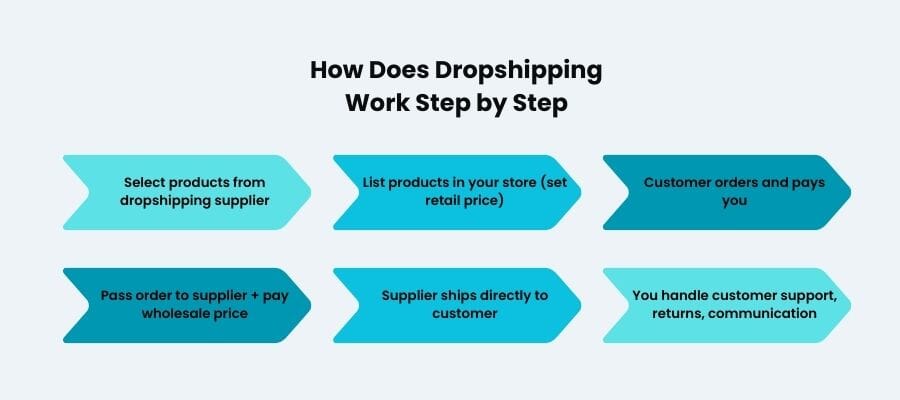
How Does Dropshipping Work Step by Step
Once you zoom in, how dropshipping works becomes very practical. There’s a clear flow, and every step has a purpose:
- You select products from a supplier willing to work on a dropshipping basis
- You list those products in your online store at your chosen retail price
- A customer places an order and pays you directly
- You pass the order details to the supplier and pay the wholesale price
- The supplier ships the product straight to your customer
- You handle customer support, returns, and communication
The difference between success and chaos is control. Even though the supplier ships the item, the customer sees you as the seller. That is why transparent pricing, delivery schedules, and policies are essential from the outset—particularly if you intend to engage in dropshipping in Dubai or elsewhere in the UAE, where expectations are high and regulations are mandatory.

What Is Dropshipping in the UAE and How Is It Different?
Once dropshipping lands in the UAE, it stops being a casual side experiment and starts behaving like an actual business. The model stays the same, but the surroundings don’t. There’s less tolerance for half-finished stores, vague policies, or “we’ll fix it later” thinking. Dropshipping in UAE works here, but it works on clear terms — and those terms are set early.
Dropshipping UAE Market Overview
The dropshipping UAE market is built around buyers who know what they want and don’t enjoy surprises. People expect prices to be final, delivery dates to be realistic, and customer support to answer without disappearing. That expectation alone changes how a dropshipping business needs to be run.
Online shopping is already a daily habit in the UAE. Mobile payments are normal, international brands are familiar, and fast delivery is the benchmark. At the same time, authorities actively filter out businesses that look temporary or misleading. That pressure forces even small online stores to act like grown-ups from day one — clear product pages, proper terms, and visible business details.

Want to learn more about UAE business setup services?
Dropshipping in Dubai vs Other Countries
Dropshipping in Dubai doesn’t follow the “launch first, think later” culture you see in many countries. In some markets, sellers hide behind platforms, test aggressively, and clean up compliance only if something goes wrong. Dubai flips that logic. You register first, clarify your activity, and then sell.
This upfront structure changes everything. Customers trust licensed stores more. Payment providers don’t hesitate as much. Banks are less suspicious when your activity actually matches what you say you do. Compared to places where enforcement is inconsistent, Dubai is predictable — and predictability is valuable.
If you desire speed without shortcuts and growth without constant danger, dropshipping in the UAE is a safer option. It demands effort early, then rewards you with stability later.
Is Dropshipping Legal in the UAE?
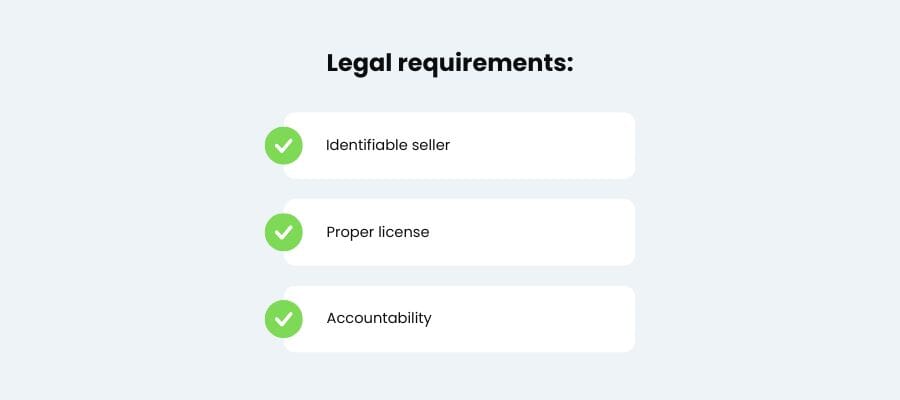
Yes. The UAE permits dropshipping activities solely when conducted transparently and under a legally registered business entity. The model itself is not subject to restrictions. The key considerations are whether the seller is identifiable, properly licensed, and accountable. Dropshipping in the UAE stops being acceptable the moment it looks like an unregistered operation trying to stay invisible.
The UAE doesn’t separate online stores from “real” businesses. If money changes hands, rules apply. Customers must be able to identify who they’re buying from, how returns work, and where complaints go. Stores that skip these basics don’t last long, not because dropshipping is illegal, but because ignoring structure always catches up.
Do You Need a Trade License for Dropshipping in the UAE?
Yes — a trade license is required, no exceptions. Running a dropshipping business without one puts you outside the legal framework from day one. Whether your store targets UAE buyers or ships abroad, the activity still needs to be registered under an e-commerce or commercial license.
There’s no safe phase where you can “test quietly.” Payment providers ask for license data. Banks expect declared activity. Advertising platforms increasingly do the same. Once flagged, accounts get frozen, not warned.
Licensing a dropshipping UAE setup isn’t complicated, but it must be done correctly. When it is, the business becomes boring in the best way — stable, bankable, and free from constant risk.
How to Start Dropshipping in the UAE Step by Step
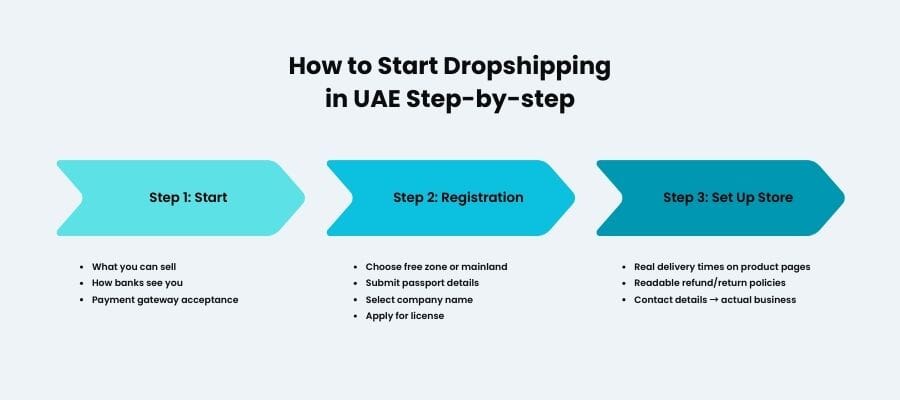
Starting a dropshipping setup in the UAE isn’t about rushing to launch a store. It’s about lining things up in the right order so nothing collapses later. When people ask how to start dropshipping in UAE, the real answer is simple: define the activity clearly, register it properly, then build the store around that structure — not the other way around.
Choosing a Business Activity for Dropshipping
Everything starts with the activity description. This step looks boring on paper, but it quietly controls what you’re allowed to sell, how banks see you, and whether payment gateways accept you. For dropshipping in UAE, the activity usually falls under e-commerce trading, online retail, or general trading with an online focus.
You don’t list every product individually, but you do need to stay within logical boundaries. Selling phone accessories today and cosmetics tomorrow under a mismatched activity is where trouble begins. A clean activity description keeps your dropshipping business flexible without raising questions later. This is also where you decide whether your operation targets UAE customers, international buyers, or both — that choice matters downstream.
Registering a Dropshipping Business in the UAE
Once the activity is defined, registration follows. This is the point where how to do dropshipping in UAE becomes official. You choose between a free zone or mainland setup, submit passport details, select a company name, and apply for the license.
Timelines are real, not forever. Once all the paperwork is in order, most registrations take between 5 and 10 business days. The cost of a license depends on where you live, but for dropshipping, it usually starts at roughly AED 12,000 and goes up according to visa demands and office needs. There’s no benefit in under-declaring your activity to save money — it almost always costs more later.
At this stage, your dropshipping business in Dubai or elsewhere in the UAE becomes visible to banks, payment providers, and platforms. That visibility is exactly what makes scaling possible.
Setting Up an Online Store for Dropshipping
Only now does the store come into play. Platform choice is flexible — what matters is clarity. Product pages must reflect real delivery times. Refund and return policies must exist and be readable. Contact details must point to an actual business, not a blank form.
When people ask how to start dropshipping, they often focus on design. In the UAE, credibility matters more. A simple store that tells the truth converts better — and lasts longer — than a flashy one built on shortcuts.
Want to learn more about UAE business setup services?
What Are the Best Business Structures for Dropshipping in the UAE?
Structure decides more than people think. It affects who you can sell to, how banks treat you, and how easy it is to grow without rewriting everything later. When setting up dropshipping in UAE, most founders land between two legal formats. Neither is “better” on its own. Each pushes your business in a slightly different direction.
Free Zone Company for Dropshipping
Free zones attract people who want clarity and speed. The rules are written out, the packages are fixed, and surprises are rare. For a dropshipping business that operates fully online, this often feels like the cleanest starting point.
You keep full ownership. Visa options are predictable. Many free zones are comfortable with e-commerce activities, which removes unnecessary explanations during licensing. This setup works well if your customers sit outside the UAE or if you’re selling digitally without relying on local retail channels.
The limitation shows up when you aim inward. Direct sales to mainland UAE customers may require additional arrangements. For many founders in dropshipping UAE, that’s acceptable early on, as long as it’s understood upfront.
Mainland Company for Dropshipping
Mainland companies suit founders who want fewer borders around their operation. If your store is aimed at people who live in the UAE, works with local suppliers, or wants to open more locations, this layout will give you some extra space to work. When it becomes important to reach people in Dubai, dropshipping here often works better.
It's easier to get in now, but there is more monitoring and slightly higher entry costs. You can sell across the UAE without structural workarounds, and some payment providers respond faster to mainland licenses.
For anyone building a dropshipping business in Dubai with long-term local plans, mainland structure feels less restrictive over time. The decision isn’t about prestige — it’s about how much room you want your business to have later.
What Licenses Are Required for a Dropshipping Business in Dubai?
In Dubai, a license isn’t something you add once the store “starts working.” It’s the starting point. Without it, payment flows stop, ad accounts get questioned, and banks don’t engage. For dropshipping in Dubai, licensing isn’t a formality — it’s the foundation everything else leans on.
Mainland/Freezone License for Dropshipping
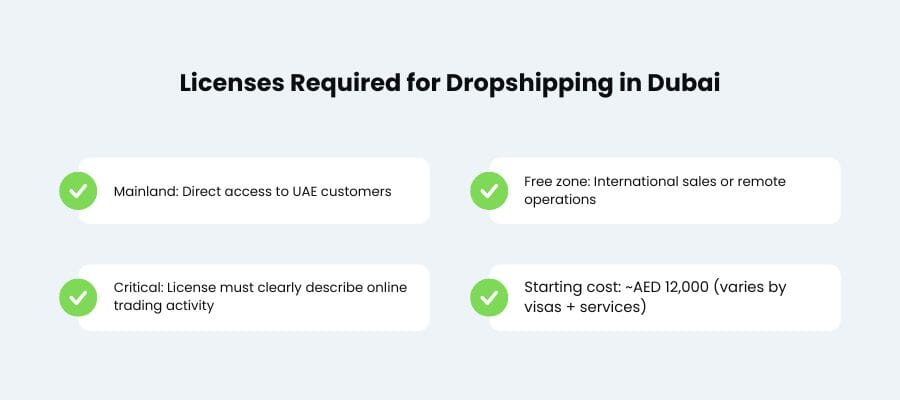
Every dropshipping setup operates under an official trading or e-commerce license. Where that license comes from depends on how you plan to sell. Mainland registration suits businesses that want direct access to UAE customers. Free zone registration works for online stores focused on international sales or remote operations.
The wording on the license matters more than the location. It must clearly describe online trading activity. Loose or mismatched descriptions raise flags later, especially when payment providers review your business. Entry-level licensing for a dropshipping business in Dubai usually begins around AED 12,000, with the final cost shaped by visas and optional services.
Additional Approvals and Compliance
Compliance is not about chasing permits; it is about consistency. Your website should clearly convey your identity, explain the refund process, and provide contact information for customer inquiries. If you sell controlled products like cosmetics or supplements, extra approvals may be required before sales begin.
VAT registration becomes compulsory once annual taxable turnover hits AED 375,000. Some sellers register earlier to avoid mid-year adjustments.
When licensing and operations match, dropshipping in UAE runs quietly in the background — which is exactly how a serious business should feel.
Payment Gateways, VAT, and Banking for Dropshipping UAE
This is the part most people underestimate. You can build a store in a weekend, but if money can’t move cleanly, nothing else matters. In the UAE, payments and banking don’t bend around “online models.” They expect structure. Dropshipping UAE is no exception.
Payment gateways only onboard businesses that look real on paper and online. Your trade license must match what you sell. Your website must say exactly who you are, how long delivery takes, and how refunds work. Gateways review this manually. If something feels improvised, approvals stall.
Banks work the same way. Corporate accounts open after licensing, not before. Expect questions about suppliers, shipping routes, and expected monthly turnover. Clear, boring answers help. Creative storytelling doesn’t. Once approved, banking becomes stable — but getting there requires patience.
VAT sits quietly in the background until it doesn’t. The UAE VAT rate is 5%. If your taxable turnover reaches AED 375,000 within any rolling twelve-month period, registration with the Federal Tax Authority becomes mandatory. Some dropshipping businesses register earlier on purpose, especially if growth is planned.
When these pieces line up, dropshipping in UAE feels smooth. Payments clear, accounts stay open, and compliance stops being a daily concern — which is exactly how it should be.
Conclusion
Dropshipping in the UAE isn’t a shortcut, and it isn’t a gamble either. It’s a business model that rewards people who set things up properly and punishes those who treat structure as optional. When licensing, payments, and compliance are aligned from the start, the model becomes predictable — and predictability is what allows growth.
The UAE gives online sellers something many markets don’t: clear rules that don’t change mid-game. That clarity helps serious founders build stores that last longer than a trend cycle. Whether you’re operating from Dubai or managing everything remotely, the same principle applies — transparency first, scale second.
If you’re planning to move beyond experimentation and turn your store into a real operation, having the setup done correctly matters more than speed. Consulting.ae helps founders handle dropshipping registration, licensing, VAT setup, and compliance in one place — so you can focus on selling, not fixing mistakes later.
What is dropshipping? It’s a way to sell online without keeping inventory, and yes, it can work financially here. Dropshipping in UAE becomes profitable when pricing, delivery promises, and licensing are realistic, not optimistic. Treated as a proper dropshipping business, it grows steadily instead of burning out fast.
No — running dropshipping UAE operations without a license isn’t permitted. Online stores are treated like any other commercial activity, even if you never touch the products. If you’re serious about dropshipping in Dubai, licensing isn’t optional.
Yes, once your sales hit AED 375,000 in any twelve-month period, VAT registration becomes mandatory. This rule applies fully to dropshipping in UAE, not just physical shops. Planning VAT early avoids awkward mid-year corrections.
Yes, people from other countries can fully own and run a dropshipping business in Dubai and the rest of the UAE. Both mainland and free zone setups allow 100% foreign ownership for online trade. That’s why dropshipping in the UAE is popular with expats and digital nomads.

