


 Calen Voss
  06.01.2026
Obtaining a work visa for foreign workers in the UAE is not just a bureaucratic step; it is the moment the country decides whether a person can enter its economic bloodstream. The Emirates rely on talent from every corner of the world, yet they never treat this movement casually. Every engineer arriving to build, every technician preparing to maintain a system, every employee stepping into an office—each one becomes part of a machine that runs fast and demands stability. That is why the UAE approaches hiring from abroad with a balance of openness and discipline.
A work visa is not a stamp in a passport; it is the state’s recognition that someone’s skills are needed inside its borders and that an employer is ready to take responsibility for them. When a company applies for a work visa for foreign workers in the UAE, it is effectively saying: we trust this person’s abilities, and we stand behind them. The country responds with its own expectations—clarity of role, legitimacy of the employer, and full compliance with labour standards.
Once you understand that logic, the process stops feeling like paperwork and starts looking like what it truly is: an invitation to join a nation built on precision, ambition, and accountability.
The Meaning Behind a Work Visa for Foreign Workers in the UAE
A work visa in the Emirates is more than permission to take a job; it is the country’s formal confirmation that a person’s skills are needed within its borders. When an employer begins the process, the UAE evaluates more than a contract. It looks at the company’s stability, the legitimacy of the role, and the responsibility that comes with bringing someone into the national workforce. That is why a work visa for foreign workers in the UAE feels heavier than a simple immigration form. It carries the weight of trust.
Every foreign worker who enters the UAE steps into a system engineered to run efficiently—offices, construction sites, clinics, logistics hubs, factories, hospitality venues. The work visa ensures that each individual joins this ecosystem legally, safely, and with clear accountability on both sides. The employer takes responsibility for the worker’s role and wellbeing; the worker receives rights protected under labour law.
This balance is what gives the UAE its rhythm. People arrive from different countries, backgrounds, and professions, but once the visa is issued, they enter the same organised framework. A work visa isn’t a symbolic formality—it is the point at which the country acknowledges that someone’s contribution matters to the pace and precision of its economy.
Understanding the UAE Labour and Immigration System for Foreign Workers
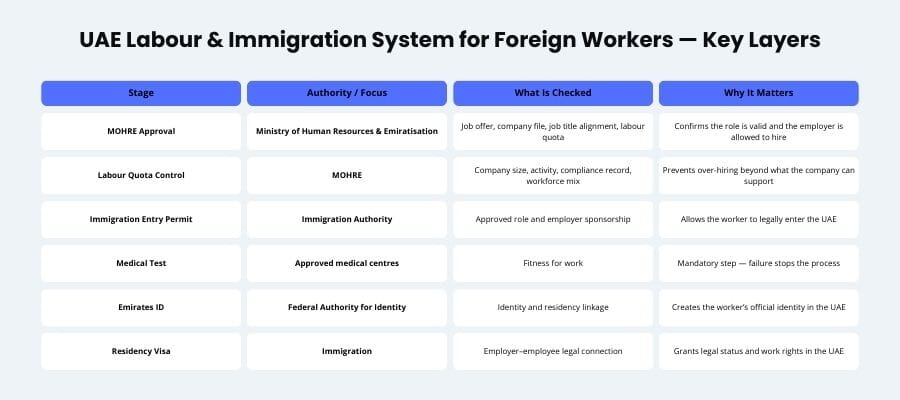
The UAE’s labour and immigration framework is built with the same precision that shapes its cities—layered, predictable, and engineered to function even as the workforce grows at remarkable speed. Bringing someone from abroad into the country means stepping into a structure where every approval exists for a reason.
The process isn’t designed to block opportunities; it’s designed to confirm that every foreign worker entering the UAE is tied to a legitimate employer, a real job, and a clear legal status. When a company applies for a work visa for foreign workers in the UAE, it enters a coordinated sequence where ministries and immigration departments verify that both sides meet the standards expected in the Emirates.
MOHRE Approval and Labour Quotas for a Work Visa in the UAE
The Ministry of Human Resources and Emiratisation (MOHRE) is the first checkpoint for most private-sector employers. MOHRE reviews the employment offer, checks the company’s file, and verifies that the job title fits within the categories allowed for that establishment.
Labour quotas—based on company size, activity, compliance record, and workforce composition—ensure that businesses only hire the number of foreign workers they can realistically support. These quotas are not obstacles; they are safeguards, preventing companies from taking more employees than they can house, manage, or pay. If MOHRE sees alignment, the approval moves forward. If it finds missing documents, unresolved fines, or inconsistent job roles, everything pauses instantly.
Residency and Identity Layers in the Work Visa for Foreign Workers in the UAE
Once MOHRE approves the role, the immigration phase begins. The worker receives an entry permit, completes medical testing, and applies for an Emirates ID—the core identity document in the UAE. The residency visa is then issued, officially linking the worker to the employer in the national system. This layered process protects both sides. The employer gains a legally recognized employee; the worker gains formal status, documented rights, and full visibility inside the UAE’s labour framework.

Want to learn more about UAE business setup services?
Employer Responsibilities Before a Work Visa UAE Can Be Issued
When you talk about a work visa for foreign workers in the UAE, the story always seems to start with the employee. In reality, it starts with the company. The file lives or dies on what the employer looks like on screen when the officer opens that record.
The first thing they see is not the CV; it’s the company status. Is the trade licence valid? Is the establishment card active? Are there unpaid fines hanging around from previous violations? If any of those lights are red, nothing else really matters. The visa request doesn’t move forward, it just hangs there in the system, unresolved.
Then the job itself comes under the microscope. The title has to match the kind of work the company is officially allowed to do. A small trading firm suddenly asking for multiple “senior engineers” without the right activity will draw attention fast. The UAE looks for a simple question to be answered: does this role make sense for this business?
Numbers and logistics also come into play. A firm that has already filled its labour quota, or one that has no clear plan for accommodation where it is required, or no proper wage payment channel in place, is going to raise doubts. The authorities have seen what happens when workers are brought in with no structure behind them, and they are not interested in repeating those situations.
You also have the contract. Not the dusty Word file someone edits five minutes before printing, but the thing that actually spells out why this person is coming, what the job is, and what money hits their account each month. Immigration sees that as more than admin. For a work visa UAE, it’s basically the state saying: “Fine, we’ll let them in — but you, the employer, are on the hook for what you’ve just written here.”
The Step-by-Step Process of Obtaining a Work Visa for Foreign Workers in the UAE
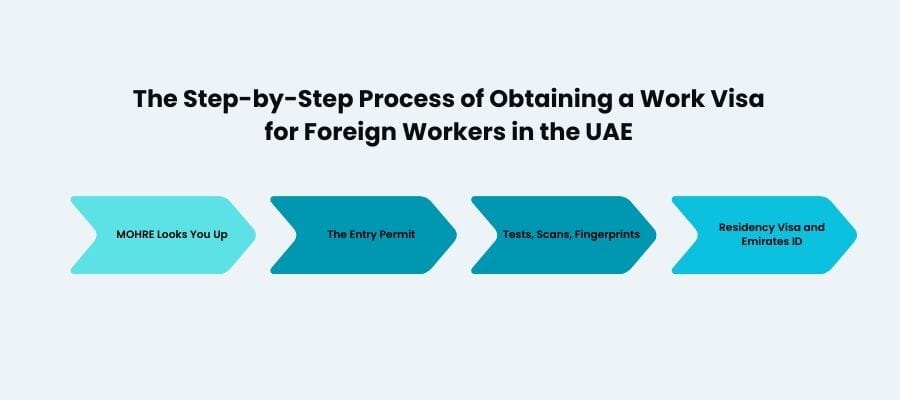
Getting a work visa for foreign workers in the UAE isn’t magic and it isn’t guesswork. It’s more like a small, very serious conveyor belt: your file hops from one station to the next, and if something looks off, the belt just stops. No drama. No warning. Just… stop.
Let’s walk through it the way it actually feels.
Step 1 — MOHRE Looks You Up
First stop is MOHRE. The employer throws in a request: we want this person, for this job. The system checks a few things in the background:
- Does the company really do what it claims to do?
- Does the job title fit that activity?
- Is there still a labour quota left, or is the firm already packed with staff?
If the licence is expired, fines are unpaid, or the job looks made up, the approval doesn’t “take longer” — it doesn’t happen. The request just sits there like a file stuck in a drawer.
Step 2 — The Entry Permit
If MOHRE is happy, immigration takes over and issues an entry permit. Think of it as the “okay, you can get on the plane now” document. It’s electronic, it has an expiry date, and it’s tied to that one employer. It doesn’t mean residency yet. It just means the door is open, not that you’ve moved in.
Step 3 — Tests, Scans, Fingerprints
Once the worker arrives, the country wants two things:
- Are you healthy enough to stay?
- Are you exactly who you say you are?
So there are medical tests, then a visit for Emirates ID biometrics. Blood work, x-ray where required, fingerprints, photo — standard package. It’s routine, but nobody skips it. This is how the UAE keeps its records clean and its population registry real.
Step 4 — Residency Visa and Emirates ID
When the medical result is clear and the ID data is accepted, the last pieces click in. The residency visa gets stamped against the passport. That’s the moment the person stops being “someone with an entry permit” and becomes a sponsored worker in the UAE.
Around the same time, the physical Emirates ID card is produced. That little card is what you use to open doors, sign things, prove you exist in the system.
You can only claim that the work visa procedure is really over when the worker is in the nation, on the books, and completely attached to the employer who asked to bring them in.
Costs and Timelines for a Work Visa for Foreign Workers in the UAE
Money first: a typical work visa for foreign workers in the UAE usually involves MOHRE fees between AED 250and about AED 3,450, an entry permit around AED 500–1,100, medical tests costing AED 250–350, and Emirates ID fees from AED 170 to 370, depending on duration. Add the residency stamping and the usual admin or insurance costs, and most employers end up in the AED 3,000–7,000 range for a normal two-year visa.
As for time, the whole chain — approval, permit, medicals, ID, stamping — often wraps in one to three weeks if nothing in the company file is expired, mismatched, or missing. If a file stalls, it’s nearly always waiting for someone to fix a loose end, not because the system moved into slow motion.
When a Work Visa for Foreign Workers in the UAE Cannot Be Issued
A work visa for foreign workers in the UAE doesn’t get rejected for mystery reasons. When the system says “no,” it’s usually one of a few very clear issues. The UAE won’t move a file forward if:
- the employer’s trade licence is expired or suspended
- the company has unresolved fines or an inactive establishment card
- the job title doesn’t match the business activity
- the worker fails mandatory medical tests
- the employer has no available labour quota
- required documents are missing or inconsistent
These are standard checks every application goes through. If even one of these points is off, the file stops cold. Fix the problem, and the process usually resumes. The UAE isn’t trying to keep people out — it’s making sure the people who come in are tied to real jobs, real companies, and real responsibilities.
Rights and Obligations Under a Work Visa for Foreign Workers in the UAE
Once a worker is sponsored, both sides step into a system with clear rules that don’t bend depending on who asks.
Worker Protections Under UAE Labour Law
A person holding a work visa for foreign workers in the UAE isn’t left to figure things out alone. The law spells out basics that can’t be negotiated away: wages paid through approved channels, limits on daily and weekly working hours, weekly rest, and access to official complaint routes if something goes sideways. The worker keeps their passport unless they choose otherwise, and any change in role or workplace must go through the proper approval process. These aren’t “benefits” — they are mandatory standards, applied across the private sector.
Employer Obligations After Issuance
Once the residency is stamped, the responsibility lands squarely on the employer’s desk. They must pay salaries on time, maintain proper records, update authorities if a worker leaves or changes roles, and cover the cost of the visa process. If accommodation is part of the agreement or required by law, it must meet the set guidelines. And if the contract ends, the company must formally cancel the visa so the worker isn’t left in legal limbo. The UAE keeps these requirements straightforward: if you bring someone in, you stay accountable for them in the system.
Common Mistakes That Delay or Block Work Visa Approvals
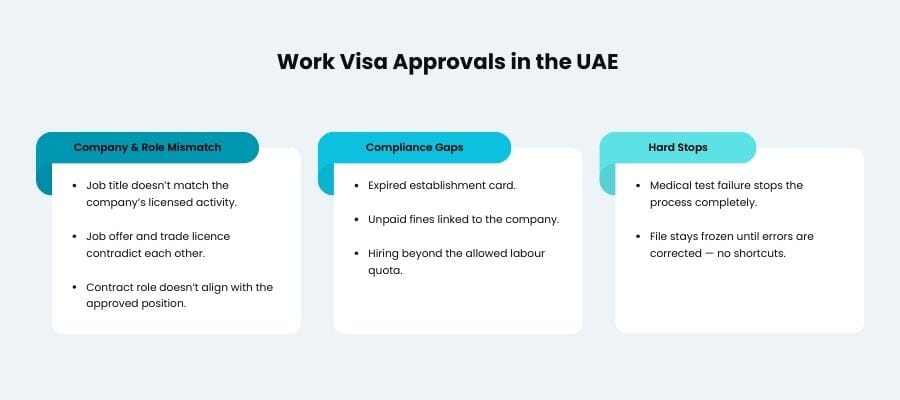
Most delays in a work visa for foreign workers in the UAE don’t come from the system — they come from avoidable slip-ups on the employer’s side. The usual troublemakers are surprisingly basic: job titles that don’t match the company’s licensed activity, expired establishment cards, or fines sitting unpaid in the background. Another frequent issue is sending in documents that contradict each other — a worker’s job offer saying one thing and the company’s licence saying another. Medical test failures also stop the process outright, and there’s no workaround for that.
A work visa for foreign workers in the UAE also freezes when a company tries to hire beyond its labour quota or submits a contract that doesn’t line up with the approved role. None of these are mysterious problems; they’re small cracks that stall the file until someone fixes them.
Conclusion
A work visa for foreign workers in the UAE isn’t just a stamp that lets someone start a job; it’s the point where the country, the employer, and the worker all agree to operate within the same set of rules. Once the residency is issued and the Emirates ID is in the worker’s hand, that person becomes part of a system that relies on order, proper documentation, and roles that actually make sense inside the business that hired them.
What stands out about the UAE is how predictable the process becomes when everyone involved does their part. Fix the mismatched titles, clear old fines, submit honest documents, and the path is smooth. Ignore those details, and the file goes nowhere. A work visa for foreign workers in the UAE rewards accuracy and punishes shortcuts.
In the end, the visa isn’t about borders or bureaucracy; it’s about making sure that people who arrive to work here do so with clarity, legal protection, and a place in a labour system designed to function cleanly.
Do I really need a work visa for foreign workers in the UAE if someone’s just “coming to help out”?
If they’re coming to work, even if you call it “help,” yes — they need a proper work visa tied to your company. The law doesn’t care what nickname you give the arrangement.
What kind of jobs can get a work visa for foreign workers in the UAE?
Anything that fits your trade licence and labour rules: office roles, site jobs, technical positions, service staff. The catch is simple: the job title has to make sense for what your company is officially allowed to do.
Can a worker change employers while on a work visa for foreign workers in the UAE?
They can, but it’s not a “just walk away” situation. The first employer has to cancel or approve the move, and the new employer has to start their own application. The system always knows who sponsors whom.
How long does it usually take to get a work visa for foreign workers in the UAE?
When the company file is clean, documents match, and quotas are available, it can be surprisingly quick. When something is outdated, missing, or contradictory, the process doesn’t slow down — it just stops until you fix it.
Who keeps the passport once the worker arrives?
The worker does. UAE rules say the passport stays with its owner unless they hand it over willingly. Keeping passports “just in case” is not how it’s supposed to work.
Who is supposed to pay for the work visa for foreign workers in the UAE?
The employer. That includes the steps for getting a visa, the medical checks, the fees for getting an Emirates ID, and the ability to cancel when the work expires.
What usually kills a work visa file?
Failed medical tests, expired company documents, unpaid fines, job titles that don’t match the licence, or no labour quota left. None of this is secret; it’s exactly what the system checks.
Do you need a medical test again when renewing a work visa?

