


 Calen Voss
  30.01.2026
 Forex trading in Dubai attracts people who prefer clarity over chaos. You don’t come here to gamble — you come to build a regulated, structured trading business in a jurisdiction that actually enforces rules. The UAE allows Forex trading, but only when you play by its regulatory framework, licensing logic, and capital discipline. This page speaks to founders, brokers, and professional traders who want facts, not hype. You’ll see when a license is required, how regulation works, what it really costs, and how to structure a Forex trading company in Dubai without missteps.
What Is Forex Trading in Dubai and Is It Legal in the UAE?
Yes — Forex trading in Dubai is legal. The key is what exactly you do, and who you do it for. If you trade your own money, privately, you don’t need a Forex trading license in Dubai. The UAE doesn’t police personal risk-taking. It polices market-facing activity.
The line is crossed when you start taking deposits, executing trades for clients, advertising trading services, managing accounts, running signals as a business, or acting like a broker. That’s not “just trading” anymore — it’s regulated financial business, and you need approval before you touch the market.
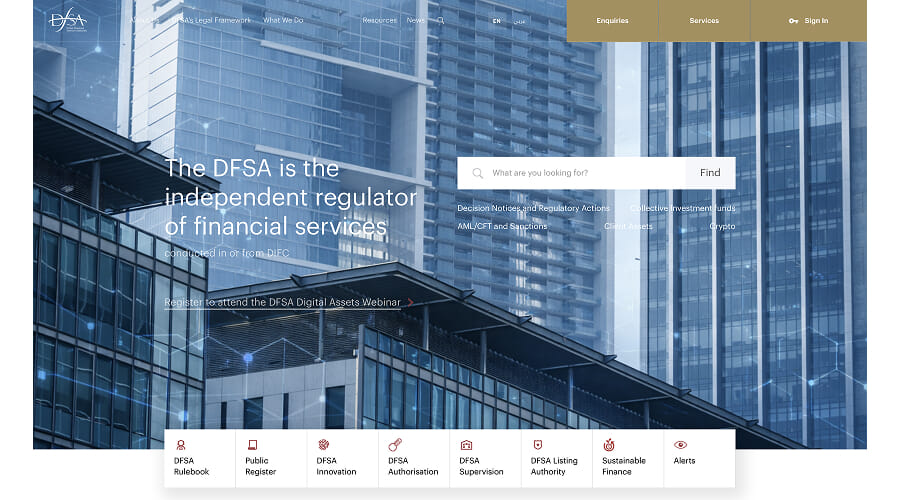
Regulation depends on the setup. Mainland oversight sits with the SCA, while DIFC-based structures fall under the DFSA. Different rulebooks, same idea: permission first, operations second.
How Does Forex Trading in the UAE Differ From Other Jurisdictions?
Forex trading in the UAE feels different because the rules actually shape behavior. Many offshore hubs sell speed and flexibility. Dubai sells structure. You don’t get licensed first and figure things out later — the regulator wants to see capital, systems, and intent before approval.
Compared to loosely regulated islands, the UAE limits leverage, reviews business models in detail, and expects real compliance staff, not paper directors. Compared to Europe, the approach is less crowded and far more selective. Fewer licenses are issued, but those that exist carry weight with banks and counterparties.
If you want to grow, this is important. A Forex trading license in Dubai shows that you are responsible, honest, and think about the long term. It gives you access to markets and reputation that goes beyond the UAE.
How to Start Forex Trading in Dubai Step by Step
Starting Forex trading in Dubai begins with clarity, not paperwork. Before you think about licenses, you need to understand what role your business plays in the market. Trading for yourself, running a proprietary desk, offering brokerage services, or managing client funds are treated very differently in the UAE.
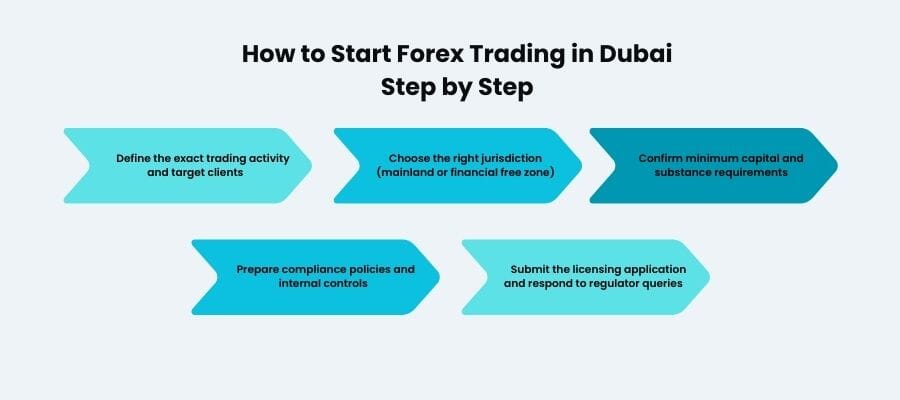
A typical setup follows a clean, predictable path:
- define the exact trading activity and target clients
- choose the right jurisdiction (mainland or financial free zone)
- confirm minimum capital and substance requirements
- prepare compliance policies and internal controls
- submit the licensing application and respond to regulator queries
Each step builds on the previous one. Skipping ahead usually causes delays later.
If you want to understand how to start a Forex trading company in Dubai without guessing, Consulting.ae can review your model, confirm license eligibility, and map the fastest compliant route before you commit capital or file anything.

Want to learn more about UAE business setup services?
How to Get a Forex Trading License in Dubai
A Forex trading license in Dubai isn’t something you “apply for” the way you apply for a trade license. It’s closer to a controlled entry into a financial market. First, you pin down the exact activity: are you a broker taking orders, a firm dealing on its own account, a manager handling client portfolios, or a team running proprietary strategies? That choice defines everything that follows — capital expectations, compliance load, even hiring requirements.
Then you build the company around that reality. Ownership structure, office presence, fit-and-proper managers, AML policies, onboarding rules, reporting routines — all of it must exist on paper and in practice. After that, the application becomes a confirmation of readiness, not a wish list.
Regulators Involved in Forex Trading License Approval in Dubai
The regulator depends on where you operate. In DIFC, the gatekeeper is the DFSA. On the mainland, the core framework connects to the SCA. Different jurisdictions, different mechanics — same principle: regulated Forex activity must be approved before you launch.
Forex Trading License Cost in Dubai: What Expenses to Expect
The Forex trading license cost in Dubai depends on one simple thing: how serious your operation is. The UAE does not price licenses for hobby projects. Costs reflect regulation depth, risk exposure, and the type of trading activity you plan to run.
Below is a realistic snapshot of core expenses for regulated Forex setups in Dubai:
|
Cost item |
Typical range (USD) |
|
License application & approval fees |
20,000 – 40,000 |
|
Regulatory capital (own funds) |
from 50,000 AED to several million USD, depending on jurisdiction and license scope |
|
Office lease & substance setup (annual) |
25,000 – 60,000 |
|
Compliance, audit & reporting setup |
15,000 – 30,000 |
|
Professional services & structuring |
10,000 – 25,000 |
These are not “optional” numbers. Regulators expect capital to be real, offices to exist, and compliance to function from day one. Cheaper jurisdictions may promise less, but Forex trading in the UAE prices credibility upfront — and banks, counterparties, and clients notice that immediately.
Why Choose Consulting.ae to Set Up Forex Trading in Dubai
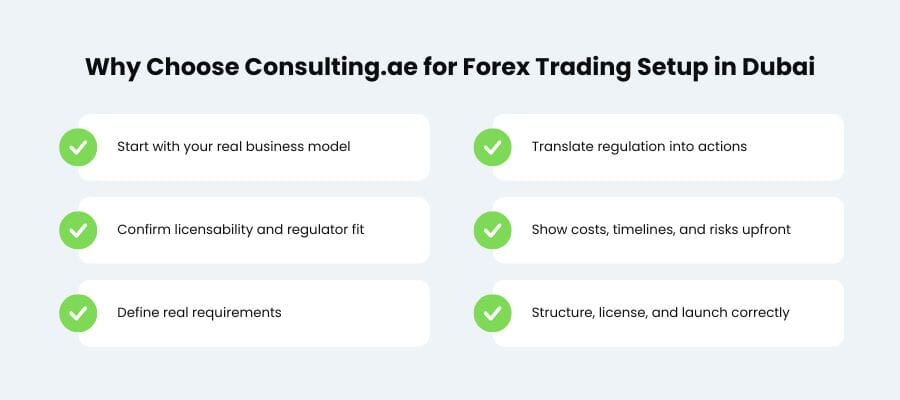
Setting up Forex trading in Dubai leaves little room for improvisation. One wrong assumption about activity scope or regulator choice can cost months. Consulting.ae starts where regulators start — with your business model. We check whether your plan is licensable, which authority fits it, and what capital and substance are actually required, not “theoretical averages.”
Our team works directly with founders, brokers, and trading firms, translating regulatory language into practical steps. You see costs before commitments, timelines before filings, and risks before they become problems.
If you want to start a Forex trading company in Dubai with clarity instead of guesswork, speak with Consulting.ae. We help you structure, license, and launch properly — so your Forex business opens with approval, not questions.
Yes, Forex trading in Dubai is legal and regulated. Personal trading is allowed, while market-facing activity requires approval. If you plan to operate commercially, regulation is not optional.
You need a license when offering services, managing funds, or promoting trading. Forex trading in the UAE without a license is limited to personal accounts. Any company activity requires authorization.
A Forex trading license cost in Dubai typically starts around USD 20,000–40,000, excluding capital. Total setup depends on structure and regulatory scope.
Yes, foreigners can fully own and operate companies. Many Forex trading license in Dubai structures allow 100% foreign ownership.


