

 Manish Kulkarni
  13.01.2026
Dubai makes space for short stays, but only when they’re done properly. If you’re planning to rent out your apartment or villa for short-term guests, the holiday home license Dubai isn’t a formality you can ignore — it’s the line between a smooth income stream and constant risk. This license is what turns a private property into a legally approved holiday home, visible to platforms, protected during inspections, and compliant with local rules.
Many owners assume short-term rentals work the same way as long-term leases. They don’t. Holiday homes sit in a separate category, with their own permits, checks, and costs. Once you understand how the system works, it becomes far less intimidating — and far more predictable.
What Is a DTCM Holiday Homes License in Dubai?
At its core, a DTCM holiday homes license is the legal approval that allows a residential property in Dubai to be rented out on a short-term basis. Without it, short stays fall outside the rules, even if everything else looks “normal” on the surface.
To clear up the name first: DTCM full form is Department of Tourism and Commerce Marketing. If you’re asking what DTCM is in Dubai, it’s the government body that shaped the holiday home framework and set the rules for how short-term rentals operate. Today, those responsibilities sit under the Dubai Department of Economy and Tourism, but the market still widely uses the original term. That’s why you’ll hear DTCM Dubai, DTCM meaning, and DTCM license used interchangeably.
The license itself connects your property to an official permit system. It proves that your flat or house is safe and meets rules for handling guests and holiday home operations. Once approved, your unit can be legally listed on booking platforms, hosted by you or a registered operator, and inspected when required.
In simple terms, DTCM holiday homes licensing separates casual renting from regulated short-term accommodation. It protects guests, gives authorities visibility, and gives you something just as important: clarity.
Who Can Apply for a Holiday Home License in Dubai?
You don’t need a “hospitality brand” or a big team to do this. If you legally control a residential unit in Dubai — and you’re willing to run it by the rules — you can apply.
If the property is in your name, you can register it and operate it yourself. Many landlords choose this route because it keeps things flexible: you decide when the unit is available, how it’s presented, and how guests are handled. Investors can do the same, even with multiple units, as long as each one is set up correctly and managed properly.
If you’d rather not touch check-ins, cleaning schedules, pricing, or guest messages, you can still move forward — just through a licensed operator. In that case, the operator carries the operational responsibility under their DTCM license, while your unit becomes part of their approved portfolio.
Companies can apply too. Property management firms and short-term rental businesses often register under DTCM holiday homes so they can run several properties with one structured system behind them.
Foreign ownership doesn’t block you. Dubai cares less about your passport and more about the paperwork: ownership, compliance, and a clean setup.

Want to learn more about UAE business setup services?
How to Start a DTCM Holiday Homes Rental Business in Dubai?
If you’re thinking about DTCM holiday homes, forget the idea that this is “just renting, but shorter.” Dubai treats short stays as a regulated hospitality product. That’s not meant to scare you — it’s actually useful. Once you accept that you’re offering a mini-hotel experience inside a residential unit, your next moves become obvious: prepare the property, choose who will operate it, and only then step into the permit side of the process.
Start with a blunt self-check. Can a guest land at 1 a.m., open the door, and live normally for a week without texting you ten times? If the answer is “not yet,” fix that first. The licensing process rewards readiness. It punishes improvisation.
Property Requirements for DTCM Holiday Homes
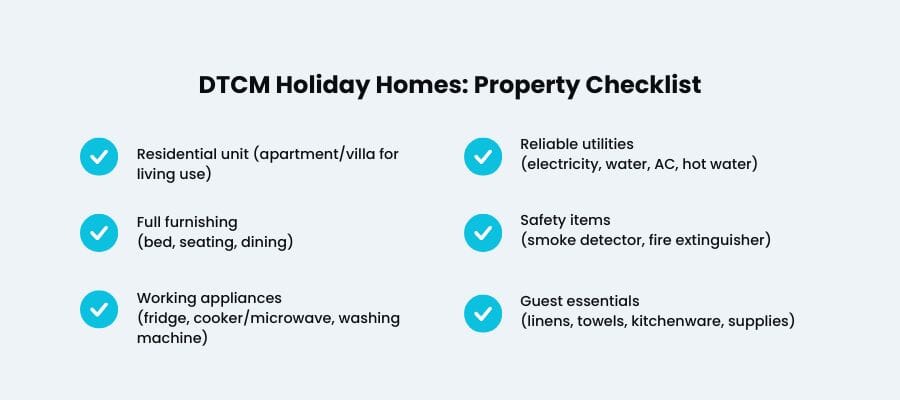
The property must be complete, safe, and genuinely livable — not “almost ready.” Here’s what operators typically prepare before the DTCM permit stage even begins:
- Residential unit only (apartment or villa registered for living use)
- Full furnishing: bed setup, seating, dining basics — no empty rooms
- Core appliances that actually work: fridge, cooker/microwave, washing machine where relevant
- Reliable utilities: electricity, water, air conditioning, hot water
- Safety items on site: smoke detector(s) and a fire extinguisher
- A clean inventory mindset: linens, towels, basic kitchenware, simple guest supplies
- Insurance that doesn’t quietly exclude short-term stays
This isn’t about style. It’s about removing friction for guests and removing risk for you.
Compliance Rules for Holiday Home Operators
Now the “operator” part — this is where many owners get surprised. Dubai expects short-term rentals to be run with discipline. Guest details must be handled correctly. Check-in and check-out must be controlled, not casual. The unit must stay inspection-ready, which basically means you can’t let standards slide after the first month.
You also need honesty in the listing. Photos, amenities, and capacity should match the real unit — no creative stretching. Noise rules and building guidelines matter because you’re not operating in isolation; you’re inside a community. And if you’re using platforms, you’re expected to follow the platform rules and the local ones.
If you want it to feel simple in real life, do the hard thinking once, upfront. That’s the trade.
How to Get a DTCM Permit for Holiday Homes Step by Step
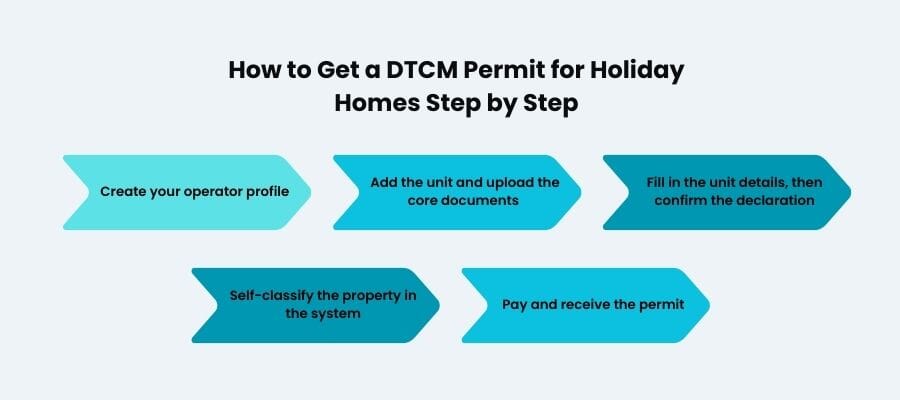
If you like clean processes, you’ll enjoy this one: the DTCM permit is basically a guided checklist inside the Holiday Homes portal. You register once, add your unit, declare the facts, pay the set fees, and your permit is issued with a QR code you can print.
Here’s the flow (this is also the exact logic for the step-by-step flowchart visual):
- Create your operator profile (individual owner or company operator).
- Add the unit and upload the core documents (typically ID/passport, title deed, and a DEWA bill that’s at least 3 months old; plus an owner authorisation form if you’re not the owner).
- Fill in the unit details, then confirm the declaration.
- Self-classify the property in the system.
- Pay and receive the permit.
On the money side, the portal is not vague. Registration is listed as AED 1,570. The unit permit fee is AED 370 total: AED 300 per bedroom + AED 50 per holiday home (classification certificate) + AED 10 knowledge + AED 10 innovation — and it can reach up to AED 1,200 per holiday home per year, depending on size.
DTCM Holiday Homes vs Long-Term Rental in Dubai
The difference shows up the moment you decide how involved you want to be. Holiday homes are active assets; long-term rentals are passive by design. Neither is “better” by default — they simply serve different goals.
With DTCM holiday homes, you trade stability for flexibility. You control pricing, availability, and presentation. Income can rise during peak seasons, dip during quiet months, and respond quickly to demand. In exchange, you accept higher operational responsibility and the need for a holiday home license Dubai.
Long-term rentals move slower. Once a lease is signed, the numbers are predictable, management is lighter, and compliance is simpler. The upside is capped, but so is the effort.
Here’s how the two models usually compare:
|
Aspect |
Holiday Homes (DTCM) |
Long-Term Rental |
|
License required |
Yes (DTCM permit) |
No |
|
Flexibility |
High |
Low |
|
Income pattern |
Variable |
Fixed |
|
Management effort |
Ongoing |
Minimal |
|
Guest turnover |
Frequent |
Rare |
Your choice comes down to control versus calm — and how hands-on you want your property to be.
Conclusion
Dubai doesn’t leave short-term renting to “common sense.” It puts it in a defined lane: register, comply, operate, renew. And honestly, that’s a good thing. When you work inside the holiday home license Dubai system, the business stops feeling like a gamble. Your listing becomes legitimate, your setup becomes inspectable, and your risks become manageable.
This is also where owners gain real control. You can run the unit yourself if you enjoy hosting and want to keep margins high. You can hand everything to a licensed operator if you want the income without the inbox. You can switch strategies season by season, scale to more units, or pause the whole thing — the framework doesn’t trap you, it simply makes your choices legal.
If you want help getting it right the first time — permits, checks, compliance, and a clean launch — Consulting.ae can take care of the DTCM holiday home licensing process and the full short-term rental setup, without the usual confusion.
Yes. If you rent a residential unit for short stays, you need a DTCM permit. If you’re already listed and unsure, treat that as a sign to verify your status before a problem finds you.
The holiday homes license Dubai cost starts with AED 1,570 for operator registration. Annual unit fees depend on the unit size and can go up to AED 1,200 per home per year, so it’s smart to price this into your plan early.
Usually a few working days, assuming your documents and unit details are clean. Most delays come from mismatched information or missing approvals. A tidy submission keeps the timeline short.
Yes, individuals can apply if they own the property and meet the requirements. You only need a company setup if you plan to operate as a management business. Many owners begin solo and expand later.
You’re exposed. Unlicensed short-term renting can trigger fines, listing removals, and forced shutdowns. If you want to keep earning without sudden interruptions, getting compliant is the safer move.

