


 Kristina Markovic
  02.01.2026
Compassionate leave in the UAE is not a vague idea or an optional gesture from an employer — it’s a defined right, and knowing how it works saves a lot of stress when life takes an unexpected turn. Many people only learn the compassionate leave meaning when they suddenly need to step away from work, and at that moment clarity matters more than anything else.
UAE rules outline exactly when you can take time off, how many days apply, and what kind of proof you must show. The framework for compassionate leave in the UAE is simple once you see it laid out plainly: it depends on who in your family has passed away and how your relationship is classified under labour law. This guide walks you through the essentials so you know what to expect before speaking to HR.
What Is Compassionate Leave and How Is It Defined in the UAE?
In the UAE, compassionate leave is a simple idea: if an employee loses a close family member, they are given a short time off from work, paid, and without having to fight for permission. It stands on its own as a legal entitlement. It can't be changed to yearly leave, unpaid leave, or any other type of leave. The rule exists so that, during a loss, you are not forced to negotiate your schedule or justify why you need time off — the law already recognises the situation.
Most companies handle these requests in a predictable way. HR checks the relationship, notes the date, and processes the leave once the employee provides basic proof. There is no debate about whether the reason “counts” because the legislation defines exactly which relatives fall under this type of leave and how many days apply to each case. Once confirmed, the leave starts immediately or on the date the employee needs to travel or make arrangements.
What Is Compassionate Leave Meaning Under UAE Labour Law?
Under UAE Labour Law, compassionate leave meaning refers to paid bereavement leave granted when a spouse, parent, child, sibling, grandparent, or grandchild passes away. The entitlement is fixed and employers must follow it; there is no discretionary clause that allows them to reduce or replace it with another form of leave. The number of days depends on the relationship, but the principle remains the same: if the employee fits the criteria and provides documentation, the employer must approve the leave.
This definition gives employees clarity and gives employers a rule they can apply consistently, without improvisation or negotiation.
How Does Compassionate Leave in the UAE Work for Employees?
In practice, compassionate leave in the UAE usually begins with a simple message to your employer. You let your manager or HR know who in your family has died and the date it happened — often by email or WhatsApp, depending on how your company normally communicates. HR then compares your situation with the categories in UAE Labour Law and checks how many days you qualify for in that specific case.
Most employers will then ask for a document to support the request — normally a death certificate, or a paper from a hospital, embassy, or local authority. If you were outside the UAE when it happened, you can still use compassionate leave; you just send the proof as soon as you can.
During these days, your salary continues as normal, and the days are not taken from your annual leave balance. The absence is recorded under compassionate or bereavement leave, not as sick leave, unpaid leave, or “absence without reason”. This way, your file shows that you followed the proper procedure and used a right that already exists in the law.

Want to learn more about UAE business setup services?
How Many Days of UAE Compassionate Leave Can Employees Take?
UAE Labour Law sets very clear limits on how many days you can take, and employers follow those numbers closely. If you lose a spouse, you are entitled to five days of paid leave. If the loss is a parent, child, sibling, grandparent, or grandchild, the entitlement is three days. These days are counted from the date of death, not from the moment you inform the company, so timing matters.
Employees sometimes expect a wider range of relatives to be covered, but the law recognises only these categories. Anything outside that list — cousins, in-laws, or non-family members — isn’t part of official compassionate leave meaning and normally falls under annual leave or unpaid leave instead.
Most HR teams grant the days once they verify the relationship and match it with the documentation you provide.
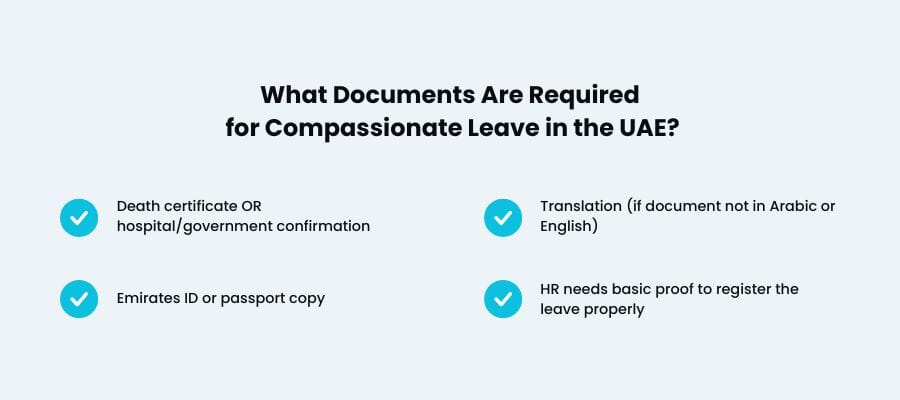
What Documents Are Required for Compassionate Leave in the UAE?
If you need to take time off, most HR departments will ask for simple proof. Employees usually show a death document or a short confirmation from the hospital or local government, even if it's from outside the UAE. When the document isn’t in Arabic or English, a simple translation is normally requested.
Companies may also attach a copy of your Emirates ID or passport to keep the file complete. The idea isn’t to complicate anything — they just need enough information to register the leave properly.
What Is the Difference Between Compassionate Leave and Bereavement Leave in the UAE?
In day-to-day conversations, people mix these two terms, but UAE rules don’t. When HR speaks about bereavement leave in UAE, they mean the days clearly written into labour law: a fixed, paid entitlement when a husband, wife, parent, child, grandparent, grandchild, or sibling passes away. The number of days is defined, and employers are expected to follow it.
“Compassionate leave” is used more loosely. Some companies use it for extra time off around the same event, others use it for serious family situations that are not strictly covered by bereavement rules. That part comes from internal policy, not from a separate article of the law.
Does UAE Labour Law Allow Employers to Extend Compassionate Leave?
UAE Labour Law sets the minimum number of paid days, but it doesn’t block employers from giving more. Some companies add extra time through internal policy, while others approve it case by case when the situation is severe or travel is unavoidable. Any extension beyond the standard bereavement leave in UAE is optional, not a legal requirement, so employees usually confirm it in writing with HR before making plans.
Does UAE Labour Law Allow Employers to Extend Compassionate Leave?
UAE Labour Law sets the minimum number of paid days, but it doesn’t block employers from giving more. Some companies add extra time through internal policy, while others approve it case by case when the situation is severe or travel is unavoidable. Any extra time off after the normal bereavement leave in the UAE is not required by law, so employees usually check with HR in writing before making plans.
Conclusion
Once you know compassionate leave meaning under UAE rules, conversations with HR become much easier and you’re not guessing what you’re allowed to ask for. The law sets the base, but how it’s applied in real offices can still feel messy.
If you’d rather not decode it alone, you can hand the details to Consulting.ae — they can review your case, align it with UAE Labour Law, and help you put together a clear, confident request.
How many days of compassionate leave are employees entitled to in the UAE?
UAE rules grant 3–5 days depending on the family relationship. It’s tied to compassionate leave meaning, not company preference, so HR follows the same structure.
Does compassionate leave apply to non-family emergencies?
No — compassionate leave in UAE only covers specific family losses. Other emergencies fall under regular or unpaid leave.
Is bereavement leave paid in the UAE?
Yes, bereavement leave is fully paid and treated separately from other leave types.
Do I need proof to apply for compassionate leave?

