


 Kristina Markovic
  05.12.2025
 Starting a business in the UAE comes with a lot of paperwork, but one document almost everyone hears about is the certificate of incorporation. If you’re new to the country—or simply new to company formation—the name alone can feel heavier than it really is. In practice, this certificate is simply the official proof that your company exists as a legal entity, whether you’re registered in Dubai, Abu Dhabi, Sharjah, or any free zone across the UAE.
You’ll deal with it when banks ask for verification, when partners want reassurance that your company is legitimate, or when government authorities need confirmation of your registration details. Think of it as your company’s birth certificate: simple, essential, and something you’ll use far more often than you expect.
In this guide, we’ll break down what the certificate actually shows, how to get a certificate of incorporation in the UAE, how to verify it, and when you’ll be asked to present it. And we’ll keep everything clear, practical, and free of legal jargon.
What Is a Certificate of Incorporation in the UAE?
If you’re setting up a company here, sooner or later someone will ask you for your certificate of incorporation and you’ll think, “Okay, but what exactly is that?” In the UAE, this isn’t some mysterious legal relic. It’s simply the document that says: your company is officially born, registered, and recognised by a government authority – whether on the mainland or in a free zone.
When a bank, landlord, supplier, or partner asks for a certificate of incorporation UAE, they’re not trying to make your life difficult. They just want proof that your company really exists, under that exact name, with that exact registration number. Without it, you’re basically saying, “Trust me, I’m a company,” and that doesn’t work in the UAE for very long.
Certificate of Incorporation Meaning and Legal Definition
The day it is given is the first day that the registry recognises your business as a real being. From then on, you can open a bank account, sign contracts, get partners, or apply for visas in the name of the business. You can open a bank account, sign contracts in the company's name, bring in investors, or apply for visas from then on.
A typical certificate of incorporation in Dubai, Abu Dhabi, or any other emirate will show things like your company name, legal form, registration or licence number, date of incorporation, and the authority that approved it. On the mainland, that’s usually DED; in a free zone it could be DMCC, IFZA, RAKEZ, or another registrar. You don’t need to memorise the legal definition of what is a certificate of incorporation in UAE – you just need to know that without this document, your business is not “real” on paper, no matter how good your idea is.
What Information Appears on a Certificate of Incorporation in the UAE?
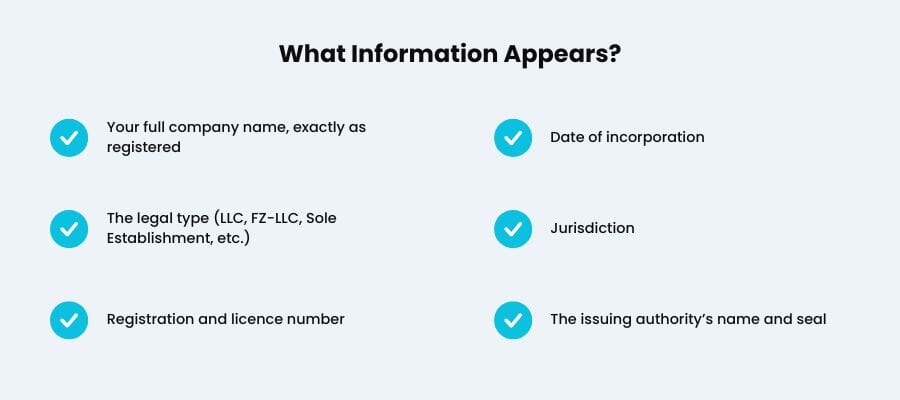
When you finally get your certificate, it might just look like another official sheet with stamps and logos. But if you look more closely, you'll see that it's really just a one-page tale about your business. A typical certificate of incorporation UAE sample will spell out:
- Your full company name, exactly as registered
- The legal type (LLC, FZ-LLC, Sole Establishment, etc.)
- Registration and licence number
- Date of incorporation
- Jurisdiction
- The issuing authority’s name and seal
This is the information banks use when they open your corporate account, what auditors check against, and what partners look at when they want to be sure your business is real. If anything on it is wrong, everything built on top of it becomes shaky — so it’s worth reading it line by line at least once.
Certificate of Incorporation in Mainland vs Free Zone in the UAE
If you’re new to the UAE, one of the first surprises is discovering that a “company” can mean very different things depending on where you set it up. Mainland and free zone businesses both issue a certificate of incorporation in UAE, but the document reflects two completely different ecosystems. Understanding the difference isn’t just paperwork trivia — it affects what your certificate shows, who recognises it, and what you can do with it.
On the mainland, your certificate of incorporation usually comes from DED Dubai or the equivalent authority in another emirate. It’s straightforward, minimal, and tied directly to your trade licence. Mainland certificates typically focus on the company’s legal name, structure, and registration number. They rarely show shareholder details, because ownership structures are stored in government systems, not printed on the document.
On the other hand, free zones treat the certificate like the company's whole identity profile. Authorities like DMCC, IFZA, RAKEZ, and others often include extra details such as share capital, full shareholder names, manager appointments, and sometimes even authorised activities. These certificates feel more “complete,” because free zones act as both registrar and regulator.
So which one is better? Neither — they’re just built for different environments. Mainland companies get broader trading rights across the UAE, while free zone companies enjoy simpler incorporation and more detailed documentation. Your certificate of incorporation UAE simply mirrors the rules of the jurisdiction that issued it.

Want to learn more about UAE business setup services?
How to Get a Certificate of Incorporation in Dubai and the UAE
It seems a lot less intimidating to get a certificate of incorporation in the UAE once you know what really goes on behind the scenes. You pick a place to start up your business (on the mainland or in a free zone), provide the registrar your firm information, and they either say "yes" and make your file or ask for changes. Once they approve everything, that’s when the certificate lands in your inbox – the moment your company is officially “real” on paper. From then on, banks, landlords, partners, and even some government portals will keep asking for it, so it quickly becomes one of the few documents you always keep close.
Documents Required for the Certificate of Incorporation
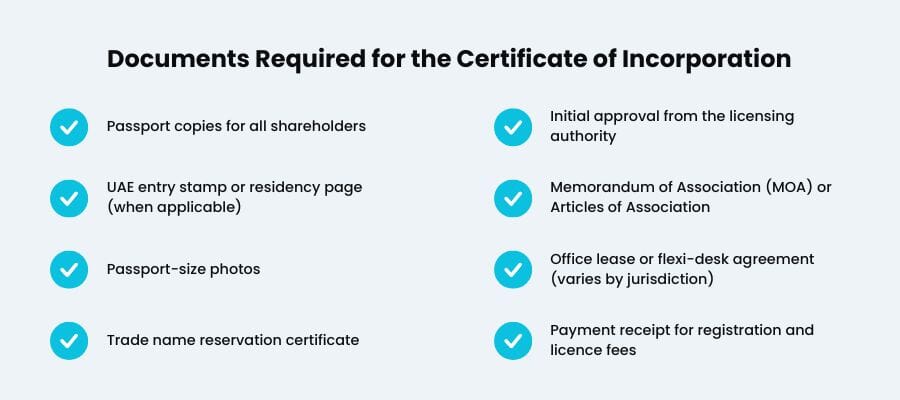
Different places in the UAE ask for different items, but the basic paperwork is the same everywhere. Free zones may ask for more details, although mainland authorities normally cut down on the list. In most cases, you will need:
- Passport copies for all shareholders
- UAE entry stamp or residency page (when applicable)
- Passport-size photos
- Trade name reservation certificate
- Initial approval from the licensing authority
- Memorandum of Association (MOA) or Articles of Association
- Office lease or flexi-desk agreement (varies by jurisdiction)
- Payment receipt for registration and licence fees
You need to be ready to fill out more forms if you want to open a branch or a business. These include incorporation papers for the parent company, board resolutions, and attestations. Regardless of the setup, having clean, consistent documents speeds up your registration dramatically.

Step-by-Step Process to Obtain the Certificate
The process is structured but not overwhelming — most entrepreneurs complete it in a matter of days:
- Choose your jurisdictionDecide whether you’re setting up on the mainland or in a free zone such as DMCC, IFZA, RAKEZ, Meydan, SPC, or SHAMS.
- Reserve your trade nameSubmit 2–3 options. Approval usually comes within hours.
- Apply for initial approvalThe authority reviews shareholder documents and confirms that your business activity is allowed.
- Sign the incorporation documentsMOA, AOA, board resolutions, and any required agreements are signed digitally or in person.
- Submit your office leaseMainland companies need Ejari or a tenancy contract. Free zones allow flexi-desks or shared facilities.
- Pay the registration feesOnce fees are paid, the authority processes your file.
- Certificate of incorporation is issuedYou receive it digitally or as a stamped PDF. This is the moment your company officially “exists.”
Most free zones issue the certificate on the same day the file is approved. Mainland authorities issue it as part of the trade licence package.
If you prefer not to manage the paperwork yourself, Consulting.ae can handle the full process — from name reservation to receiving your certificate of incorporation.
Government Authorities That Issue the Certificate
In the UAE, only licensed registrars and government-backed bodies can give out a Certificate of Incorporation. On the mainland, this is typically DED Dubai or the equivalent Department of Economic Development in each emirate.
In free zones, the certificate comes directly from the zone’s registrar, for example:
- DMCC
- IFZA (Dubai)
- RAKEZ (Ras Al Khaimah)
- ADGM or Masdar (Abu Dhabi)
- Meydan Free Zone
- Sharjah Media City (Shams)
- SPC Free Zone

Each authority has its own format, but all certificates serve the same purpose: confirming that your company is legally incorporated and recognised as a corporate entity in the UAE.
How to Verify a Certificate of Incorporation in the UAE
Before you trust any company document — even your own — it’s worth asking one basic question: “Did this really come from the authority that says it did?” That’s what verification is about. You’re not trying to be suspicious; you’re just making sure the certificate of incorporation UAE in front of you is genuine and up to date.
In practice, you usually have three checks:
- Does the certificate match the company name, licence number, and jurisdiction you’ve been given?
- Is there a QR code, reference number, or barcode you can run through the issuing authority’s website or email support?
- Does the layout and logo match other documents from that same registrar (DED Dubai, DMCC, IFZA, RAKEZ, etc.)?
If something feels “off” — wrong spelling, odd fonts, cropped logos, conflicting dates — don’t just file it and hope for the best. Ask the authority to confirm it, or let a consultant like Consulting.ae review it before you rely on it for banking, visas, or contracts.
When Do You Need a Certificate of Incorporation in the UAE?
You’ll be surprised how often this document comes up once your company is formed. At first, it feels like just another PDF in your inbox, but the moment you try to do anything “official,” someone asks for it. Banks won’t open a corporate account without your certificate of incorporation UAE, landlords want it before signing commercial leases, and partners or suppliers often request it before they agree to work with you.
You may also need it for simple tasks like setting up online government accounts or showing ownership during audits, as well as for investment visas, government approvals, and bid applications. This certificate will be used whenever someone needs to prove that your business is real, registered, and accepted by the law. It’s one of those documents you keep on hand because it quietly unlocks almost every next step in the UAE business world.
Conclusion
A certificate of incorporation may look like a simple document, but in the UAE it holds a lot of weight. It’s the paper that proves your business truly exists — and the one you’ll be asked for whenever you open a bank account, onboard partners, apply for visas, or deal with government authorities. Once you understand what appears on the certificate, how to obtain it, and how to verify it, navigating the UAE business environment becomes far less confusing.
If you need help getting your certificate of incorporation in UAE, reissuing a lost one, or setting up a new company with clean, compliant documentation, Consulting.ae can take the entire process off your hands and make sure everything is issued correctly from day one.
It’s the official document that proves your company legally exists in the country. A certificate of incorporation in the UAE includes your company name, registration number, incorporation date, and issuing authority. You’ll need it for banking, visas, and most compliance steps.
You receive your certificate of incorporation after your company registration is approved by DED or a free zone authority. If you haven’t set up your business yet, Consulting.ae can handle the full formation process for you.
Yes. Most authorities allow you to download a certificate of incorporation UAE as a stamped PDF through their online portals. If yours is missing or outdated, it can usually be reissued quickly.
Absolutely. Every free zone — DMCC, IFZA, RAKEZ, Meydan, Shams, and others — issues its own version of the certificate of incorporation UAE sample. Details may vary, but the purpose is the same.


