


 Sergey Dimitrov
  27.03.2026
 There’s something quietly magnetic about buying real estate in Abu Dhabi. It’s not just the skyline or the promise of sun all year round — it’s the feeling that you’re stepping into a system that actually works. Clean rules, clear ownership, and a market that doesn’t feel chaotic or rushed.
For many foreign investors, the first question isn’t even about price — it’s about control. Can you truly own the property? Can you resell it freely? Can you build something long-term here, not just hold an asset on paper? Understanding property ownership rights in Abu Dhabi becomes the real starting point, long before you even look at listings.
At the same time, structuring real estate acquisition in UAE isn’t just a formality. It shapes how you manage the asset, how you move money, and even how you plan your residency. A simple purchase can turn into a strategic decision — if you approach it right.
This guide walks you through the process the way people actually experience it — step by step, with all the details that tend to stay between the lines.
Legal Framework and Property Ownership Rights in Abu Dhabi
Before anything else — before viewings, prices, or negotiations — there’s one quiet question sitting in the background: what exactly are you allowed to own here? Not in theory, but in practice. Abu Dhabi answers this question in a structured way, but you have to read it carefully. Securing property ownership rights in Abu Dhabi is less about paperwork and more about understanding the logic behind the system.
Foreign Ownership: Freehold vs. Leasehold
At first glance, the terms look simple. In reality, they shape everything.
Freehold means you’re not borrowing time — you’re holding the asset. The apartment, the villa, the share of land beneath it — it all sits under your name without an expiry date. You decide when to sell, rent, or transfer it. No countdown, no renewal discussions.
Leasehold feels different. You’re stepping into a long-term arrangement rather than full control. The timeline can stretch up to decades, and for many investors that’s more than enough. Still, the idea that ownership eventually returns to the original holder changes how people think. It’s not worse — just a different kind of commitment.
When people start structuring real estate acquisition in UAE, this is usually the first fork in the road. Not dramatic, but decisive.
Where Foreign Nationals Can Legally Acquire Real Estate
Ownership in Abu Dhabi is also tied to geography. Not every district is open, and that’s intentional.
Foreign buyers are guided toward specific investment zones — places like Yas Island, Saadiyat Island, Al Reem Island. These areas are built with international ownership in mind. The rules there are clear, transactions move smoothly, and the legal side feels predictable.
Step outside those zones, and the landscape changes. Restrictions appear, and ownership rights shift. It’s not something you want to discover halfway through a deal.
So when you’re buying property in Abu Dhabi, you’re not just choosing a building — you’re choosing a legal environment. Some locations give you full flexibility. Others quietly limit what you can do next.
Meeting the UAE Golden Visa Investment Criteria
For many buyers, the property itself is only part of the story. The other part is what it unlocks.
The UAE Golden Visa has turned real estate into a kind of entry point. Not automatic, not guaranteed — but possible if the structure fits. The commonly referenced threshold sits at AED 2 million. The property needs to be properly registered, clean from legal issues, and aligned with regulatory requirements.
This is where decisions start to shift. It’s no longer just about finding a good unit. It becomes about qualifying — about making sure the investment supports something bigger.
Some buyers approach it casually. Others plan it down to the smallest detail, making sure every step supports obtaining residency through property ownership.
And that’s where Abu Dhabi starts to feel different. You’re not just acquiring space. You’re positioning yourself inside a system that rewards clarity, planning, and patience.
Corporate Structuring and Required Documentation for Property Acquisition
At some point, the conversation shifts from what to buy to how to hold it. This is where many investors slow down — not because it’s difficult, but because the structure you choose quietly affects everything that follows. Structuring property acquisition in Abu Dhabi isn’t just a legal step. It shapes ownership, control, and how easily you can move later.
Ownership Structures: Buying as an Individual vs. Corporate Entity (ADGM SPV / Offshore Company)
There are two common paths, and they feel very different in practice.
Buying property in Abu Dhabi as an individual is the straightforward route. Your name goes on the title, the process moves faster, and the structure stays simple. For many first-time buyers, this is enough. You see the property, you complete the transaction, and that’s it — no extra layers.
But once the investment becomes part of a bigger plan, people start looking at corporate ownership. An ADGM SPV, for example, is often used when investors want separation — between personal assets and the property itself. It also helps when there are multiple stakeholders or when the property is part of a broader portfolio.
Offshore companies enter the picture for similar reasons. They can offer flexibility in managing assets, especially for international investors who already operate across different jurisdictions. Still, they come with more requirements, more checks, and a need for careful alignment with local regulations.
There’s no universal “better” option. The right structure depends on what you’re trying to build — a single asset or a system around it.
Preparing the Documentation Package: Personal Identity and Corporate KYC Requirements
Once the structure is clear, the process becomes more document-driven. And this is where attention to detail really matters.
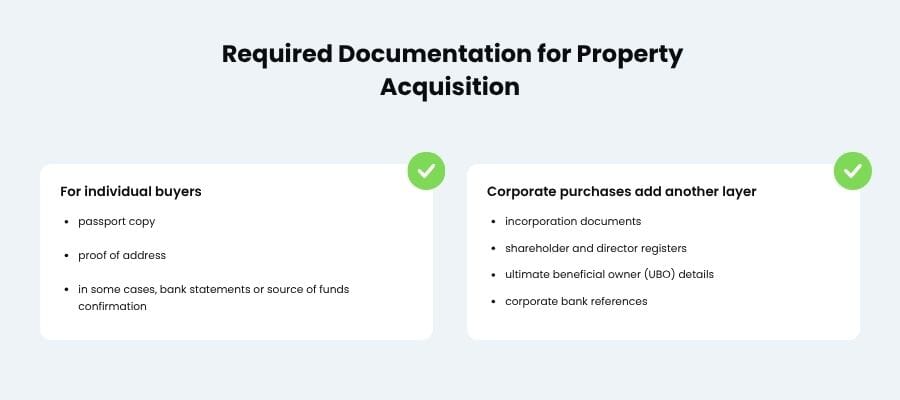
For individual buyers, the basics are expected but must be clean and consistent:
-
passport copy
-
proof of address
-
in some cases, bank statements or source of funds confirmation
It sounds routine, but inconsistencies here can slow things down more than anything else.
Corporate purchases add another layer. Authorities and developers need to understand not just the company, but the people behind it. That means:
-
incorporation documents
-
shareholder and director registers
-
ultimate beneficial owner (UBO) details
-
corporate bank references
This is part of the wider KYC framework. It’s not about making the process harder — it’s about transparency. And in Abu Dhabi, transparency isn’t optional. If something doesn’t align, it gets flagged.
When you’re preparing documentation for buying property in Abu Dhabi, the goal isn’t to gather papers — it’s to present a clear, traceable story of ownership and funds.
Developer's No Objection Certificate (NOC)
Then comes a step that many overlook at the beginning — the developer’s No Objection Certificate.
The NOC is essentially a confirmation that the developer has no outstanding claims on the property. No unpaid service charges, no unresolved obligations, no hidden issues tied to the unit. Without it, the transfer simply doesn’t move forward.
In ready property transactions, this step is usually procedural, but still critical. In off-plan or recently completed projects, it can take more time, especially if there are pending payments or administrative checks.
It’s a small document, but it carries weight. It connects the past of the property with your future ownership.
And this is often where the structure, the documents, and the property itself finally meet — in one place, under review, before the deal becomes real.
Step-by-Step Procedure for Purchasing Real Estate in Abu Dhabi
Once everything is clear — the area, the structure, the budget — the process itself feels surprisingly linear. Buying property in Abu Dhabi doesn’t involve unnecessary loops, but each step carries weight. Miss one detail, and the timeline stretches.
It usually begins with selection, but not just visually. You’re not only choosing a unit — you’re confirming that it sits in an approved zone, that the ownership type matches your plan, and that the developer or seller has a clean track record.
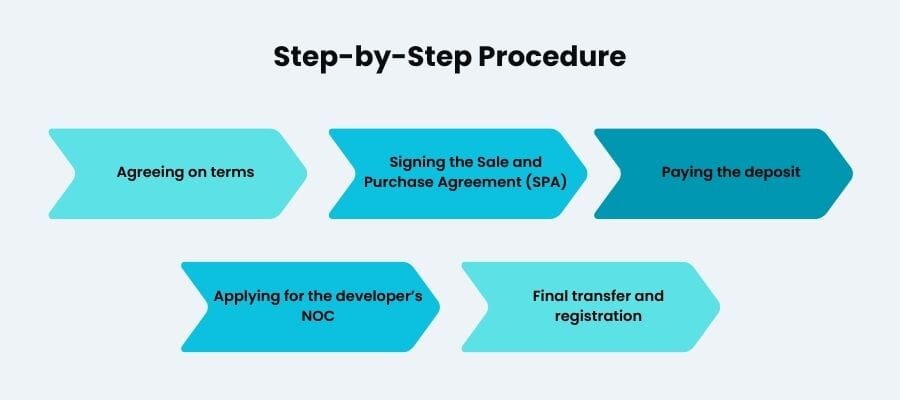
After that, things start moving:
-
Agreeing on terms — price, payment schedule, and key conditions are outlined, often in a reservation form or initial agreement
-
Signing the Sale and Purchase Agreement (SPA) — this is where the deal becomes formal, and obligations on both sides are defined
-
Paying the deposit — typically a percentage of the property value, securing your commitment
-
Applying for the developer’s NOC — confirming there are no outstanding liabilities tied to the property
-
Final transfer and registration — ownership is recorded with the
Abu Dhabi Department of Municipalities and Transport, and the title is issued
For off-plan properties, the rhythm is slightly different. Payments are linked to construction milestones, and the final transfer happens closer to completion. For ready properties, the process is more direct — once documents and payments align, ownership moves quickly.
What makes this process work is not speed, but sequence. Each step builds on the previous one. When done correctly, purchasing real estate in Abu Dhabi feels less like a negotiation and more like following a well-defined path — one where clarity is expected at every stage.
Financial Planning: Transaction Costs, Taxation, and Realistic Timelines
Numbers in Abu Dhabi rarely surprise you — but only if you look at the full picture from the start. The price of the property is just the surface. The real clarity comes when you begin structuring real estate acquisition costs in UAE with all the surrounding expenses, timelines, and ongoing commitments in mind.
Structuring the Acquisition Costs: Municipality Transfer Fees (2%), Agency Commissions, and NOC Fees
Beyond the purchase price, there’s a set of costs that appear almost immediately once the deal takes shape.
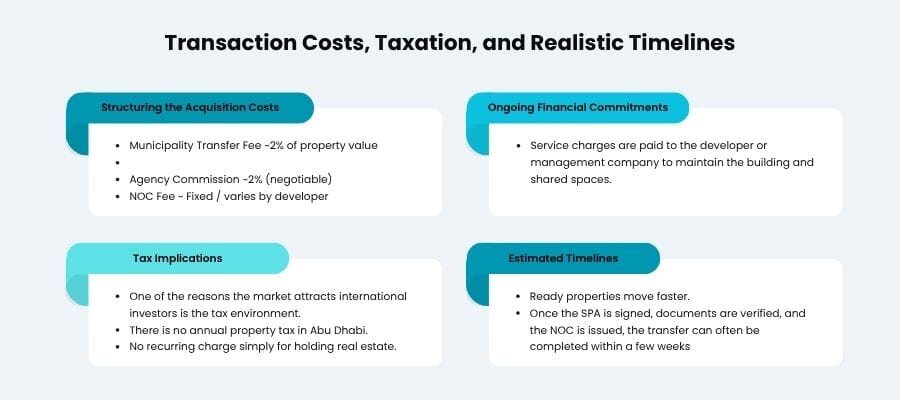
The municipality transfer fee is the most consistent, typically averaging around 2% of the property value. It is an essential component of the official registration procedure and cannot be avoided. The subsequent step is the agency commission, which is frequently negotiated but typically hovers around 2%.
Add to that the developer’s NOC fee. This one varies depending on the project, and it’s easy to overlook early on. Yet without it, the transfer simply doesn’t happen.
A simple way to look at it:
|
Cost Type |
Typical Range |
|
Municipality Transfer Fee |
~2% of property value |
|
Agency Commission |
~2% (negotiable) |
|
NOC Fee |
Fixed / varies by developer |
Individually, none of these costs feel overwhelming. Together, they shape the real entry point into the transaction.

Want to learn more about UAE business setup services?
Ongoing Financial Commitments: Understanding Developer Service Charges and Maintenance Fees
After the purchase, the financial story doesn’t stop — it settles into a quieter rhythm.
Service charges are paid to the developer or management company to maintain the building and shared spaces. This includes everything from cleaning and security to landscaping and facility upkeep. The amount depends on the project, its location, and the level of amenities.
Some properties carry minimal costs. Others — especially those with pools, gyms, and waterfront access — come with higher annual fees.
This is where experienced buyers pause and ask a simple question: not “Can I buy it?” but “Can I comfortably hold it?” Understanding long-term property maintenance costs in Abu Dhabi often makes the difference between a good investment and a stressful one.
Tax Implications: Absence of Property Tax, VAT Regulations, and Corporate Tax Nuances for SPVs
One of the reasons the market attracts international investors is the tax environment. There is no annual property tax in Abu Dhabi. No recurring charge simply for holding real estate.
VAT exists, but its application depends on the type of property. Residential units are generally exempt after the first supply, while commercial properties may involve VAT considerations.
Things become more nuanced when corporate structures are used. SPVs, especially those registered in ADGM, may fall under broader corporate tax frameworks depending on their activity and income. It doesn’t automatically create a burden, but it requires alignment — especially if rental income or multiple assets are involved.
So while the system is often described as “tax-friendly,” it still rewards those who approach it with structure rather than assumptions.
Estimated Timelines: How Long It Takes to Complete a Transaction (Off-Plan vs. Ready Property)
Timeframes in Abu Dhabi are fairly predictable — but they depend on what exactly you’re buying.
Ready properties move faster. Once the SPA is signed, documents are verified, and the NOC is issued, the transfer can often be completed within a few weeks. The process feels direct, almost procedural.
Off-plan investments follow a different rhythm. Payments are spread across construction milestones, and the final ownership transfer happens only upon completion. That can take months or years, depending on the project.
So the timeline isn’t just about duration — it’s about structure. Buying property in Abu Dhabi means aligning your expectations with the type of asset you choose. Some deals close quickly. Others unfold gradually, step by step, over time.
Hidden Pitfalls, Legal Risks, and Compliance Challenges
At first glance, the process of buying property in Abu Dhabi feels clean and structured — and in many ways, it is. But the risks don’t disappear; they just sit a bit deeper. Not obvious, not loud, but very real if you move too quickly.
Understanding legal risks in Abu Dhabi real estate isn’t about expecting problems — it’s about seeing where they could appear before they actually do.
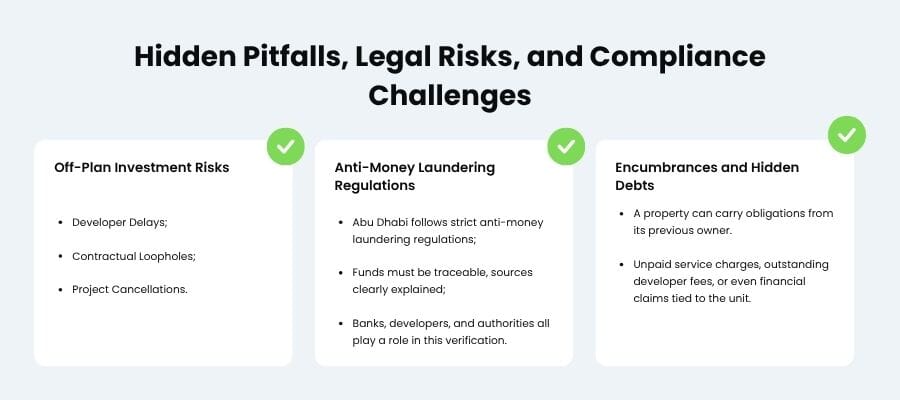
Off-Plan Investment Risks: Developer Delays, Contractual Loopholes, and Project Cancellations
Off-plan projects often look the most attractive. New buildings, flexible payment plans, strong marketing — everything feels aligned. But what you’re buying here isn’t a finished asset. It’s a promise.
Delays are the most common issue. Construction timelines shift, sometimes quietly, sometimes significantly. A project that was expected in two years can stretch further, affecting both your plans and your capital.
Then there’s the contract itself. Sale and Purchase Agreements for off-plan units can contain clauses that protect the developer more than the buyer. Payment obligations are clear, but delivery timelines and penalties for delays are not always equally strict.
In rare cases, projects can be restructured or even cancelled. It doesn’t happen often, but when it does, recovery depends entirely on how the deal was originally structured.
This is where careful reviewing property contracts in UAE becomes essential — not optional.
Anti-Money Laundering Regulations
Another layer that doesn’t show up in listings is compliance.
Abu Dhabi follows strict anti-money laundering regulations, especially in real estate transactions. Funds must be traceable, sources clearly explained, and all parties properly identified. Banks, developers, and authorities all play a role in this verification.
For buyers, this means one thing: transparency is expected at every step. Sudden transfers, unclear income sources, or inconsistent documentation can slow down or even block a transaction.
It’s not about suspicion — it’s about alignment with a system that prioritizes clean capital. And once you understand that, navigating property compliance in UAE becomes much more predictable.
Encumbrances and Hidden Debts
Finally, there’s the part many people assume is already handled — but shouldn’t.
A property can carry obligations from its previous owner. Unpaid service charges, outstanding developer fees, or even financial claims tied to the unit. These don’t always appear upfront, especially if checks are rushed.
That’s where due diligence steps in. Confirming that the property is free from encumbrances isn’t just a formality — it’s the moment where you make sure you’re not inheriting someone else’s problem.
When it comes to a system that functions well in general, the majority of problems are not caused by the market itself; rather, they are caused by skipping steps. When it comes to transactions in Abu Dhabi, the difference between a straightforward one and a convoluted one is frequently determined by how thoroughly one examines the details that lie beneath the surface.
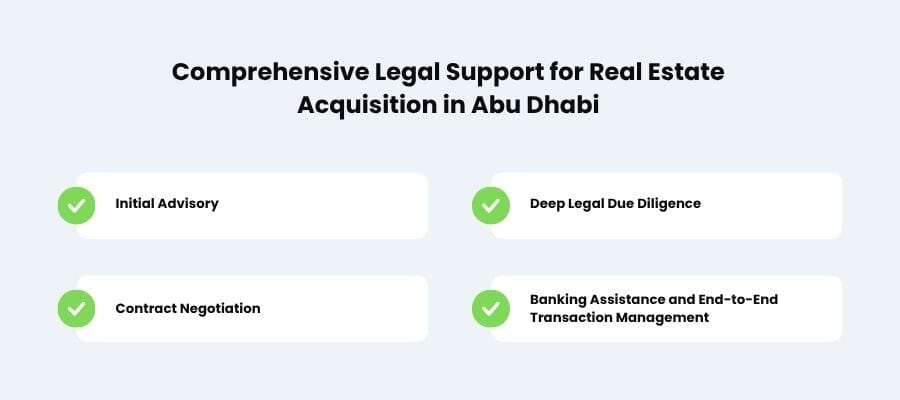
Comprehensive Legal Support for Real Estate Acquisition in Abu Dhabi
At some point, even experienced buyers realize something simple — it’s not the process itself that’s difficult, it’s the number of moving parts. Property, documents, payments, approvals, compliance. Everything connects. And that’s exactly where comprehensive legal support in Abu Dhabi real estate starts to make a difference.
Initial Advisory
It usually begins with a conversation, not a contract. What are you actually trying to achieve? A rental asset, a long-term hold, residency, portfolio expansion?
This early stage shapes everything that follows. Choosing the right ownership structure, identifying suitable zones, understanding limitations before they become problems — all of that happens here. A well-placed decision at the start often removes multiple complications later.
Deep Legal Due Diligence
Once a property is selected, attention shifts from opportunity to verification.
Due diligence is where the surface is stripped away. Ownership history, developer reputation, existing obligations, registration details — every layer is checked. Not because issues are expected, but because certainty matters more than assumptions.
In practice, this step protects you from the quiet risks that don’t show up during a viewing or in a brochure.
Contract Negotiation
Contracts in Abu Dhabi are structured, but not always balanced.
Reviewing and negotiating the Sale and Purchase Agreement is about more than reading clauses. It’s about understanding how those clauses behave under pressure — delays, disputes, unexpected changes.
Even small adjustments can shift the position of the buyer significantly. And once signed, those terms define your protection.
Banking Assistance
Then comes the financial side, which is often underestimated.
Opening accounts, aligning payment flows, ensuring compliance with local banking requirements — these steps can slow down a transaction if not handled properly. Especially for non-residents, where additional checks are standard.
Coordinating this early keeps the transaction moving without unnecessary pauses.
End-to-End Transaction Management
Finally, everything comes together.
From initial structuring to final registration, managing the entire acquisition process means keeping each step aligned — documents, approvals, payments, timelines. Not rushing, not skipping, just making sure nothing falls out of sequence.
This is what turns buying property in Abu Dhabi from a fragmented experience into a controlled one. Not simpler, but smoother — because every detail is handled before it has a chance to become an issue.


