


 Calen Voss
  12.05.2026
 Buying a ready-made company in Dubai is a way to get an active legal entity without going through the full registration process from zero. Such a company may already have a license, the right to make payments, the option to apply for resident status, and the ability to start commercial activity almost immediately. In practice, this can mean either a shelf structure with no real operating history or a working business with contracts, employees, a bank account, and tax duties already attached to it. The chosen format shapes everything: how deep the checks go, which documents are needed, and what level of risk the buyer takes on.
The legal route for acquiring an existing business in Dubai depends on where the company is registered. For a mainland company, the process goes through the emirate’s licensing authority. In free zones, however, each jurisdiction has its own rules for administration and approval of changes in shareholders or participants. This affects the transfer of rights, the corporate resolutions required, and the time needed to close the deal.
The final cost of buying a ready-made Dubai company is made up of the business price itself and the extra expenses around it: license renewal, amendments to constitutional documents, tax registration, and arranging resident status through migration procedures.
Buy a Ready-Made Company in Dubai: What Is Available for Purchase
When people speak about a ready-made business in Dubai, they often imagine one simple product. In reality, it is not that neat. One offer may be a company that only exists legally. Another may be a living business with clients, payments, staff, debts, and its own past. Before buying a ready-made company in Dubai, the buyer needs to understand what exactly is being sold, because the difference is huge.
Shelf Organization
A shelf organization is a company that was registered earlier but has not been used for real trading. Sometimes it has no business activity at all. Sometimes it has only a small formal trail, created to keep the structure alive and valid.
Such a company is usually purchased for one reason: speed. The buyer does not need to begin with incorporation, wait for the basic approvals, and pass through the first registration circle. The legal entity already exists, and the license has already been issued.
Still, this is not a reason to relax. A company with no visible activity may still have details that must be checked: license status, internal records, ownership papers, old filings, and possible gaps in maintenance. Buying a shelf company in Dubai looks simple only from the outside. The quietest file still deserves a careful read.
Active Organization
A working company is a much heavier purchase. Here, the buyer receives not just a name in the register, but a business that has already moved through the market. It may have earned money, signed contracts, hired people, opened accounts, filed reports, and built a reputation.
That can be a major advantage. It can also be the place where problems hide.
In most cases, the deal may cover:
-
agreements that are still active with buyers, clients, or suppliers;
-
rent duties and other unfinished contractual matters;
-
hired staff and issued work permissions;
-
the company’s banking record and previous payment flow;
-
tax filings, reporting history, and possible unpaid amounts;
-
disputes, complaints, or questions from partners, clients, or public authorities.
This format is useful when the buyer wants a business that already works: the right license, real processes, payment channels, market proof, and documents showing actual activity. But the more history the company has, the deeper the inspection must be. When acquiring an active company in Dubai, the buyer may receive not only useful assets, but also old obligations that are not obvious at first glance.
Mainland or Free Zone
The place of registration changes the whole deal. A company registered on the mainland is transferred under one procedure. A company inside a free zone follows another.
For a mainland business, ownership changes are handled through the emirate’s economic authority. The license belongs to the Dubai-level system, and any change of owners, managers, or company records must be made through official government channels. UAE corporate rules also have to be followed.
A free zone company lives by the internal rules of its own zone. Each zone has its own forms, approval habits, checks, and timing. Among the well-known Dubai zones are:
-
Dubai Multi Commodities Centre;
-
Dubai International Financial Centre;
-
Jebel Ali Free Zone.
When an existing business is sold in this type of zone, the new owner is usually checked out by the administration, who also looks into where the money is coming from and only changes the company file after getting permission. It might look like the process is more confined than work on the mainland, but it is not effortless.
This is why the registration area should be checked before the price is even discussed seriously. It affects the documents, the waiting time, the approval route, and the future freedom of the company to operate outside its original zone.

Why People Buy a Ready-Made Company in Dubai: Advantages of Choosing the Emirate
According to the latest official Dubai FDI Annual Results report, foreign direct investment in the UAE rose by 48.7% and reached USD 45.6 billion. In the first half of 2025, Dubai ranked second worldwide for attracted greenfield capital. Dubai Chamber of Commerce figures show the same rush toward the market: in the first nine months of 2025 alone, more than 53,000 new companies joined the Chamber, a 4% year-on-year increase, while the total number of active market players passed 292,000 by early 2026. Mergers and acquisitions, along with buying shelf companies in Dubai, form a visible part of this growth, as investors often want to skip the long compliance road linked to fresh registrations.
Buying a ready-made company in Dubai is not just a shortcut. It is a practical move that saves time and uses several strong features of the UAE business system:
-
Passing the “bank filter” through corporate history.In the UAE, opening a bank account for a newly registered company is often the slowest and most tiring stage. It may take 3 to 6 months. Buying a vintage company in Dubai, especially one with an existing account, can give the buyer a much faster start. Banks usually look more calmly at entities that have existed on paper for over a year than at brand-new firms;
-
Linking the purchase with the Golden Visa without strict stay rules.Acquiring a company with assets from AED 2 million, or about USD 545,000, may open the door to a 10-year Golden Visa. Holders of this visa can stay outside the UAE for unlimited periods while keeping resident status and tax benefits;
-
Using full foreign ownership in the mainland.Unlike many nearby jurisdictions, Dubai allows foreigners to own 100% of mainland companies in more than 1,000 business activities. Buying an existing legal entity in Dubai can be done without a local nominee partner;
-
Getting tax sovereignty with access to double tax treaties.Dubai offers a rare mix: 0% personal income tax and 9% corporate tax only on profit above AED 375,000, or around USD 102,000. At the same time, the company enters a wide network of double taxation agreements, something classic offshore structures cannot usually offer;
-
Using Invest in Dubai and digital ownership transfer.The emirate has built a fully digital platform for business management. After buying a ready-made firm in Dubai, ownership transfer goes through the single DET portal, the Department of Economy and Tourism. This makes it possible to change the owner and renew the license quickly, without the long bureaucratic chains common in the European Union or the United States.

Want to learn more about UAE business setup services?
Due Diligence Before Buying a Ready-Made Business in Dubai: What to Check Before Paying
Before buying a ready-made business in Dubai, the buyer has to see what is really inside the company. A legal entity never comes alone. It brings earlier rights, old duties, documents, promises, and sometimes problems that were not visible at first glance. A weak check at this stage may lead to hidden debts, loss of license, or a bank refusing to continue service after the transfer.
The review usually starts with the basic registration file. Even a small mismatch in official records can slow down the transfer. The buyer needs to confirm:
-
whether the license is valid, when it was issued, and when it expires;
-
whether the constitutional documents match the current ownership structure;
-
who the current shareholders and beneficial owners are;
-
whether the director and manager were appointed correctly and have proper authority;
-
whether the declared capital matches the company papers;
-
whether past corporate resolutions were prepared correctly;
-
whether there are limits on transferring rights, including approval from a regulator or other shareholders.
If the documents say one thing and the register shows another, this is already a warning sign. Such gaps can make registering changes much harder.
The license defines what the company is allowed to do, so the real activity must match the permitted business activity. When buying a registered company in Dubai, it is also important to check:
-
whether the declared business activity reflects actual operations;
-
whether a change of owner or management needs prior approval;
-
whether there are limits on services, clients, or the geography of work.
If the company has worked outside its license, the result may be fines, restrictions, or suspension of the permit.
Tax matters also move with the company, so they must be checked before buying a ready-made firm in Dubai. The review should cover:
-
corporate tax and VAT registration;
-
whether tax reports were filed on time;
-
unpaid tax amounts and penalties;
-
correct use of the free zone regime if a zero-rate position was claimed.
One issue is ownership chain. If the ownership structure was shady, buying a Dubai firm may be difficult. The registers must precisely identify the final beneficial owner; the chain of control must be complete. A clear source-of-funds history and precise owner data are needed for anti-money laundering checks. If this information doesn't match, banks may stop file updates and ask awkward questions.
Staff and immigration records are another separate layer. They are tied to the license and employee quota. When buying a registered firm in Dubai, the buyer should review:
-
current employment contracts;
-
valid employee visas;
-
available staff quota;
-
the establishment card, which is the employer registration card.
Without an establishment card, the company cannot apply for new visas or renew existing ones.
Financial and contractual ties usually create the biggest risk zone when buying an existing Dubai enterprise. The buyer should examine:
-
the lease agreement and termination rules;
-
obligations to suppliers;
-
ongoing disputes and claims;
-
overdue payments;
-
penalties issued by the free zone or the Department of Economy and Tourism;
-
court or arbitration cases.
Unsettled obligations directly affect the deal price, the payment schedule, and the conditions for closing the purchase.
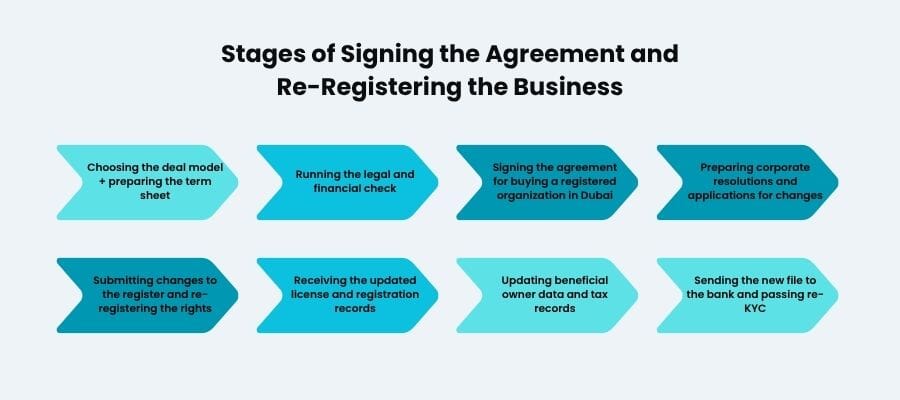
How to Buy a Ready-Made Firm in Dubai: Stages of Signing the Agreement and Re-Registering the Business
Buying a ready-made company in Dubai is not just a handshake and a payment. The deal has to be written, the shares must be legally transferred, and every register, tax profile, bank file, and corporate record has to show the new owner before real control passes. The process usually moves through the following stages:
-
Choosing the deal model.First, the parties decide how the rights will move: a purchase of 100% of the shares, entry of a new participant, a buyout with replacement of the director and manager, or keeping the current license with later changes to business activities. At this point, it is also fixed whether the existing management structure remains and whether the registrar or free zone authority must approve the changes.
-
Agreeing on the terms of buying a ready-made firm in Dubai and preparing the term sheet.The parties put the key points on paper: what exactly is being transferred, the price, the list of assets, license status, access to bank accounts and tax portals, responsibility for hidden liabilities, closing dates, and final payment rules.
-
Running the legal and financial check.Corporate papers, the license, tax records, bank history, and company obligations are reviewed. After this check, the buyer either moves to the main agreement or asks to change the price, terms, or risk allocation.
-
Signing the agreement for buying a registered organization in Dubai.The contract sets out the payment method, the date when rights pass to the buyer, the seller’s statements about the condition of the business, and liability for obligations that may appear later. If the deal is sensitive, escrow or staged payment may be used.
-
Preparing corporate resolutions and applications for changes.The participants issue corporate resolutions, update the constitutional documents, appoint the director, manager, and authorized signatory, and then collect the file for submission to the registration authority.
-
Submitting changes to the register and re-registering the rights.The change feature on the Invest in Dubai website makes it easier to send in paperwork for a business that is already up and running on the island of Dubai. Changes are made to the participants and other relevant info. A company can move into a free zone with the help of the zone's management. In DMCC, this is done through the member portal, which lets you trade shares.
-
Receiving the updated license and registration records.Once the changes are approved, the company receives a new version of the license and its attachments. These documents show the new participants, managers, and other details proving that the rights have been transferred.
-
Updating beneficial owner data and tax records.The UBO information is changed, the EmaraTax profile is updated, and, where needed, VAT and corporate tax details are corrected.
-
Sending the new file to the bank and passing re-KYC.The bank receives the updated corporate package, checks the new owner, ownership chain, and business activity profile. After that, it either confirms that the account can stay open or changes the service conditions.
Taxation After Buying a Ready-Made Company in Dubai
The tax story does not restart after the buyer takes over the company. Dubai authorities still see the same legal entity, with the same registration file, previous reports, tax profile, and unpaid duties if any. So, before buying a ready-made company in Dubai, the buyer should look at taxes closely. One forgotten filing or wrongly used benefit can later cost money.
Corporate tax is simple on paper:
-
profit up to AED 375,000 is taxed at 0%;
-
everything above that level is taxed at 9%.
When it comes to a firm that operates in a free zone, the regulations are not as lenient as they may appear in brochures. By default, a ready-made Dubai firm that is located in a free zone does not receive a tax rate of zero percent on every dirham. First things first: it needs to meet all the requirements to be considered a special free zone. Earnings that qualify are the only ones that will be subject to the zero rate. The authority looks into the company's real operations, verifies if it has a local presence in the UAE, and finds out if it stays away from prohibited activities. If the company doesn't pass this criteria, the normal rate can end up paying all of the taxes.
Value added tax is checked separately. It applies to most transactions inside the country and to many imported services. After buying a ready-made firm in Dubai, registration depends on turnover:
-
above AED 375,000, registration is required;
-
from AED 187,500, registration is allowed voluntarily.
The rate is 5%. The return is filed after the tax period, and the payment must be made within 28 days. Delay here is rarely harmless: fines and system restrictions may follow.
Small Business Relief — Regime for Small Businesses
This lighter regime can help smaller companies reduce the tax burden. It is available when:
-
yearly revenue stays below AED 3 million;
-
the company is a tax resident of the UAE;
-
books and reports are kept properly.
When the relief works, taxable profit may be treated as zero. But the company must stay within the rules. If the revenue limit is crossed or another condition is broken, the business returns to the standard tax regime.

Buying a Ready-Made Business in Dubai with Clean Ownership
Professional support when buying a ready-made business in Dubai helps keep the deal under control from the first check to the final transfer. The buyer does not just receive a company name and a license. They receive a legal asset with a past, so the license, tax file, ownership chain, contracts, and possible obligations must be reviewed before the agreement is signed.
A proper legal review makes the seller’s guarantees part of the deal, not just friendly words. All steps are taken to handle ownership transfer, changes in the official registers, changes in the details of the beneficial owner and communication with the bank, so that the company does not lose its status halfway through the process. Thus, the new owner gets a properly re-registered business with confirmed rights, a defined management structure and a working basis for starting activities and qualifying for resident status.
It depends on business activity and registration location. Most free zones allow full foreign ownership, therefore no Emirati partner is needed. For mainland enterprises, licensed activity determines answer. Many commercial and service activities allow 100% foreign ownership, although regulated industries may require a local agent or unique ownership model.
The buyer should verify that the license permits entire foreign ownership prior to purchasing a pre-established company in Dubai. The local partner cannot be eliminated from the structure if the firm was initially registered with them. The registration authority must authorize the amendment to the company documents.
The safer option is the one that has been checked properly. A shelf company usually carries fewer risks because it has no real trading past, no staff, no active contracts, and no serious tax history. It is simpler, quieter, and easier to inspect.
An operating business is more useful in practice. It may already have clients, payment history, a license for the needed activity, suppliers, employees, and working systems. But this value comes with baggage. Tax claims, unpaid invoices, penalties, staff issues, or disputes with third parties may be hiding inside the company file. That is why buying an operating business in Dubai requires full due diligence and clear seller guarantees written into the contract.
Yes. A Dubai legal entity is usually bought together with its history, including debts, penalties, and other obligations. A different result is possible if the deal is structured as the purchase of separate assets rather than corporate rights, but that route is less common and needs its own legal setup.
To reduce risk when buying an active firm in Dubai, the agreement should include the seller’s statements that there are no hidden debts, claims, or unpaid duties. It should also explain what happens if such problems appear after closing. Compensation rules, payment holdbacks, or escrow can protect the buyer if the company’s past suddenly becomes expensive.


