


 Kristina Markovic
  05.05.2026
Opening a company in Umm Al Quwain is a move that draws in investors looking to build a legal foothold inside the UAE. This jurisdiction offers flexible legal setups and direct access to the domestic market. Well-equipped free zone facilities make daily operations feel smooth and manageable. At the same time, this emirate is not just a lower-cost version of Dubai. For trade, services, or industrial ventures, it shapes its own legal and administrative space — separate, structured, and quietly efficient.
Launching a business here usually follows two main routes. The first is obtaining local status through the Department of Economic Development. The second path leans on establishing a business in Umm Al Quwain Free Zone, where autonomy and simplified procedures come into play. The final choice depends on what exactly you plan to build and how you see your market unfolding. Tax considerations, office space needs, visa access, and banking setup all start influencing the direction earlier than most expect.
Setting up a company in Umm Al Quwain Free Zone means taking a closer look at licensing terms and ownership structures ahead of time. It is worth carefully mapping out what transactions are allowed when dealing with UAE residents. This guide walks through the legal framework and the available ownership formats. It also breaks down the registration flow, required paperwork, and tax environment. On top of that, it touches on compliance checks and shaping a solid financial profile — the part many underestimate when starting out.
Company Formation in Umm Al Quwain: Why This Jurisdiction Works for Foreign Businesses
Choosing to open a company in Umm Al Quwain often comes down to location. The emirate sits roughly half an hour from the central districts of a neighboring metropolis. That proximity quietly improves logistics and cuts down unnecessary friction in transport. The area is connected through Sheikh Mohammed bin Zayed Road — a major highway that keeps goods and people moving without interruption. Registering a company in Umm Al Quwain opens the door to working with partners across more than 150 countries, naturally expanding your network without forcing it.
The local authority offers access to around 1,500 licensed business activities. The licensing body operates directly, without unnecessary layers. That is one of the reasons why registering a company in Umm Al Quwain Free Trade Zone attracts both service providers and trading firms. The process itself feels transparent, without hidden turns.
Infrastructure inside the emirate supports steady industrial growth:
- an industrial city spanning over 60 million square feet;
- direct links to Sharjah, Ajman, and Ras Al Khaimah;
- dedicated zones for warehouses and staff accommodation;
- flexible land lease terms that can stretch up to twenty years.
Starting a business in Umm Al Quwain removes the pressure of renting space in premium districts. Instead, it offers a more practical environment, especially for small and mid-sized companies that need efficiency over status. The atmosphere is built for comfort, but also for movement. Local regulations show a noticeable openness toward tech-driven startups, and innovation is not just encouraged — it is actively absorbed into the system.
Registering a company in Umm Al Quwain can also serve as a step toward optimizing tax exposure in the UAE, when structured correctly. Corporate frameworks align with federal standards, and documentation is monitored with precision. It is structured, but not suffocating.
Opening a company in Umm Al Quwain Free Zone is often the choice of businesses operating internationally. The removal of customs barriers speeds up product movement and simplifies trade flows. Choosing a specific base location, however, is rarely random — it is often shaped by banking requirements.
Financial institutions tend to assess whether a company truly operates within the region. That physical and operational presence matters more than it seems at first glance. At the same time, the administration actively supports projects involving artificial intelligence and advanced systems. Progress here does not feel forced — it is simply happening, and it shows.
How Business Activity Is Regulated in Umm Al Quwain
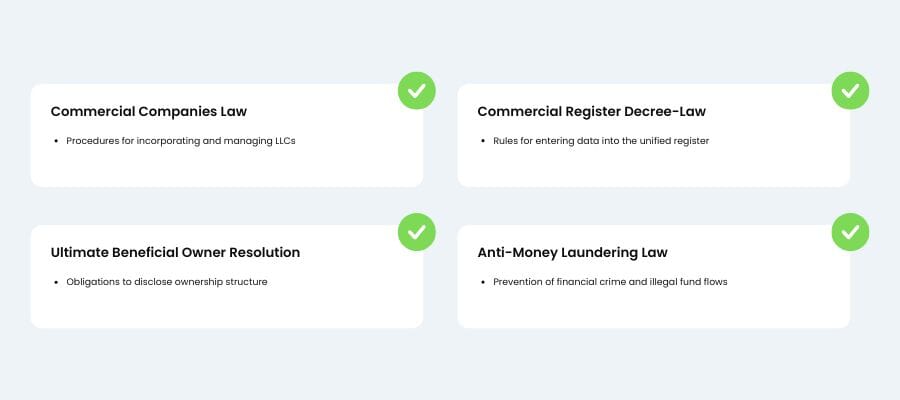
Data transparency is not just a formality — it becomes a strict requirement when registering a business in Umm Al Quwain. The Companies Law clearly outlines how legal entities are created and how they operate day to day. These rules apply across the board. The emirate’s Department of Economic Development, established back in 1995 by a ruler’s decree, oversees the mainland side of things. On a broader level, UAE corporate legislation brings reporting standards into one unified system for all business structures. Control here feels structured, not chaotic.
Registering a legal entity in Umm Al Quwain cannot happen without disclosing ultimate beneficial owners. Authorities follow a risk-based approach when reviewing ownership. This keeps potential threats in check and filters out questionable setups early on.
Regulatory framework of commercial activity:
|
Name of the Act |
Scope of Regulation |
|
Commercial Companies Law |
Procedures for incorporating and managing LLCs |
|
Commercial Register Decree-Law |
Rules for entering data into the unified register |
|
Ultimate Beneficial Owner Resolution |
Obligations to disclose ownership structure |
|
Anti-Money Laundering Law |
Prevention of financial crime and illegal fund flows |
Setting up a commercial entity in this emirate automatically means registering with tax authorities. The central department manages corporate income obligations as well as value-added tax. The system leaves little room for careless mistakes. Today, opening a company in Umm Al Quwain means fully complying with AML and CFT standards. Supervisory bodies take a close look at the origin of funds contributed by each investor. Protecting financial integrity is not just a principle here — it is the baseline.
Company registration in Umm Al Quwain also requires a precise understanding of how trade names are chosen. Every name goes through verification against the national registry. Borrowing or imitating existing brands is strictly off-limits. Incorporating a business within UAQ Free Trade Zone follows its own internal regulations, yet federal tax rules still take priority. The standards stay aligned.
The legal system in the region also protects intellectual property rights, including patents. Foreign owners retain full control over managing their assets, without hidden restrictions. There is no real concern about nationalization risks. Labor laws regulate relationships with employees, and all contracts are formalized properly — no shortcuts, no grey zones.
Opening a Company in Umm Al Quwain: Choosing Between Mainland and Free Zone
When you decide to start a business in Umm Al Quwain, the first step is not paperwork; it is determining where your firm will legally reside. The emirate provides two main directions. One is connected to the mainland and administered by the local economic authority. The other is establishing a business in Umm Al Quwain Free Trade Zone, where the ecosystem has its own internal logic. Each option influences how your company operates, grows, and communicates with customers.
If your focus is the local UAE market, the mainland route usually feels more natural. Companies here are formed through the Department of Economic Development. This path suits those who plan to deal directly with customers inside the country — signing contracts, opening shops, or running service points without restrictions tied to specific zones. It also allows you to place offices or storage facilities across the emirate, not just within designated clusters. At the same time, authorities pay close attention to your business activity and physical address. In many cases, additional approvals and visa-related steps come into play.
In the free zone, things are a little different. It is often picked by people who want to do business across borders, like in holding structures, digital services, and foreign trade. When freedom and easy ownership are more important than being physically present, setting up a business in the Umm Al Quwain Free Zone becomes a good idea. A lot of different things are allowed—in well over a thousand different directions—and companies from all over the world work together here.
Key differences between mainland and free zone in Umm Al Quwain:
|
Parameter |
Mainland (UAQ DED) |
Umm Al Quwain Free Trade Zone |
|
Market focus |
Local UAE clients |
Cross-border and global operations |
|
Typical use |
Shops, services, local deals |
Trade flows, consulting, export |
|
Authority |
Economic Development Department |
Free zone administration |
|
Physical setup |
Address within the emirate |
Warehouses, plots, business spaces |
|
Work with UAE clients |
Direct interaction allowed |
Often through intermediaries or structured models |
|
Ownership |
Depends on structure |
Full foreign ownership permitted |
Many people search for phrases like “opening and registering a company in Umm Al Quwain Free Trade Zone,” but behind those words lies a more practical choice. It is about picking the right license, the right structure, and the right location for your goals. A free zone setup does not automatically give access to every activity inside the UAE. If your plan includes regular sales within the country, it is better to check in advance how you will legally connect with local clients.
There is also a separate industrial platform in the emirate — a large area designed specifically for production, storage, and logistics. It is not a replacement for registration authorities but rather a place where industrial projects take shape. The scale is impressive, stretching across tens of millions of square feet, with space for factories, warehouses, commercial units, and even staff housing.
Choosing the mainland option means accepting closer supervision. This becomes especially noticeable in sectors like food production, chemicals, or heavy industry. Authorities do not just issue permits — they examine locations, inspect storage conditions, and check environmental compliance. That is why starting a manufacturing business in Umm Al Quwain begins with understanding how operations will actually run, not just comparing setup prices.
On the other hand, the free zone often feels lighter and faster when your focus is international reach or residency options. It works well when you want a clear ownership structure without building a large physical presence. Still, one detail remains constant: banking expectations. Any business created in Umm Al Quwain, especially by foreign founders, will be reviewed carefully. Financial institutions look at tax positioning, ownership transparency, and the real purpose behind the activity. When these pieces are aligned from the beginning, passing compliance checks becomes much smoother.
Available Corporate Structures and Requirements When Registering a Legal Entity in Umm Al Quwain
The choice of legal form in Umm Al Quwain is closely tied to where exactly the company is being set up. On the mainland, everything follows federal legislation, with clear but sometimes layered rules. Inside the free zone, the structure feels lighter and more straightforward. An investor can choose between sole ownership, partnerships, or opening a branch of an existing business.
On the mainland side, the range of legal formats is quite broad. Official sources list limited liability companies, civil partnerships, and branch offices among the common options. In practice, holding structures and joint-stock setups also appear, especially in larger projects. Still, smaller businesses tend to lean toward simpler formats — LLCs or individually owned entities that are easier to manage and scale.
Setting up an LLC in Umm Al Quwain is a popular route for trade and service activities. It gives founders the ability to run operations independently while keeping personal risk limited. In most sectors across the UAE, full foreign ownership is now allowed, unless the activity falls into a sensitive or tightly regulated field. Areas like financial services, payment systems, virtual assets, healthcare, education, real estate, precious metals, and certain licensed professions often require additional approvals before moving forward.
Key legal structures available in Umm Al Quwain:
|
Model |
Area of use |
Core characteristics |
|
LLC |
Mainland |
Widely used for trading and service businesses |
|
Sole establishment |
Mainland |
Individual ownership tailored to specific activities |
|
Civil company |
Mainland |
Designed for qualified professional services |
|
Branch |
Across jurisdictions |
Extension of an existing company |
|
FZE |
Free zone |
Single shareholder structure |
|
FZC |
Free zone |
From 2 up to 50 partners |
|
Holding company |
Mainland |
Used for managing assets and ownership stakes |
In the case where there is just one owner involved, selecting a FZE format in Umm Al Quwain is an effective choice. Depending on the circumstances, that owner may be an individual or another company. As a result of the limited liability that exists within the free zone, the founder acquires an additional layer of protection. At the same time, establishing a capital base of 300,000 dirhams is required in order to create a company in the Umm Al Quwain Free Zone. The average value of each share is one thousand AED.
An FZC structure, on the other hand, is built for collaboration. It allows several investors to come together under one framework — up to fifty participants in total. Opening such a company requires appointing a real individual as director. Administrative roles, including a company secretary, are also mandatory, ensuring that governance is not just formal but actually functioning.
A branch office in Umm Al Quwain is often chosen by businesses that already operate elsewhere and simply want to extend their presence into the emirate. This option avoids creating a completely new ownership structure. Instead, the parent company remains at the center, while the branch acts as its local extension. To make this work, a full set of official documents is required — resolutions from decision-makers, proof of authority for representatives, and detailed information about shareholders. If these documents originate abroad, they must go through consular legalization before being accepted.
Documentation and Stages of Setting Up a Business in Umm Al Quwain
Before anything official begins, the idea itself goes under the microscope. Starting a business in Umm Al Quwain is not about rushing into applications — it is about understanding how the activity will actually work. A trading company thinks in terms of volumes and movement of goods. A service business builds around client interaction. Industrial projects, however, depend on land, infrastructure, and environmental clearance. Each direction quietly reshapes the entire setup process.
Not all places in Umm Al Quwain are the same when it comes to starting a business. It all depends on whether you want the island or a free zone. The first thing that most Chinese businesses do is register their business name and seek the government's permission to start. Then there is the official paperwork, followed by locating a place to live and acquiring the final certificate. In the free zone, the process changes when you choose out the structure, receive the license, and then choose office space or land.
Before understanding how to open a company in Umm Al Quwain, applicants focus on document preparation. For individuals, the list includes a passport, visa details or entry stamp, and identification if available. A neutral-background photo is needed, and sometimes written consent from a sponsor. Corporate participants submit incorporation records and internal approvals. Foreign documents must go through legalization in the UAE.
Required documents for setting up a company in Umm Al Quwain:
|
Applicant category |
Main documents |
|
Individual |
Passport, visa or entry proof, Emirates ID (if available), photo, sponsor approval if applicable |
|
Corporate investor |
Registration certificate, constitutional documents, board decision, power of attorney, ownership details |
|
Free zone company |
Application form, chosen structure, license type, premises information, shareholder and manager data |
|
Mainland company |
Trade name approval, initial consent, founding documents, address details, external permits |
|
Industrial project |
Activity permit, project outline, warehouse or land, environmental clearance if needed |
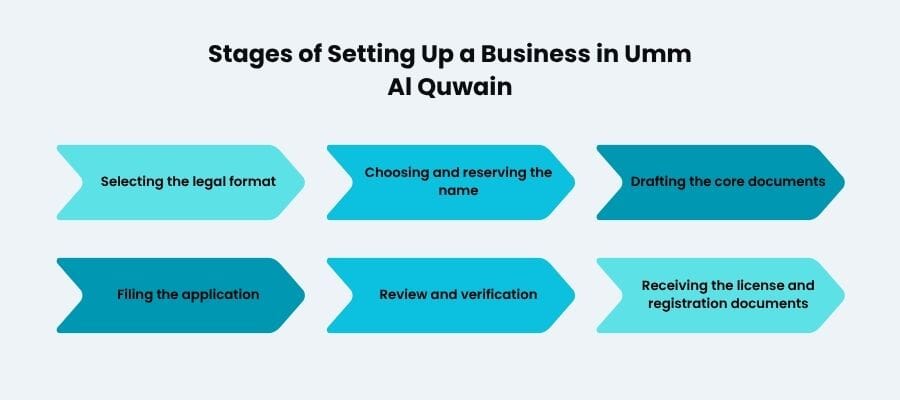
Creating a company here unfolds step by step, each stage building on the previous one.
Stage 1. Selecting the legal format. The founder chooses the structure of the firm, whether it will be a limited liability company, a branch, or something else. You can also choose to work with other professionals or set things up on your own. If you want to start a business in Umm Al Quwain Free Zone, you have to choose between FZE and FZC. This means you have to say you have 300,000 dirhams in capital, and shares are usually worth 1,000 AED apiece. In fact, you don't always need to send this much money at the start.
Stage 2. Choosing and reserving the name. A business cannot move forward without a verified name. It must be original, appropriate, and free from conflicts with existing entities or public interests. Mainland applications are reviewed by the economic authority, while the free zone administration handles its own approvals.
Stage 3. Drafting the core documents. At this point, the company begins to take shape on paper. The documents outline who the owners are, who manages the business, and what activities it will carry out. Many authorities now accept digital submissions, making remote processing possible depending on the case.
Stage 4. Filing the application. All prepared materials are submitted along with details about ownership and planned operations. In the free zone, the applicant also specifies visa needs, business type, and location. Mainland setups go through additional checks — authorities review the address, ensure compliance with municipal rules, and verify approvals for regulated sectors.
Stage 5. Review and verification. During this phase, the process of establishing a company in Umm Al Quwain transforms into a comprehensive analysis. The name, ownership structure, management, business activity, and physical presence are all components that are scrutinized by the authorities. Increasing the number of approvals and inspections may be necessary for projects that are associated with the production of food, chemicals, logistics, or manufacturing.
Stage 6. Receiving the license and registration documents. The final step comes once all requirements are satisfied and fees are settled. The company receives its official documents and becomes fully operational. The timeline depends on the nature of the activity — service businesses usually move faster, while industrial projects take longer due to additional checks and site evaluations.

Want to learn more about UAE business setup services?
Business Licensing Process in Umm Al Quwain
Before anything else, the nature of your activity sets the tone for the entire licensing process. In Umm Al Quwain, permits are not issued in isolation — they are tightly linked to what the business actually does. The chosen license affects how the company operates and even how it is taxed later on. That is why selecting the right category requires careful thought, not guesswork. Within the free zone, licenses are typically divided into production-related and service-oriented directions. Trade permissions, in turn, define which goods can be handled and sold. Choosing to launch a business in Umm Al Quwain with the correct license opens access to a broader range of opportunities from the beginning. Activities like software creation or marketing fall into service categories, while independent professionals often rely on personal permits.
Types of business licenses in Umm Al Quwain:
|
License type |
Area of use |
|
Commercial License |
Trade operations, import, logistics, storage |
|
General Trading License |
Wide spectrum of commercial transactions |
|
Professional License |
Legal work, accounting, IT development |
|
Service / Consultancy License |
Advisory support within the free zone |
|
Freelance Permit |
Individual professional activity |
|
Industrial License |
Production, packaging, processing |
|
Crafts License |
Manual services, repair work, small production |
|
Tourism License |
Travel services, guest management |
|
Agricultural License |
Farming, fishing, raw material preparation |
Some fields require a deeper level of approval. For example, financial activities cannot move forward without consent from the Central Bank. Projects involving digital assets are reviewed separately before permission is granted. An additional level of oversight is provided by the national authorities that oversee real estate activities and audit-related services.
Inspections by local authorities become a part of the procedure when the business is associated with food goods. Only once there is convincing evidence of appropriate facilities—storage, production space, or both—are industrial enterprises authorized. A regular license is frequently intended for use either inside the free zone's borders or outside of the United Arab Emirates. Establishing a trade presence in Umm Al Quwain frequently necessitates collaboration with a local distributor or partner if the objective is to sell directly on the mainland.
Additionally, the system incorporates flexibility. Multiple licensing types can be combined by a single business, which lowers recurring expenses and streamlines organizational structure. Consultants frequently choose service-based permissions to work remotely, while trading businesses officially list their goods with customs authorities. Respecting licensing requirements is more than a formality — it plays a direct role in keeping financial operations stable and ensuring that banking relationships remain smooth.
Tax Rules and Regulatory Compliance for Those Planning to Set Up a Company in Umm Al Quwain
In Umm Al Quwain, taxation is not built at the local level — everything follows federal legislation across the Emirates. That is why the choice between mainland registration and a free zone setup should be approached carefully. It is not just about structure or convenience, but about how financial obligations will later be calculated. The same corporate tax framework applies to both local companies and those operating inside special economic zones. Profit up to 375,000 dirhams is not taxed, while any amount above that level falls under a 9% rate.
Many people think that when they start a business in Umm Al Quwain, especially in a free zone, they will instantly get full tax relief. However, this is only partly true in real life. Being in such a zone doesn't mean you're completely immune. Companies can only get benefits if they meet certain requirements. In simple words, getting special treatment depends on the type of income and whether it comes from activities that are allowed.
Authorities pay attention to substance, not just paperwork. To maintain access to reduced rates, a company must demonstrate real operations — not just exist on paper. Activities must remain within permitted boundaries, and income streams outside those limits can cancel out advantages. It is this combination of factors that determines whether the zero rate remains valid.
Main tax parameters for companies in Umm Al Quwain:
|
Parameter |
Official rate |
|
Corporate tax (within threshold) |
0% up to AED 375,000 |
|
Corporate tax (above threshold) |
9% |
|
Value Added Tax |
5% |
|
Mandatory VAT registration |
Taxable turnover and imports above AED 375,000 |
|
Voluntary VAT registration |
From AED 187,500 |
|
Small business relief |
Revenue up to AED 3,000,000 (subject to conditions) |
|
Validity of relief |
Until 31 December 2026 |
|
Audit requirement |
Applies to qualifying free zone entities |
|
Revenue control threshold |
Mandatory from AED 50,000,000 |
|
Beneficial ownership threshold |
25% ownership or control |
The system of value added tax comes into play once a business reaches a certain level of activity. When taxable turnover crosses the established yearly threshold, registration becomes unavoidable. Even earlier, if projections show that this level will soon be reached, authorities may require the company to enter the system. At the same time, voluntary registration is possible from 187,500 dirhams, which can be useful for companies working with other businesses and managing input costs.
Tax registration is handled separately from incorporation. After the company is formed, the owner must organize reporting and maintain proper financial records. There is also a support mechanism for smaller enterprises with turnover below 3,000,000 dirhams, although it does not apply to those recognized as qualified free zone entities.
Anyone considering building a company in Umm Al Quwain should take compliance seriously before filing documents. The country requires full disclosure of ultimate owners, with a control threshold set at 25%. Some industries face stricter monitoring — including real estate, precious metals, audit, and corporate services. In such cases, additional reporting procedures and financial checks are part of the process.
Tax benefits in free zones only apply when the license, genuine activity, income type, and reporting match. Economic presence requirements matter for some businesses. Today, a company's zone tax status is crucial to proving operations. Foreign-owned enterprises must declare income under corporate tax and value added tax standards to maintain consistency and transparency.
Specifics of Opening Bank Accounts in Umm Al Quwain
Many founders are surprised by this: getting a company registered is often the easy part, while connecting it to a bank takes patience. Financial institutions do not rely on the certificate alone. They look at the whole picture — how the business earns money, where funds come from, who owns the company, who it plans to work with, and which countries will be involved in payments. The license opens the door, but the decision comes only after a careful internal review.
For a foreign proprietor, the fundamental inquiry is straightforward however significant – why was the enterprise established specifically in Umm Al Quwain? A mainland company addresses this by establishing genuine connections to the UAE market: clientele, contracts, and a physical presence. Establishing a company in Umm Al Quwain Free Zone typically aligns with global trade, export dynamics, consulting, or logistics. The region endorses these models; nonetheless, financial institutions anticipate a coherent and credible rationale for the selection.
Every application turns into a kind of portrait. The bank studies the structure of ownership, looks at the people behind the business, and checks their background. It reviews financial capacity, documents, and the way the company plans to operate. Evidence of real activity matters — not just intentions. In sectors like trading, logistics, advisory services, finance, or anything connected to digital assets, the level of scrutiny becomes even deeper.
How banks evaluate a company in Umm Al Quwain:
|
What is reviewed |
What is usually provided |
|
Nature of activity |
License copy, explanation of operations |
|
Ownership |
passport details of the owners, ownership structure, beneficial ownership declaration |
|
Origin of funds |
Statements, agreements, proof of capital |
|
Business partners |
Contracts, invoices, offers |
|
Payment routes |
Countries involved in transactions |
|
Real presence |
Office, workspace, staff, website |
|
Expected scale |
Forecasts, currencies, payment plans |
|
Experience |
Background of founders, previous projects |
The document package for a corporate account usually includes licensing papers, incorporation proof, and company records. Beyond that, banks request detailed information about the leadership and ownership structure. They also expect confirmation that the business is operational. Contracts and ownership documentation are part of this check.
Banks frequently ask for personal financial statements or data from related companies. For foreign investors, transparency is non-negotiable — the origin of funds and business history must be fully clear.
Business Setup Strategy in Umm Al Quwain
When it comes to launching a business, understanding your environment is more crucial than speed. There is a solid legal structure in the area, and customers may easily access worldwide marketplaces. Forming a business in Umm Al Quwain is an excellent concept for businesses that provide services and wish to grow into other nations. What happens depends on how closely the rules are followed and how well the process is managed from the outset.

