


 Calen Voss
  09.07.2025
Choosing to open a company in Sharjah is a move often made by international investors and established businesses that want direct access to the UAE market while keeping flexibility through different legal setups within a single emirate. This place draws attention for a reason — it blends the mainland route via SEDD with multiple free zones, each offering its own corporate structure and rules. Within these frameworks, everything can shift: requirements for company form, licensing procedures, ownership composition, and even how you prove your business actually operates on the ground.
There is no one-size-fits-all approach to starting a business in Sharjah. Because the mainland and free zone models have different corporate maintenance and incorporation logic, they must be treated independently. In this guide, we walk through what legal structures are open to foreign founders, which documents are typically requested in real cases, how the licensing process unfolds step by step, and what tax and compliance responsibilities come into play once the company is up and running — especially when navigating the process of obtaining a Sharjah business license.
Why Entrepreneurs Choose to Open a Company in Sharjah
The emirate holds its ground as a strategic bridge linking trade routes between East and West. When it comes to operational efficiency, running a business in the UAE starts with choosing the right location — one that doesn’t quietly drain resources at the very beginning. Sharjah steps in as a smart alternative to its neighbors, offering solid infrastructure without the heavy price tag on rent and licensing. The real strength of doing business here lies in a rare mix: access to ports on two different bays and a flexible stance toward foreign investment, especially when opening a company in Sharjah with long-term goals in mind.
Many entrepreneurs look to open a company in Sharjah for one simple reason — cost control. Office space and warehouse rentals remain far more affordable compared to nearby emirates. Industrial zones, in particular, keep square meter prices at a level that feels realistic, not inflated. This attracts manufacturers and trading businesses that rely on space and logistics. Add to that lower utility bills and smoother logistics costs, and you get a setup where expenses stay manageable without sacrificing service quality.
Within this area, there are two major ways to begin a business: either by establishing a company on the mainland or by entering one of the free zones. You can choose either of these two choices. It is important to keep in mind that the total cost of starting a business in the UAE depends on both the type of business structure you choose and the type of license you need for your product or service. When business owners get a Sharjah business license, they can choose whether they want to be able to freely work in the local market or focus only on trade with other countries. They have this freedom because there is a clear line between the island and the free zones.
The emirate is divided into several specialized clusters, each with its own rhythm and purpose:
- Hamriyah Free Zone — an industrial hub built for oil & gas and construction sectors;
- Shams — a space shaped for media, IT, and creative industries;
- SAIF Zone — a logistics-driven area near the international airport with quick access to cargo terminals;
- SPC Free Zone — tailored for publishing and commercial service activities.
Investors quickly see why Sharjah stands out. Its geography alone gives it an edge — direct access to both the Persian Gulf and the Gulf of Oman. That dual connection turns the emirate into a natural transit point for goods moving toward Africa and South Asia. Modern container terminals keep cargo moving fast, which means capital doesn’t stay frozen in transit for long.
The decision to set up a company in Sharjah becomes even more appealing thanks to ready-made solutions for small businesses. Coworking spaces, flexible office setups, and pre-built infrastructure make the entry stage much smoother. These options help reduce early expenses while a company is still building its client base. In many zones, administrative processes are partially automated, which speeds up obtaining permits and keeps paperwork from turning into a bottleneck.
For startups and tech-driven ideas, launching a startup in Sharjah opens doors to support programs designed for innovation. Scaling a project here doesn’t feel restricted by outdated bureaucracy. Local authorities actively adjust licensing categories to match new digital activities, creating space for experimentation. It’s a comfortable environment for testing products before taking them to a global stage.
In the end, the choice to open a company in Sharjah often comes down to balance. On one side — access to government contracts through the mainland. On the other — tax advantages inside free zones. Registering a business in Sharjah creates a stable legal framework for working with international partners and building something that can grow beyond borders.
Legislative Framework and Company Registration Process in the Emirate of Sharjah
Running a business in this region rests on a mix of federal laws and local regulations. For mainland companies, the legal backbone is the legislation governing commercial entities. This framework shapes how legal entities are created and sets clear rules for internal management — rules that every market player is expected to follow without exception.
For limited liability companies, there’s an additional cabinet resolution focused specifically on LLC structures. This corporate law instrument in the UAE defines the rights of participants and explains how internal decisions are made. It also formally allows for single-owner companies, which makes the structure far more practical for solo investors planning on establishing a company in Sharjah without partners.
Free zones operate under their own internal rulebooks, and they enjoy a noticeable level of independence. Anyone planning to open a company in Sharjah should keep in mind that regulations within a specific zone — including Shams rules on corporate structure and licensing — can, in certain procedures, take priority over general legislation. This flexibility allows zone authorities to simplify document requirements and reduce the reporting burden where possible.
The tax framework is structured around federal company taxation legislation. When contemplating the registration of a business in Sharjah, it is essential to account for the usual corporation tax rate of 9% imposed on income surpassing 375,000 AED. Simultaneously, enterprises located in free zones may avail themselves of a 0% tax rate, contingent upon satisfying criteria related to qualifying income and maintaining audited financial records.
Rules around identifying ultimate beneficial owners are defined in a separate regulation focused on UBO procedures. Setting up a company in Sharjah includes the mandatory step of disclosing controlling individuals in the official register at the incorporation stage. Missing deadlines when updating this information can lead to administrative penalties under federal compliance rules.
On the mainland side, licensing authority sits with the Sharjah Economic Development Department (SEDD). Looking at the broader corporate regulation landscape in the UAE, SEDD acts as the central body handling all categories of mainland licenses. It also coordinates approvals with other authorities when a business activity requires additional permits — a key step in obtaining a Sharjah business license without delays.
Non-residents are subject to stringent anti-money laundering (AML) regulations as part of the comprehensive company registration process in Sharjah city. Due diligence systems for evaluating partners and reporting any suspicious activities are required to be implemented by corporations in order to comply with the regulations that are now in place for businesses. When it comes to conducting a business in the emirate, this layer of compliance is not merely a formal thing; rather, it is an active component of keeping a legally sound organization.
Options for Registering a Commercial Presence in Sharjah: Mainland and Free Zone
The choice of legal structure always depends on the jurisdiction you step into. Outside the mainland, regulatory oversight shifts away from SEDD and into the hands of local zone authorities. This setup pushes investors to think ahead — where exactly will the business operate, and what model will actually work in practice?
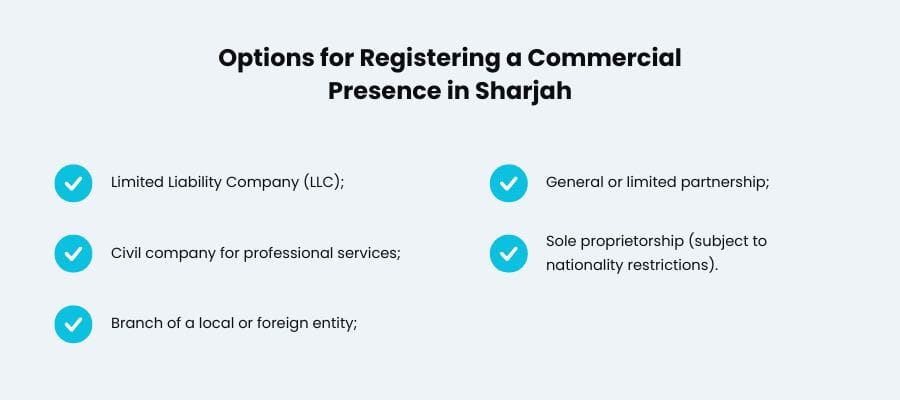
Establishing a limited liability company (LLC) in Sharjah is the most frequent method to take if the objective is to act directly inside the local market. With this structure, there can be as many as fifty shareholders, and their liability is restricted to the amount of capital that they have contributed. In most industries, foreign investors will be able to own one hundred percent of such enterprises beginning in 2021, without the necessity for a local partner. While this is going on, mainland company registration in Sharjah also permits general and limited partnerships. These partnerships provide more conventional formats for joint operations, while also allowing for greater flexibility when creating a company in Sharjah.
Running a business on the mainland also gives access to full and limited partnership models. However, sole proprietorships — whether commercial or industrial — remain restricted to UAE or GCC nationals. Foreign founders can still enter the market through a professional license model, where a local service agent is involved, typically for consulting, medical, or similar service-based activities.
The legal landscape offers several structured options:
- Limited Liability Company (LLC);
- Civil company for professional services;
- Branch of a local or foreign entity;
- General or limited partnership;
- Sole proprietorship (subject to nationality restrictions).
For international holdings that don’t want to create a separate legal entity, expanding into Sharjah through a branch office often makes the most sense. A branch doesn’t stand alone as a legal person — it remains fully tied to its parent company. Still, regulators require such entities to be officially registered in the federal registry under the Ministry of Economy, which is a key step when establishing a corporate presence in Sharjah.
Free zones, on the other hand, offer a different rhythm. A free zone company in Sharjah operates independently from mainland restrictions, making it attractive for international trade and specialized industries. A popular format here is the FZE — a company with a single shareholder. When two or more partners are involved, the structure shifts to FZCO, which functions as an independent entity with its own financial responsibility.
In the SAIF Zone, there exists a stipulated minimum capital requirement of 150,000 AED for newly established enterprises. A foreign company's branch in the same zone is notably free from this requirement. This fact renders the branch model attractive for firms seeking to explore opportunities while maintaining control over initial investments during company establishment in Sharjah.
Innovation-driven zones like Shams take things even further. They apply flexible rules tailored for media businesses and IT startups. In these environments, a company set up by a non-resident can include different classes of shares — a useful tool when attracting investors or structuring funding rounds. Choosing the right legal form at the preparation stage doesn’t just simplify things — it can significantly reduce future compliance costs.
On top of that, the region has embraced digital processes. Whether you’re registering on the mainland or inside a free zone, most procedures can now be completed through online platforms with clear verification steps. It turns what used to feel like a bureaucratic maze into a much more manageable process of setting up a company in Sharjah.
Algorithm for Registering a Legal Entity in Sharjah
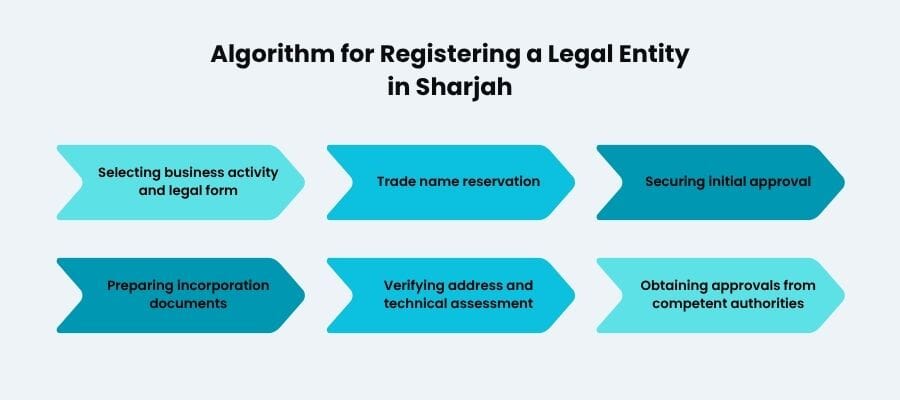
The process of setting up a company on the mainland and within free zones follows a generally similar path. The differences appear in the required documentation and the number of authorities involved. Launching a business requires preparation in advance — defining how ownership will be structured and selecting an appropriate office location before moving into the process of opening a company in Sharjah.
Stage 1. Selecting business activity and legal form. At the initial stage, the concept of the project is matched with the official activity list used in the emirate. The answer to how to open a company in Sharjah depends directly on this classification, since certain types of work require professional qualifications or approvals from specific government bodies.
Stage 2. Trade name reservation. The proposed company name is checked for availability in the SEDD database or through the administration of the chosen free zone. Registering a business in Sharjah requires that the name meets formal standards and does not include restricted terms such as religious references or country names without approval.
Stage 3. Securing initial approval. An application is submitted to confirm that the selected activity is permitted in the chosen location. This document is essential, as it allows the investor to proceed with signing a lease agreement and preparing the company’s founding documents.
Stage 4. Preparing incorporation documents. At this stage, the founders sign the Memorandum of Association (MoA) or conclude an agreement with a service agent. This can be done either in person or through the UAE PASS digital platform. For branch structures, board resolutions and powers of attorney for management representatives are prepared.
Stage 5. Verifying address and technical assessment. To finalize the licensing process, a registered lease agreement must be submitted through the Tahseel system. If the business involves production activities, the premises are inspected to issue a technical evaluation report.
Stage 6. Obtaining approvals from competent authorities. Additional regulatory approvals are necessary for specific sectors, including healthcare, education, and construction. The business registration process in Sharjah is temporarily suspended in these instances until the appropriate authority issues a favorable decision.
Required documents for mainland registration (SEDD):
|
Document Type |
Requirements |
|
Trade Name Certificate |
Issued after approval and reservation in SEDD |
|
Passport and visa copies |
Copies of all shareholders and the appointed manager |
|
Memorandum of Association (MoA) |
Notarized or completed with a digital signature |
|
Tenancy Agreement |
Registered through the Tahseel system |
|
GDRFA approval |
Required for foreign non-resident investors |
|
Technical report |
Needed for industrial or production activities |
Attaining the incorporation certificate is the last step in the process. The authorities will provide both the commercial license and the registration certificate once all of the fees that are owed to the government have been paid. When it comes to finishing the process of company formation in Sharjah, one of the most important steps involve registering the company with the tax office in order to obtain its tax number.
As far as the information that must be supplied is concerned, the SEDD regulations for the mainland are very specific. Copies of technical documents, visa records, and passports are often included in the package it contains. In the event that one of the proprietors is a business, they will be required to fill out extra forms, such as board resolutions and constitutional documents, which are licensed to be used in the United Arab Emirates in the suitable manner.
Operations are more straightforward in SAIF free zones. A "single window" system enables investors to submit a form including a concise firm concept. Authorities assess the project's alignment with the zone's economic framework. Powers of attorney and parent company registration are crucial for branch arrangements.
A lot of the time, timing depends on how effectively foreign paperwork are prepared ahead of time. If all goes well, the process usually takes three to seven days on the mainland. Some free zones, especially those that specialize on digital or remote services, can move significantly faster. They can even give permissions in as little as 24 hours, which makes starting a business in Sharjah feel quite speedy.

Want to learn more about UAE business setup services?
You may also do the whole thing from a distance. With a legitimate power of attorney, investors can act through authorized representatives. The business gets its commercial certificate and can then apply for an immigration card when it has registered.
Every step of the process is now visible online through official digital systems. Upon obtaining the primary license, the company is required to register with the Ministry of Human Resources to acquire work visa quotas. A final examination by municipal officials is mandatory prior to the full launch of any firm involving industrial operations.
In reality, a full and well-prepared licensing package is all that is required to set up a business in Sharjah. The single-window model is used in most free zones. This speeds things up by cutting down on needless back and forth. Once everything is finalized, the company can carry on as usual, make contracts that are legally binding, and start business bank accounts.
Licensing and Mandatory Compliance for Those Planning to Set Up a Company in Sharjah
You can't just open a business in Sharjah and figure out what to do later; the license you get from the start is directly linked to your ability to do business. On the island, the Sharjah Economic Development Department (SEDD) is in charge of the whole process and is like a gatekeeper. Even the smallest thing, like the activity code you pick, affects the rest of the process. It affects the annual fees and whether or not other officials get involved. Getting a business license in Sharjah is a complex, well-organized process that has many steps.
Licenses here are not generic — they follow the logic of what your business actually does. If your company is built around buying and selling goods, whether locally or across borders, you’ll be working under a commercial license in Sharjah. If the focus shifts toward knowledge-based services — legal advisory, accounting, software development — then a professional license becomes the natural fit. And when the business moves into physical production — manufacturing, processing, packaging, or storing goods — the path leads to securing an industrial license in Sharjah.
Beyond these core categories, the system also opens the door to more specialized permits defined by law:
- Crafts license — for hands-on trades, small workshops, and technical maintenance work;
- Tourism license — for businesses operating in travel, both inbound and domestic;
- Agricultural license — for ventures in farming, livestock, or aquaculture.
Holding the correct license isn’t just a formality — it signals that the company meets industry expectations, from safety standards to the qualifications of its team.
Before stepping in, investors usually take a closer look at the regulatory landscape. Some activities come with very specific requirements, including the need to rent premises of a certain size or category. For example, obtaining a production-related business license in Sharjah requires a technical assessment of the site and approval from the municipality. Consulting businesses, on the other hand, tend to move faster through the process, although they often require proof that the company’s manager has the right professional background.
Free zones tell a slightly different story. Each one operates with its own classification system, shaped around particular industries. To give one example, permits in the Hamriyah Free Zone are organized into three primary categories: commercial (which includes general trading), service, and industrial. This framework not only enables businesses to conduct operations within the zone, but it also enables them to manage import and export operations through the zone's deep-water port, which is a significant benefit for those business owners who are constructing international trade flows.
Licensing specifics across Sharjah free zones:
|
Free Zone |
Available License Types |
Key Feature |
|
SAIF Zone |
Trading, service, industrial |
License tied to facilities near the airport |
|
Shams |
Service, trading, light industrial |
Flexible share structures for IT and media businesses |
|
Hamriyah |
Commercial, service, industrial |
Strong focus on heavy industry |
|
SPC Free Zone |
Business, consulting, media, trading |
Ability to combine up to five business activities |
Shams, which is frequently referred to as the creative center of the emirate, provides a more adaptable setting for media and technology-related initiatives. Smaller teams find it particularly appealing because a trading license in Sharjah may occasionally be granted here without the initial need for a physical presence. Customs registration and the proper codes are still required if the business involves importing goods.
SAIF Zone, by contrast, takes a more structured approach when it comes to industrial operations. Facilities must be closely tied to airport infrastructure, and companies need to demonstrate that their capacity meets the zone’s technical standards. In this setting, licenses in Sharjah often relate to specialized services connected to aviation or logistics — making the zone a natural fit for businesses operating within global supply chains.
Fiscal Obligations of Commercial Companies in Sharjah
Sharjah's tax laws are a reflection of the UAE's larger federal structure rather than being in a vacuum. Corporate tax, which is implemented progressively, is at the heart of it all. The rate maintains at 0% if a company's net profit stays below 375,000 AED, allowing smaller companies to expand without hindrance. When planning and managing company taxation in Sharjah, it is important to remember that if that threshold is exceeded, profits are subject to the regular 9% tax.
The Federal Tax Authority must list all legal entities, including free zone entities. Even if the corporation has no financial activity, it must get a taxpayer identity number and file annual reports. The system prioritizes transparency and consistency above activity.
Free zone companies can go a step further and apply for what’s known as qualified status. When granted, it allows them to maintain a 0% tax rate — but only if they demonstrate real economic presence. At the same time, any income generated from dealing with mainland partners is taxed at the standard 9%, which becomes a crucial detail when structuring cross-border operations in Sharjah.
VAT in Sharjah is tied directly to annual turnover. Once revenue reaches 375,000 AED, registration becomes mandatory. If turnover exceeds 187,500 AED, businesses have the option to register voluntarily — often used as a strategy to optimize supply chain costs and input tax recovery while handling VAT registration in Sharjah.
Internal compliance isn’t just a checklist — it’s an ongoing process that keeps the company aligned with regulations. Key elements include:
- identifying and verifying ultimate beneficial owners (UBO);
- maintaining updated registers of shareholders and directors;
- submitting reports on economic substance (ESR);
- connecting to the goAML system when handling significant financial transactions;
- undergoing regular external audits to maintain licensing status.
Disclosure of beneficial ownership is governed by Cabinet-level regulations focused on transparency. When a company is first registered, details about its controlling individuals must be submitted to the official register. If the ownership structure changes, the company is required to notify the authorities within 15 days — a rule that directly impacts maintaining compliance in Sharjah.
ESR, or Economic Substance Regulations, only apply to some areas, such finance, insurance, investment, and transportation. To achieve these standards, businesses must show that they are really doing business in the UAE. This implies having staff and an office in the area. If you don't follow these rules, you could face fines or, in more extreme circumstances, lose tax benefits.

Opening a Corporate Bank Account in Sharjah: What to Expect
The process of getting your license is just the beginning. People can't just go to the bank and start using it right away; they have to pass a strict compliance check first. UAE banks follow strong international rules about being open and honest. This means that before they open an account, they carefully check out who you are, how your business works, and where the money comes from. This is very important to know if you want to open a business account in Sharjah.
The review process goes deeper than documents. A bank officer will not only verify registration papers but also assess whether the business makes real economic sense. To successfully open a business account in Sharjah, the company must demonstrate actual activity — clear services or products, realistic turnover expectations, and a transparent ownership structure. If something feels vague or incomplete, the process tends to slow down or stop entirely.
Companies registered on the mainland often have an advantage at this stage. A physical office and a lease registered through Tahseel signal real presence, which banks value. In contrast, businesses operating from free zones — especially those using flexi-desk or virtual office formats — may face additional scrutiny. Banks want to see substance: employees, operations, and genuine activity inside the UAE when approving a corporate bank account in Sharjah.
Document preparation begins immediately after licensing. A standard file for opening a company account in Sharjah usually includes:
- official corporate documents: license, incorporation certificate, and constitutional papers;
- lease agreement confirming the company’s address;
- identification documents of owners and managers (passports, visas, Emirates ID);
- a structured business plan outlining services, products, and expected partners;
- personal bank statements covering the last six months;
- draft agreements or invoices that show planned transactions.
For companies planning cross-border payments, having a fully functional business account in the UAE is essential. Many prefer well-established banks like Emirates NBD or Mashreq. The approval timeline typically ranges from one to three months, depending on how complex the ownership structure is and the jurisdictions involved.
Ownership transparency plays a central role. Anyone looking to open a corporate bank account in Sharjah must disclose all ultimate beneficial owners, especially those holding more than 25%. Structures involving intermediaries or nominees often require additional clarification and deeper checks.
There’s also the financial side to consider. Banks usually set a minimum balance requirement — often between 50,000 and 200,000 AED — which must remain in the account. At the same time, newer digital banks such as Wio Bank offer more flexible entry conditions, reducing the burden on initial deposits when opening a corporate account in Sharjah.
Building a Business Presence in Sharjah
Choosing Sharjah as a base is rarely coincidence — it’s a calculated move for those looking to expand into the Middle East and Africa. But success here depends on more than just registration. Knowing how to open a company in Sharjah is only part of the equation; what really matters is how well the financial and operational structure is built around it.
One of the emirate’s strengths is flexibility. Mainland licenses provide direct access to the local market, while free zones open doors to international trade advantages. This balance allows businesses of different scales — from early-stage startups to large industrial players — to shape a structure that fits their growth strategy.

