


 Kristina Markovic
  06.05.2026
Choosing to open a company in Fujairah is a move often made by foreign entrepreneurs and active businesses aiming to step into the UAE market with a clear structure. It’s not only about presence — it’s about shaping a flexible setup, optimizing taxation, and using free zone benefits where regulation feels lighter and more adaptable for international operations. This environment quietly supports cross-border activity and gives businesses space to grow.
The process of registering a company in Fujairah comes with practical advantages. One of them is direct access to major maritime routes, which simplifies trade and logistics. At the same time, administrative procedures are more straightforward, especially for non-residents, making entry into the market less complicated.
This article looks closely at setting up a business in Fujairah, from choosing the right legal form based on real goals to understanding licensing steps. It also touches on regulatory interaction, required documents, and key tax considerations, offering a clear view of how the system works in practice.
Advantages of Registering a Company in Fujairah
One of the first things that draws attention when you start a business in Fujairah is how quickly everything moves. In many cases, a company can be formed within just three to seven working days, which already sets a different pace compared to more crowded jurisdictions. Add to that a wide choice of activity licenses — from trade and services to consulting — and the entry feels far less restrictive.
What truly shapes Fujairah’s appeal, though, is its geography. The emirate opens directly onto the Gulf of Oman, giving it a natural advantage as a transport and shipping point. This access quietly supports international trade flows. At the same time, the cost of entering the market remains relatively moderate, especially when compared to business-heavy centers like Dubai. Infrastructure is well-developed, yet the regulatory environment does not feel overly rigid.
For those planning on opening a company in Fujairah, the setup itself is not overly complicated. Foreign founders can keep full ownership without searching for a local partner, which removes one of the typical barriers. Even more flexibility comes from the option of handling much of the process remotely, allowing entrepreneurs to launch a company in Fujairah without constant travel or physical presence.
Many choose to register a company in Fujairah inside a free zone. Fujairah Creative City and the local Free Zone Authority are among the most established options. These zones offer a wide mix of permitted activities, while internal rules are easier to navigate. Smaller businesses, in particular, benefit from reduced administrative pressure, as routine audit obligations are not always required, which helps keep maintenance costs at a manageable level.
Another practical aspect of completing business registration in Fujairah is access to residency. Once the company is officially in place, it becomes possible to apply for resident status. This allows business owners to stay in the country legally, open bank accounts, and operate without interruptions.
At the early stage, flexibility matters. Entrepreneurs can rely on a virtual address or choose compact office solutions instead of committing to large spaces. This approach cuts initial expenses and keeps the structure light and adaptable. In many cases, setting up a company in Fujairah within a free zone also means getting bundled services — licensing, registration, workspace, and visa allocations all packaged together.
Banking procedures here tend to feel less complicated than in some other emirates, and the tax environment remains one of the strongest advantages. For international operations, this means maintaining a structure with minimal fiscal pressure while staying fully within the legal framework.
Opening a Company in Fujairah: Regulatory and Legal Framework for Starting a Business
To open a business in Fujairah, it’s important to understand how the legal system is built. It’s not a single layer — it’s a mix of federal UAE laws and the internal rules of each free zone. Because of this, requirements, procedures, and even available business tools can vary quite noticeably depending on the jurisdiction you choose.
The process of registering a company in Fujairah usually goes through the Department of Economic Development or through the authority of a selected free zone. When you’re opening a company in a Fujairah free zone, interaction happens directly with the zone’s governing body. This makes the process feel more straightforward and less bureaucratic compared to mainland registration, where regulation is more centralized and formal.
At the same time, free zones don’t exist in isolation. They operate within the broader UAE legal framework. Key rules still apply — including Economic Substance requirements, anti-money laundering regulations (AML/CTF), and transparency standards related to identifying ultimate beneficial owners. Each free zone in Fujairah follows its own internal regulations, which define licensing terms, permitted activities, office requirements, and company structure.
From a compliance perspective, running a business in Fujairah means following several mandatory standards:
- providing accurate information about company owners;
- maintaining proper accounting records;
- completing KYC procedures;
- keeping corporate documentation within the UAE.
One more point that quietly shapes decisions: companies set up in free zones cannot work directly with the mainland market without limitations. Access is usually arranged through a local distributor or by setting up a mainland branch. This detail often plays a key role when choosing how to structure a business in Fujairah and plan its long-term direction.
Opening a Company in Fujairah: Choosing Jurisdiction and Legal Structure
Before taking the first formal step to open a company in Fujairah, the key decision sits right at the beginning — choosing the legal form. It quietly defines everything that follows: how the business is managed, what licenses are available, whether tax advantages can be used, and how residency visas are arranged.
Entrepreneurs entering the emirate don’t face a single path. Some move toward solo ownership models, while others build partnerships with several founders. The final choice depends not only on business goals, but also on where the company is registered. Rules differ between free zones such as Fujairah Free Zone or Creative City and the mainland system managed by the local economic department.
For many foreign founders, the natural choice is to register a company in Fujairah within a free zone. These jurisdictions offer full ownership, fewer formalities, and a more adaptable environment for day-to-day operations. But if the plan involves working directly inside the UAE market or dealing with government contracts, a mainland setup often becomes necessary.
When focusing on the internal market, one of the most widely used formats is the limited liability company. This structure allows up to fifty participants, and each is responsible only for their contribution. In recent years, foreign founders gained the ability to launch a business in Fujairah with full ownership in most sectors, which has shifted how companies approach expansion. Alongside this model, partnership formats also exist on the mainland, though individual entrepreneurship remains restricted to nationals of the region.
For larger groups looking to expand without building a separate legal entity, another path appears — opening a branch. This option allows the parent company to extend its presence by creating a structural unit that operates locally while remaining tied to the main organization. Such a branch must still be formally recorded within the federal system.
Inside free zones, structures are more clearly defined:
- a single-founder setup is typically registered as an FZE;
- a company with multiple participants takes the form of an FZCO, functioning as an independent entity with its own financial responsibility.
The type of activity a business can pursue is never random. It is directly linked to both the chosen structure and the jurisdiction. That is why, when planning setting up a company in Fujairah, this early decision shapes not just the start, but the entire direction of the business.
How to Open a Company in Fujairah
The path to opening a company in Fujairah may look similar whether you choose the mainland or a free zone, but the details quickly begin to differ. The list of documents, the authorities involved, and even the approval flow depend on the jurisdiction. Before anything formal begins, founders usually shape the ownership model and select a suitable office or production space that meets local requirements. This early groundwork makes the entire process smoother.
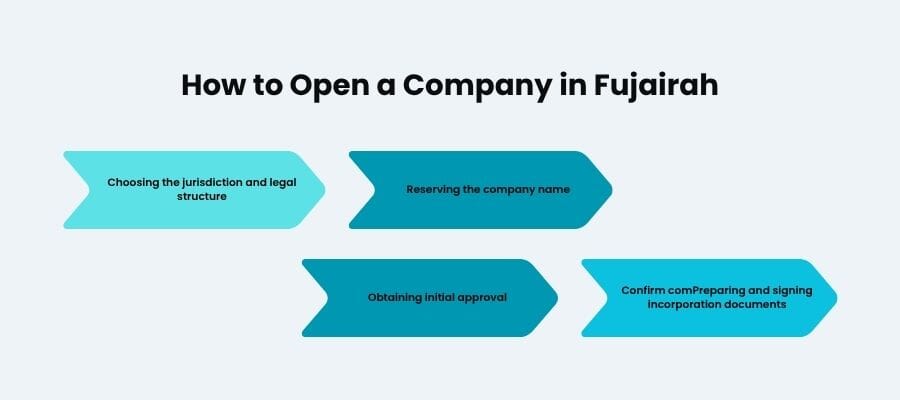
Step 1. Choosing the jurisdiction and legal structure. At the starting point, you decide where the company will live — either through the mainland economic department or inside one of the free zones. When the focus is on a free zone, it becomes important to review allowed activities, visa quotas, and expectations regarding office space. At the same time, a business plan or feasibility outline is prepared, forming the backbone of the project and supporting further steps in setting up a business in Fujairah.
Step 2. Reserving the company name. Next comes selecting and securing a unique name. It is checked and registered through the official registry of the mainland authority or the chosen free zone. The name must follow specific rules — certain words, especially those linked to religion or state references, cannot be used without prior approval.
Step 3. Obtaining initial approval. At this stage, the investor submits a request confirming that the planned activity is acceptable within the chosen jurisdiction. This step unlocks everything that follows. Only after receiving approval can you proceed with leasing premises, drafting documents, and finalizing the company structure.
Step 4. Preparing and signing incorporation documents. Here, the legal foundation takes shape. Founders sign the memorandum of association or, in some cases, an agreement with a service agent. This can be done in person or through digital identification tools. If a foreign company is opening a branch, additional documents are prepared, including corporate resolutions and powers of attorney. Sometimes an interview or remote identity check of the beneficial owner is required. Once everything is verified, preliminary approval is issued along with an invoice for government fees.
The final stage is the issuance of the incorporation certificate and the business license after all payments are completed. At this point, the company must be registered for tax purposes and receive its tax number. Certain sectors — such as healthcare, education, or construction — may require additional approvals from specialized authorities before operations can begin.
To register a company in Fujairah on the mainland, a more detailed package is submitted. It usually includes passports of investors, visa information, a lease agreement, incorporation documents, and a business plan. If corporate shareholders are involved, their documents must be properly legalized.
In contrast, registering a company in a Fujairah free zone follows a “single window” approach, where most procedures are handled through one administrative body. The focus shifts more toward the business model and its economic logic, while branch setups rely heavily on corporate authorizations and parent company records.
The timeline for launching a business in Fujairah depends on how well the documents are prepared. On the mainland, it can take up to a week, while some free zones move much faster — in certain cases, the process can be completed within just one day.

Want to learn more about UAE business setup services?
Business Licensing in Fujairah
Once you finish registering a company in Fujairah, the next essential step is obtaining a license. This document is not just a formality — it legally confirms your right to operate. Running a business without proper authorization is treated as a violation and can lead to restrictions, fines, or even suspension of activity.
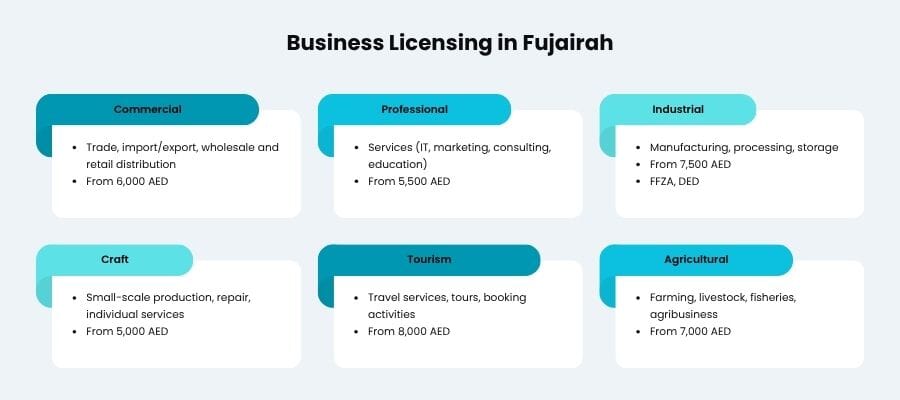
Before moving ahead, it’s worth carefully selecting the right license type, understanding its cost, and considering how rules differ across jurisdictions. For businesses focused on trading — whether within the UAE or across borders — obtaining a commercial license in Fujairah becomes the natural path. If the activity leans toward expertise and knowledge-based services such as consulting, legal support, marketing, or software development, then applying for a professional license in Fujairah is the logical choice.
When operations involve production — processing raw materials, packaging goods, or managing storage — the process shifts toward securing an industrial license in Fujairah. Alongside these core categories, the regulatory system also includes more specialized permits designed for niche activities. Below is a structured overview of the main license types available.
|
License Type |
Purpose |
Issuing Authority |
Approximate Cost |
|
Commercial |
Trade, import/export, wholesale and retail distribution |
FFZA, FCC, DED |
From 6,000 AED |
|
Professional |
Services (IT, marketing, consulting, education) |
FFZA, FCC |
From 5,500 AED |
|
Industrial |
Manufacturing, processing, storage |
FFZA, DED |
From 7,500 AED |
|
Craft |
Small-scale production, repair, individual services |
FCC, DED |
From 5,000 AED |
|
Tourism |
Travel services, tours, booking activities |
DED, FFZA |
From 8,000 AED |
|
Agricultural |
Farming, livestock, fisheries, agribusiness |
DED |
From 7,000 AED |
A business license in Fujairah is always issued within the jurisdiction where the company is registered. At the same time, the selected license must strictly match the declared activity. If there is a mismatch, authorities may reject the application or suspend the license later during inspections. That’s why it’s important to estimate regulatory requirements in advance. Some activities require leasing premises that meet specific criteria — both in size and purpose.
For example, when applying for a production license, authorities often request a technical report confirming that the facility meets safety and operational standards, along with approval from municipal bodies. In contrast, launching a service-based business in Fujairah tends to be faster, although it may still require proof of qualifications or professional background from the company’s director.
Free zones follow their own internal classification of activities. Licenses are typically grouped into three broad categories:
- commercial;
- service;
- industrial.
Once you move through obtaining a business license in Fujairah, the company gains the right to operate locally and to handle import and export through the emirate’s port infrastructure. For those registering in free zones, there are also bundled licensing packages. These usually combine the activity permit, workspace rental, and visa quotas — often ranging from one to six visas. This setup is especially convenient for startups and small businesses that do not need large-scale infrastructure.
The process of securing a license in Fujairah typically includes several steps:
- selecting the business activity from the approved list;
- matching it with the correct license type;
- submitting the application to the relevant authority;
- paying government fees;
- receiving approval (and, in some cases, additional clearances from specialized institutions).
Licenses are usually issued for one year and must be renewed afterward. Some free zones also offer flexible formats that allow combining multiple activities under a single permit — for example, blending IT services with consulting. This approach adds versatility and helps reduce administrative overhead.
Before fully setting up a business in Fujairah, it’s wise to carry out a preliminary legal review or consult with specialists. This helps align every step with current regulations and minimizes risks right at the starting point, when decisions have the biggest long-term impact.
Taxation in Fujairah
The tax framework in the emirate follows the broader legal system of the UAE, where rules are aligned at the federal level. For anyone planning setting up a company in Fujairah, the central element to understand is corporate tax. It works on a tiered basis. If annual profit stays within 375,000 dirhams, the rate remains at zero — a deliberate move to support smaller businesses and encourage early growth. Once this threshold is exceeded, the company becomes liable to pay corporate tax in Fujairah at a rate of 9% on the portion above that limit.
Every business, regardless of its activity level, must be registered with the Federal Tax Authority and assigned a tax number. Reporting is required on a regular basis, even if the company is not actively trading. This approach reflects a system built on full financial transparency and continuous oversight. Companies operating in free zones may qualify for a special status often referred to as a qualifying free zone entity. This allows them to retain tax advantages, provided they meet conditions related to real economic presence. However, income derived from interaction with mainland companies is still taxed at the standard 9% rate.
Value-added tax also plays a role when running a business in Fujairah. Registration becomes mandatory once annual turnover reaches 375,000 dirhams. There is also an option to register voluntarily at a lower threshold of 187,500 dirhams, which can be useful for optimizing tax flows. The standard VAT rate across the UAE remains fixed at 5%, applied to most goods and services.
Internal compliance requirements go beyond simple reporting. Companies must clearly identify their ultimate beneficial owners, maintain up-to-date registers of shareholders and directors, and follow rules linked to economic presence. Businesses dealing with significant financial transactions are expected to monitor operations carefully and follow anti-money laundering guidelines. Regular audits may also be required, particularly when renewing licenses or confirming that the company operates transparently.
Economic presence rules apply across a wide range of sectors, including finance, insurance, investment activity, and transport. In practice, this means maintaining a real office and having staff within the jurisdiction. Failure to meet these expectations can lead to penalties and loss of tax advantages, which directly affects long-term business stability.
Market Entry and Tax Strategy in Fujairah
Choosing opening a company in Fujairah offers a clear pathway into the UAE market with room for structuring operations efficiently. Businesses benefit from access to international trade routes, a manageable tax burden, and flexible organizational models. At the same time, the system demands careful attention to reporting, compliance, and transparency. Missteps during registration or later administration can result in fines, revoked privileges, or operational limits.
This is why many founders rely on experienced advisors. Professional support during registering a company in Fujairah helps reduce risks at every stage. Specialists assist in selecting the right jurisdiction and structure, shaping a tax-efficient model, and ensuring alignment with all regulatory expectations. With that support in place, business owners can focus on growth and daily operations instead of navigating complex legal details.

