


 Mohammed Khalil Al Qasim
  04.05.2026
Opening a company in Dubai attracts entrepreneurs who are looking for a jurisdiction with a well-built international infrastructure, flexible market entry formats, and a clear path to launching commercial activity. For a foreign investor, it’s not just about speed — though setting up a business in Dubai can indeed move quickly — but also about choosing the right model: mainland, free zone, or, for certain sectors, the DIFC regime. Each option comes with its own logic, shaped by the type of business, ownership structure, and licensing requirements. Registering a business in Dubai means looking beyond the license itself. It’s about shaping a legal framework, understanding the tax environment, setting up corporate governance, and navigating banking conditions — all of which define how smoothly the company will actually operate once it enters the market.
This article walks through the key decisions behind choosing the right registration regime, explores corporate structures available to foreign investors, and outlines what it really takes to build them. We’ll also dive into the regulatory framework, the step-by-step incorporation process, required documentation, licensing for regulated activities, taxation rules, and the compliance obligations that follow registration. In the final part, we connect the dots — showing how, in practice, company structure, tax status, and opening a corporate account come together to support real business operations, including working with international partners and handling cross-border payments beyond the UAE.
Strategic Advantages and the Decision to Open a Company in Dubai for Global Growth
Dubai doesn’t try to impress — it just works. Capital moves through it easily, businesses plug into global routes without friction, and the system feels built for people who think beyond one market. Many investors step in here not for the city itself, but for what it connects to — the Middle East, North Africa, and everything in between. The decision to launching a business in Dubai for global expansion often comes down to practical things: no currency barriers, smooth financial flows, and a place where moving your life — not just your company — feels manageable. Add a legal framework that doesn’t shift unpredictably, and the ground under your business starts to feel solid.
Inside the emirate, everything splits into two working formats: mainland and free zones. Mainland is straightforward — you operate across the country without restrictions and can take part in government contracts. That alone changes the scale of what’s possible. The commonly mentioned benefits of opening a company in Dubai — like access to long-term visas and a reliable banking system — are real, but they only matter if the structure behind them fits your goals. The jurisdiction you pick quietly defines how your logistics work and how much you spend just to stay operational.
Foreign ownership rules have loosened, and in most sectors, investors can now hold 100% of the company. There are still exceptions, but they sit within clearly defined strategic activities under Cabinet Resolution No. 55 of 2021. In practice, structuring a compliant company in Dubai for foreign ownership begins with something technical — selecting the right activity codes. It’s not the most exciting step, but skipping precision here usually leads to complications later, when changes become slower and more expensive.
What used to take weeks now moves faster. Through the Invest in Dubai platform, registering a company in Dubai has turned into a process that feels almost compressed — documents, fees, approvals, all handled through one system. Less back-and-forth, fewer delays. Once everything is submitted and accepted, the company appears in the register almost immediately. That moment — when the record goes live — is when the business officially exists in the system.
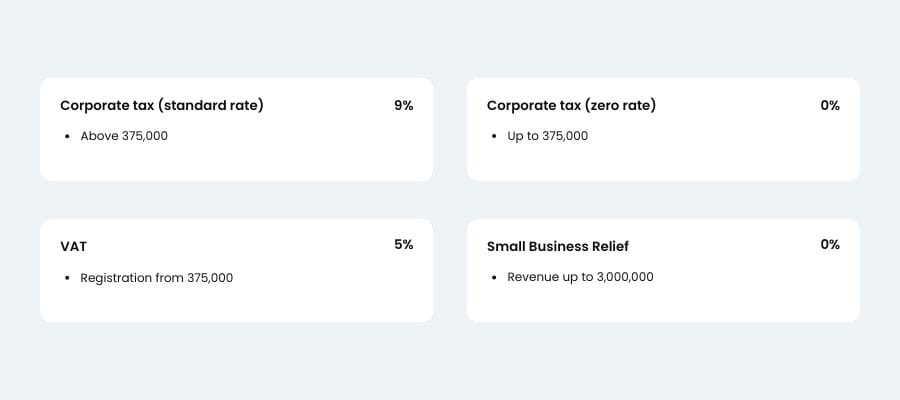
Taxes are still a big reason why people come here, but they need to be reasonable about what they expect. Up to 375,000 AED, there is no corporation tax. Whatever is more than that is taxed at 9%. Overall, it's not zero, and it's not supposed to be. If you register a standard company in Dubai, you may also have to pay 5% VAT once your sales hit a certain level.
Free zones sound simple on paper, but the details matter. Being registered there doesn’t automatically mean zero tax. The 0% rate is tied to a specific status — Qualifying Free Zone Person — and depends on how income is structured. Choosing to open a company in Dubai without mapping this out in advance often leads to unpleasant surprises. Tax benefits here are not given — they are maintained through the right structure.
Dubai fits businesses that don’t want to stay local. Trade, IT, consulting — all of them find space here. A company in Dubai for a non-resident often becomes part of a larger system — supply chains, holding structures, cross-border operations. Double taxation agreements add another layer of predictability. And for startups, the environment is active — funds, accelerators, partnerships — not waiting, but already in motion.
Regulatory Framework and Modern Business Registration in Dubai Under Federal Reforms
Everything about UAE company setup is governed by federal laws. Federal Decree-Law 32 of 2021 on Commercial Companies is the key one. It describes how firms are founded, run, and close. This structure is required for Dubai company registration under UAE corporate legislation. Ownership, company functions, and control distribution are defined.
Tax rules come from a separate source — Federal Decree-Law No. 47 of 2022. At the same time, financial monitoring is covered by AML legislation under Federal Decree-Law No. 20 of 2018. These rules are not optional — they shape how money moves through the system. The goal is simple: transparency and control. This forms the base for running a business in Dubai within regulatory requirements.
Ownership transparency is handled through a dedicated regulation. Cabinet Resolution No. 109 of 2023 requires businesses to record and update information about their actual owners. This data must stay accurate at all times. If not — fines or other consequences. Building a company in Dubai starts with making sure ownership is clearly documented.
The system itself is divided between authorities. Mainland companies go through DET, free zones operate under their own rules, and DIFC follows its own legal framework. This choice impacts both setup and daily operations.
Corporate structure, licensing, and sector rules all connect. A company does not operate based on registration alone — it needs the correct license for its activity. Re-registration is not common, unless the business changes jurisdiction or goes through major restructuring. In certain industries, like finance or manufacturing, extra approvals are required. This is part of obtaining regulatory clearance for business activity in Dubai.
Main steps confirming legal status:
- selecting an activity code from the official list;
- registering the company name;
- preparing and notarizing the Memorandum of Association;
- receiving initial approval;
- securing an office or workspace agreement.
Legal status is confirmed through registry records and official extracts. Companies with foreign ownership go through additional checks. These procedures are part of the system — they are not optional. Following them ensures the business operates without legal issues. Ignoring them leads to fines or restrictions.
Recent reforms made entry easier, especially for foreign investors. At the same time, control remains in place. The system is designed to keep businesses transparent while allowing them to operate internationally. For anyone building a company in Dubai under the current legal framework, this balance defines how the process works.
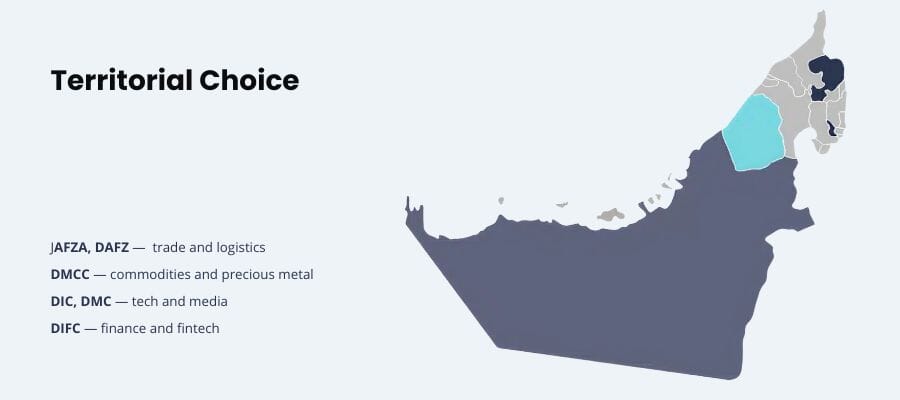
Territorial Choice or How to Register a Company in Dubai on the Mainland or in a Free Zone
Everything in Dubai begins with a straightforward but crucial division: free zone or mainland. Although it may sound technical, it actually determines how your company will operate. Every commercial establishment in Dubai is subject to regulation, with distinct authorities inside each free zone and the Department of Economy and Tourism for mainland businesses. Making this decision incorrectly at first doesn't necessarily hurt right away, but it eventually starts to manifest as limitations you weren't prepared for.
The open format is called Mainland. You can enter government tenders, sign contracts immediately, and work anywhere in the United Arab Emirates. When comparing Dubai's mainland and free zone registration, that's the biggest distinction that people notice. A mainland business is not restricted to a single region. Free zones are unusual; unless you bring in a local partner or distributor to reach the wider market, activity typically stays inside the zone.
The rules around ownership changed in recent years. Now, in most sectors, foreigners can set up a mainland company in Dubai with full control — no local shareholder required. There are still protected industries — security, defense, banking — where approval goes case by case. In those areas, structure is not something you choose freely; it’s something you negotiate.
Location is never random here. Each zone is built around a specific type of business:
- trade and logistics — JAFZA, DAFZ
- commodities and precious metals — DMCC
- tech and media — DIC, DMC
- finance and fintech — DIFC
DIFC works on its own terms. Separate courts, separate rules, even labor law follows a different logic. If the plan involves building a financial structure in Dubai through DIFC, there’s no real alternative. But getting in means going through detailed checks — the people behind the company matter as much as the company itself.
Free zones attract a lot of startups for one reason — simplicity at the start. No need for a full office, fewer formal steps, faster setup. Many founders go with flexi-desk options. Choosing to register a free zone company in Dubai with minimal physical presence works well early on, but it can slow things down later, especially when banks start asking questions.
Larger businesses use Dubai differently. Not just as a place to operate, but as a point where different parts of the business connect. A properly structured company in Dubai for international activity can handle export flows, contracts, and payments across several countries. In these cases, creating a free zone company in Dubai for global operations is often part of a broader setup, especially when tax agreements between countries come into play.
At some point, the decision becomes very practical — where exactly to register. If this step is rushed, it often leads to higher taxes or limited access to clients. Those planning to work through a free zone should look closely at license types and whether a dual license is available. A careful approach to choosing a business jurisdiction in Dubai allows you to stay in a free zone while still working with companies on the mainland.
Offshore companies are sometimes mentioned alongside these options, but they serve a different role. They are used for holding assets, not for running operations. Trying to use them for active business usually leads nowhere.
Permitted Structures When Registering a Business in Dubai
In Dubai, you don’t invent your company structure — you choose from what the law allows. The list is fixed. Each legal form comes with its own rules: how many people can be involved, how responsibility is shared, and how decisions are made. The backbone here is the Commercial Companies Law — it quietly defines how businesses are run and how profits are split.
Most companies start with a familiar option — the limited liability company. An LLC in Dubai usually includes between 2 and 50 partners, and each one is only responsible for the amount they invest. It’s a practical format. Trade, services, light production — it fits many types of activity without overcomplicating things.
For those who prefer working alone, there’s another route. A single-person LLC allows one founder — either an individual or a legal entity — to own the company fully. Choosing setting up a single-owner LLC in Dubai removes the need to bring in partners, while still keeping personal assets separate from business risks. That separation matters more than it seems at first.
Each structure has its own internal logic — who participates, who carries responsibility, and how control is distributed.
Comparative parameters of corporate structures:
|
Type of structure |
Number of participants |
Liability |
Specifics |
|
LLC |
2–50 |
Limited |
Standard format for trading activities |
|
Single-person LLC |
1 |
Limited |
Full control by one owner |
|
Civil Company |
From 2 |
Unlimited |
Used for professional services |
|
Branch |
None (parent company) |
Borne by parent company |
No separate legal identity |
|
PJSC |
From 5 |
Limited |
Required for banking and insurance |
Major multinational corporations frequently do not create novel products; rather, they enhance existing offerings. Establishing a branch of a foreign corporation in Dubai maintains a direct connection to the headquarters. A branch is not autonomous. It lacks independent legal status and adheres to the directives of the parent firm. The name remains unchanged – there is no rebranding at this level.
Joint stock companies—both public (PJSC) and private (PrJSC)—emerge when achieving size becomes the objective. These formats are not suitable for entry-level positions. They are utilized for extensive projects, capital acquisition, and regulated industries. In certain financial sectors, the registration of a Public Joint Stock Company (PJSC) in Dubai for regulated activities is mandated by law. This entails more stringent reporting and increased scrutiny from regulators.
Professional services move differently. Lawyers, doctors, engineers — they often choose the civil company model. This format allows them to operate under their profession without forming a typical commercial structure. In certain cases, a local service agent is required. This person doesn’t own part of the business and doesn’t share profits, but represents the company when dealing with government bodies.
Some situations need more capital than others, but not always. The location of the company's registration is significant. Others, like DAFZ, let you start with a small amount, even 1 dirham. Others decided on higher limits, like 50,000 or 300,000 dirhams. Getting a company registered in Dubai quickly means agreeing on the capital with the registrar ahead of time and writing it down clearly in the incorporation papers.
The structure you choose at the beginning doesn’t just define your company on paper. It shapes how easily you can grow, how risks are handled, and how flexible the business remains over time.

Want to learn more about UAE business setup services?
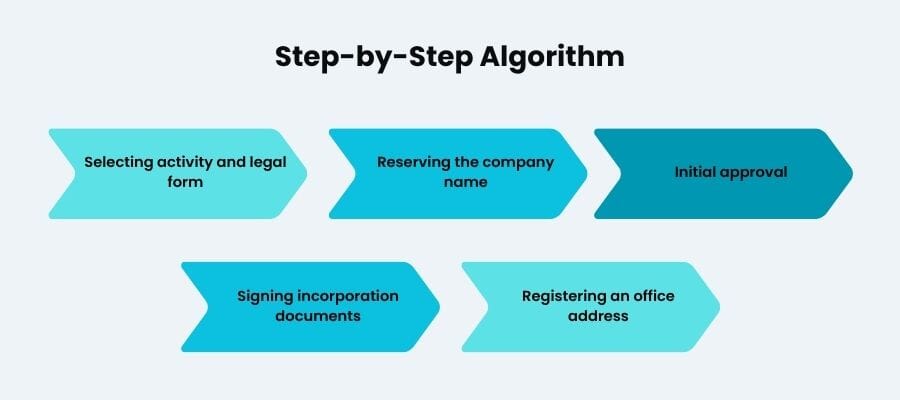
Step-by-Step Algorithm for Incorporating a Business in Dubai for Foreign Investors
Setting up a company in Dubai follows a fixed order. You don’t skip steps, and you don’t rearrange them. At the same time, most of the process now runs online, so instead of dealing with multiple offices, the interaction goes through digital systems. It saves time, but only if everything is prepared correctly.
Step 1. Selecting activity and legal form.The starting point is choosing what the business will actually do. Each activity must match an official code. This is not just a formality — the entire registration depends on it. If the description is too vague or incorrect, the application can be delayed or even rejected. This stage defines the direction of choosing business activity for company registration in Dubai.
Step 2. Reserving the company name.The name is checked against local rules. Certain words are not allowed, and similarity to existing brands can lead to refusal. Once approved, the name is temporarily reserved for the applicant. This allows reserving a trade name for company registration in Dubai without the risk of duplication.
Step 3. Initial approval.Before moving further, the authorities review the applicant. This includes basic background checks and confirmation that the activity itself is acceptable. For mainland companies, the process goes through the Invest in Dubai system, where different departments are connected. At this point, getting initial approval for business setup in Dubai becomes a required step.
Documents need to be prepared carefully, especially when a foreign company is involved.
Required documents may include:
- copies of passports of shareholders and directors;
- UAE entry stamp or valid visa;
- board resolution confirming the decision to open a subsidiary, legalized where required;
- corporate documents translated into Arabic for registration purposes.
Step 4. Signing incorporation documents.The Memorandum of Association is the main document. It sets out ownership shares, management roles, and how profits are distributed. It must be signed and certified, either online or in person. This part completes preparing incorporation documents for a company in Dubai.
Step 5. Registering an office address.A mainland company must have a registered lease — Ejari. Without it, the process will not move forward. Free zones allow simpler formats, including shared workspaces. Even a basic setup is enough to confirm presence. This is part of securing a legal address for company registration in Dubai.
At the end, the company receives its incorporation certificate and trade license. From that moment, it is officially registered and can operate. The data is added to the economic register, and the business can proceed with banking and visas.
In most cases, the process takes between 5 and 15 working days. Timing can change if additional approvals are required. To register a company in Dubai without delays, it is better to prepare all legalized documents in advance. Many investors also prefer to start at the beginning of the financial year to simplify reporting later.
Licensing and Regulated Activities Under UAE Authorities
In Dubai, a company does not operate freely by default — everything starts with a license. It is tied to specific activity codes, and those codes define what the business is allowed to do. Nothing extra, nothing outside that list. Authorities use this system to compare declared activity with what the company actually does. If there is a mismatch, it usually shows up fast — through compliance checks or even banking restrictions.
Licenses are divided into categories, and each one brings its own conditions. Some require proof of qualifications, others — insurance or additional approvals. Choosing the wrong type at the beginning can create problems later: frozen accounts, questions from regulators, delays in reporting. To avoid this, the activity must be checked carefully against the official register. This step is part of selecting the correct business license in Dubai based on operations.
Different licenses cover different types of work. The classification is simple — it depends on what the company produces or what service it provides.
Classification of licenses by type of activity:
|
Name |
Scope |
Conditions |
|
Commercial |
Trade (wholesale and retail) |
Office or storage space |
|
Professional |
Services, consulting |
Proof of qualification |
|
Industrial |
Production, processing |
Approval from MoIAT |
|
Crafts |
Manual work, repair services |
Workshop required |
|
Tourism |
Travel and hospitality |
Financial guarantees |
|
Agricultural |
Farming, processing |
Sector compliance |
The commercial license is used most often. It covers buying and selling goods, both inside the country and abroad. Businesses focused on supply, resale, or export usually start here. In practice, obtaining a commercial license in Dubai for trade operations is the most common route.
Service-based work follows a different path. Consulting, IT, legal, accounting — all fall under the professional license. In some cases, the person managing the company must confirm their education or experience. For smaller technical services or manual work, a crafts license is used.
Some areas are handled separately and require closer supervision. Tourism companies need a dedicated license, especially if they organize trips or manage accommodation. Agricultural projects also follow their own rules. Financial activity is stricter — it involves direct interaction with the Central Bank or the securities regulator. In such cases, getting approval for financial activity in Dubai is not a quick step and usually takes longer.
VARA is in charge of making sure that businesses that deal with crypto follow the rules. The steps in this procedure are tiered. Getting permission to start the business comes first. After that, the business model is looked at in depth. A VASP license is only given out after that. This is part of the process of getting a virtual asset license in Dubai from VARA.
The Ministry of Industry and Advanced Technology is in charge of industry. You need permission to make, store, and handle things. You have to renew every Dubai license. Fees are due every year. It's not just a formality to renew a Dubai business license on time; it's also important for keeping things running smoothly.
Taxation and Mandatory Compliance After Opening a Company in Dubai
The UAE tax system isn’t what it used to be — it’s now fully aligned with global transparency rules. The main piece here is corporate tax in Dubai. It kicks in at 9%, but only once profits go past 375,000 AED. Stay under that line, and the rate is zero. Still, once you go through registering a company in Dubai and entering the tax system, you’re expected to sign up with the Federal Tax Authority — even if the business hasn’t started making real money yet.
There’s also a softer entry for smaller players. The government rolled out something called Small Business Relief. If your revenue stays within 3,000,000 AED, you can keep a 0% tax rate for now — this applies to tax periods up to the end of 2026. For new companies, that breathing space matters. It lets you keep cash inside the business instead of sending it out too early. Many founders rely on this when using small business relief in Dubai to grow faster.
Key parameters of the tax system:
|
Indicator |
Rate / Condition |
Limit (AED) |
|
Corporate tax (standard rate) |
9% |
Above 375,000 |
|
Corporate tax (zero rate) |
0% |
Up to 375,000 |
|
VAT |
5% |
Registration from 375,000 |
|
Small Business Relief |
0% |
Revenue up to 3,000,000 |
Free zone businesses can apply for a specific designation known as Qualifying Free Zone Person (QFZP). If everything is managed correctly, a portion of the income can be tax-free. However, this does not occur automatically. Only certain types of income qualify, and the qualifications are listed separately. Simply being in a free zone does not mean "no tax." To keep this benefit, the organization must engage in real-world activities and undergo annual audits. That is the reality of maintaining free zone tax status in Dubai while keeping privileges.
And then there's VAT. It's a different layer. You must register whenever your company's revenue reaches 375,000 AED per year. You can also register early for as low as 187,500 AED. If you do not pay VAT, you will be unable to work with local suppliers or get an input tax return. As a result, VAT registration and reporting in Dubai have swiftly become common corporate practices.
On the compliance front, there are stringent disclosure requirements. Companies must disclose who owns them - the ultimate beneficial owners. This information is entered into the registry within 60 days of establishment. If anything changes, an update must be sent within 15 days. If you miss certain deadlines, you will face consequences, including possible license suspension. Getting this correctly is part of establishing adequate compliance for a firm in Dubai from the start.
AML rules mean that some areas need to be more closely watched. The goAML system requires companies that deal with precious metals, real estate agencies, and law firms to sign up. It's about keeping track of money and lowering risk. Taxes and following the rules are all tied to accounting in the end—if the numbers aren't right, everything else starts to fall apart.

Opening Bank Accounts for Corporate Clients in Dubai
A license alone won’t get you a bank account. Banks in Dubai don’t move fast just because the company is registered. They check everything — what the business does, where the money comes from, who is behind it. If you’re trying to open a company bank account in Dubai, expect questions about real operations, not just documents. A physical office and a clear ownership structure usually come up first.
Risk level matters. Banks group clients based on activity. Trading companies, fintech projects, crypto — these get more attention than others. The more layers in the structure, the longer the review. To move things forward, you need to explain how the business works in simple terms — partners, payments, routes. This is part of handling bank compliance in Dubai for a corporate client.
Before applying, a full set of documents is prepared.
What banks usually ask for:
- trade license and incorporation certificate;
- Memorandum of Association with ownership details;
- bank statements for the last six months;
- documents showing the director’s background;
- proof of address for the owners (utility bills, for example).
Banks also expect a minimum balance. The exact number depends on the bank, but it often starts around 50,000 AED and can go much higher. If the director has a UAE residence visa, the process becomes easier. In some cases, getting a business bank account in Dubai approved only happens after the company shows real activity connected to the UAE.
If the company belongs to a foreign group, additional documents may be required from the home country. These usually need legalization. The review itself can take time — sometimes a few weeks, sometimes longer. Knowing how to answer questions about expected turnover and clients helps when preparing for opening a corporate account in Dubai.
When a business opens an account, banks often ask for supporting documents like bills and shipping papers. The activity is watched. Restrictions may be put in place if transactions don't fit the stated business plan. Sudden blocks are less likely to happen if you keep the bank up to date. This is part of having a business account in Dubai open and legal.
Dubai Company Setup and Growth Strategy
Opening a company in Dubai works best when everything is aligned from the start — structure, taxes, banking. The choice between mainland and free zone is not just formal. It affects how the business operates later. The same applies to compliance — banks and regulators expect clarity. When these points are handled properly, using a Dubai company for international business expansion becomes a practical step, not just an idea.

