


 Manish Kulkarni
  08.07.2025
Opening a company in Ajman is a path many entrepreneurs choose when they need a real foothold in the UAE, along with access to flexible corporate structures, solid trade infrastructure, and a licensing process that doesn’t feel like a maze. This emirate pulls in foreign investors by offering a smart mix: mainland registration through Ajman Department of Economic Development and the option of a free zone environment, where you can build a setup for trading, services, e-commerce, manufacturing, or cross-border operations. For an investor, choosing Ajman is never just about registering a legal entity — it’s also about handling taxes, setting up banking, and smoothly navigating compliance from day one. One key step here often revolves around launching a company in Ajman Free Zone, especially for those planning international activity.
This publication walks you through the conditions for establishing a legal entity both on the mainland and inside autonomous zones. Business registration in Ajman Free Zone is explored with a closer look at real presence requirements, applicable tax rates, and the practical side of dealing with banks. The final section brings everything together — from government fees and the full list of registration documents to the rules you’ll follow when renewing your license each year.
Company Registration in Ajman: Mainland or Ajman Free Zone
Setting up a legal entity in Ajman always begins with a clear choice — mainland or a preferential zone. These two paths may look similar at first glance, but in reality, they operate under separate authorities and lead to very different legal outcomes. The mainland format follows the rules of Ajman Department of Economic Development, while the free zone environment is managed by the administration of Ajman Free Zone.
The Economic Development Department handles licensing for companies operating on the mainland. Its role goes far beyond paperwork — from reserving a company name to reviewing business activities and issuing approvals. It also oversees license issuance, calculates fees, and supports investors along the way. Choosing this route to establishing a business presence in Ajman makes sense when your focus is direct cooperation with local partners. It also allows renting office space outside special zones, giving full access to the domestic UAE market.
Mainland incorporation comes with a layered process. You deal not only with the department itself but also with external authorities. Certain business types require additional approvals. Foreign applicants, for example, go through clearance with Federal Authority for Identity and Citizenship, while high-risk activities may trigger reviews from sector-specific regulators. Even a lease agreement must be stamped by the municipality and planning department. This structure stands in contrast to the more flexible setup inside the free zone, where companies can operate from shared offices or internal facilities.
Comparative features of registration formats in Ajman:
|
Criterion |
Mainland (Ajman DED) |
Dedicated Zone (AFZ) |
|
Business activity in the UAE |
Full and direct access |
Through a distributor or branch |
|
Import customs duties |
Standard rate of 5% |
Zero rate (within the zone) |
|
Office requirements |
Physical lease agreement required |
Flexible or shared workspace allowed |
|
Supervisory authority |
DED Department |
AFZ Administration |
Registering a company in Ajman Free Zone follows its own internal framework. This cluster offers independent legal forms such as FZE, FZC, and branches of local or foreign entities. For the applicant, this means a separate process — from submitting documents to obtaining a license, completing registration, and handling visas. One of the key steps here often involves building operations in Ajman Free Zone, especially for businesses targeting international markets.
Entrepreneurs tend to choose the free zone when their model revolves around foreign trade, online sales, consulting services, warehousing, or production within the zone’s infrastructure. The AFZ administration provides a wide range of options: offices, business centers, storage facilities, eco-units, industrial spaces, digital platforms, and even flexible setups for freelancers and innovators. This format works especially well for companies that don’t need an immediate physical presence on the mainland.
At the same time, registering in Ajman Free Zone does not automatically grant unrestricted access to the entire UAE market. If a company plans to sell goods or provide services beyond the zone, each operation must be carefully reviewed. Authorities examine logistics chains, counterparties, and where exactly the service is delivered. In many cases, obtaining dual approval or a special permit becomes necessary — and this only happens after clearance from the DED. Even then, the original license remains subject to compliance checks and ongoing verification.
Legal Framework for Business Incorporation: UAE Federal Decrees and Regional Regulations
Building a company in Ajman means stepping into a legal system that is layered and carefully structured. It combines nationwide legislation, local rulings issued at the emirate level, and separate rulebooks created inside free zones. At the heart of this framework lies UAE Federal Decree-Law No. 32 of 2021 on Commercial Companies — a document that quietly shapes how companies come to life, how ownership is divided, and how foreign businesses extend their presence through branches.
Alongside that, there is a separate set of rules that governs how businesses are officially recorded. The process of fixing a company name, entering data into registers, and securing recognition is guided by UAE Federal Decree-Law No. 37 on Commercial Register. It may sound procedural, but this stage defines how a company is seen and tracked within the system.
Once the decision around setting up a company in Ajman is made, financial obligations naturally follow. Corporate income is handled under UAE Federal Decree-Law No. 47 on Corporate Tax, while consumption-based taxation is shaped by UAE Federal Decree-Law No. 8 on VAT. These rules influence how profits are structured and how transactions are reported over time, becoming part of the daily rhythm of running a business.
Oversight of financial activity is not left to chance. The system includes several core documents designed to prevent misuse of funds and to keep operations transparent:
- UAE Federal Decree-Law No. 10 of 2025 on Anti-Money Laundering focusing on preventing illicit financial flows
- UAE Cabinet Resolution No. 134 of 2025 on Financial Control Measures setting out monitoring mechanisms
- Internal compliance rules issued by the Ajman economic authority for verifying clients
- Supervisory instructions released by Central Bank of the UAE for corporate conduct
Anyone moving toward registering a business in Ajman quickly realizes that ownership transparency is essential. Companies are required to maintain clear records of the individuals who ultimately hold control — the so-called ultimate owners behind the structure. These details must remain accurate and accessible at all times.
There is also a practical side to presence. Certain sectors — banking, insurance, investment-related services — are expected to show real activity within the country. That means having people on the ground, an actual workspace, and operations that go beyond paperwork. Failing to demonstrate this, or skipping required reports, can lead to penalties that disrupt the flow of business.
For foreign founders, entering this system includes an additional checkpoint. Before establishing a company in Ajman as a non-resident, authorities review the investor’s background and the origin of funds. This screening follows international transparency standards and acts as a safeguard. It’s part of what keeps the emirate stable — a place where capital moves through a system that values clarity, control, and predictability.
Company Registration in Ajman: Available Legal Forms and Capital Considerations
Starting a business in Ajman always comes down to one early decision — where exactly the company will live: on the mainland or inside Ajman Free Zone. This choice quietly shapes the entire future of the project: how the company is seen legally, how it is managed, what activities are allowed, whether an office is required, how risks are distributed, and even how banks react to the application. A wrong turn here doesn’t stay unnoticed — it can later force changes to the license or even push a full restructuring. That’s why selecting a company format in Ajman is never just paperwork — it’s strategy.
If we look at the mainland route, supervised by Ajman Department of Economic Development, the range of possible setups is quite broad. There are structures built for individual ownership, professional activity, partnerships, and larger corporate models. In real life, though, foreign founders usually narrow it down to a few practical options: a limited liability structure, a professional setup for service-based work, or a branch of an already existing company.
The limited liability model is often chosen for businesses dealing with trade, support operations, or production. It gives the company its own identity while keeping obligations within defined boundaries. Changes in UAE legislation have opened the door to full ownership in many sectors, allowing investors to control the business entirely. Still, some areas remain restricted, and the exact activity must be confirmed with the regulator before moving forward.
Other formats serve different purposes. A sole-owned structure works best when the business revolves around personal expertise — consulting, advisory, or niche services where the founder’s role is central. A branch, on the other hand, is not a new company in the full sense. It acts as an extension of an existing entity. Because of that, attention shifts to the head office: its documents, internal approvals, and the authority granted to the local manager all come under review.
Things are different inside the free zone. Most businesses are either single-owner or multi-participant, and they may also have branches of foreign or local companies. The rules are different for each zone and package, and they depend on the zone's own rules. For many business owners, building a business in Ajman Free Zone is more flexible, especially when they want to do business outside of the UAE.
The chosen structure also influences how financial institutions see the company. Banks don’t just glance at documents — they follow the ownership chain, identify who actually controls the business, and look into where the capital comes from. They study the background of investors and try to understand how money will flow through the company. When it comes to branches, the parent company becomes the main subject of analysis, including its legal standing and business history. A formal decision confirming the opening of a UAE office is always part of the file.
There is no universal capital requirement that fits every case. The expected level depends on the type of structure, the nature of the activity, and the internal rules applied by the authority in charge. In practice, registering a company in Ajman begins with a detailed evaluation — who the founders are, how the business is structured, what documents are in place, and whether there is a physical location involved. Only after that comes the financial planning, where taxation, operational costs, and banking expectations are mapped out.
Choosing the right setup also means thinking one step ahead — how the company will actually operate. Will it trade locally, sell online, provide services, or rely on storage and production facilities? Each of these directions leads to a different structural choice. And if the business is placed inside a special zone, it must align with that zone’s internal standards to function without friction.
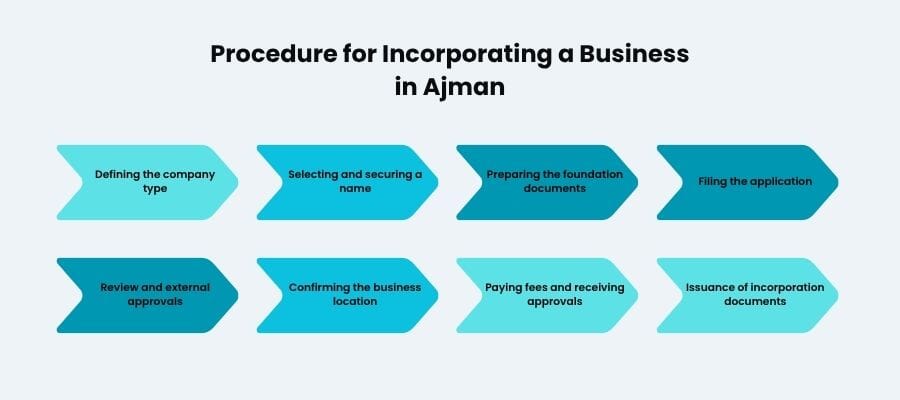
Procedure for Incorporating a Business in Ajman: Steps and Required Documents
The journey of setting up a business in Ajman doesn’t begin with paperwork — it starts with a choice of location. An investor first decides whether the company will operate within the mainland framework or inside Ajman Free Zone. From there, the path unfolds differently. On the mainland, the process ties together licensing, name approval, lease agreements, and activity confirmation. In the free zone, the flow feels more streamlined — many steps can be handled remotely through packaged solutions and internal procedures. This is where starting a company in Ajman from scratch becomes a structured journey rather than a guesswork process.
Step 1. Defining the company type. Before anything else, the investor chooses the form of the future business. It could be a liability-based company, a personal enterprise, a service-focused entity, or even a branch linked to an existing organization. This decision shapes ownership rules, document requirements, operational limits, and even how the company will be perceived by banks later on.
Step 2. Selecting and securing a name. You don't just pick a business name; you test it. Authorities look for duplication words, words that are not allowed, and words that could be misleading. This process goes through the Ajman Department of Economic Development on the mainland, while in the free zone, it follows AFZ's own rules. The name must also go organically with the activity that was picked and show what the business does.
Documents required for company registration in Ajman:
|
Founder Type |
Documents |
|
Foreign investor |
Passport copy (minimum 6 months validity), color photo, visa or UID copy |
|
UAE resident |
Emirates ID, visa copy, and, if needed, a no-objection letter from sponsor |
|
Mainland entity |
Application form, shareholder data, trade name, activity details, incorporation document, attested lease |
Step 3. Preparing the foundation documents. Once the form is selected, the legal paperwork is drafted. For most corporate structures, this includes an agreement outlining ownership shares and internal management rules. If the project is a branch, an official decision from the parent company is required, along with proof of its existence and authority. To build a company structure in Ajman, every document must align precisely with the chosen format.
Step 4. Filing the application. Routes for submitting the company registration in Ajman depend on the jurisdiction. Mainland applications go through the Ajman authority, where details such as activity and ownership are reviewed. In the free zone, the sequence revolves around choosing a package, submitting documents, and waiting for approval before receiving the registration bundle.
Step 5. Review and external approvals. Foreign applicants face an additional layer of verification through Federal Authority for Identity and Citizenship. Certain fields — like finance, healthcare, education, or production — may require extra permissions from specialized bodies. In these cases, the business must confirm that its activity is allowed within the regulatory environment.
Step 6. Confirming the business location. A company cannot exist without an address. On the mainland, lease agreements must be verified by the relevant municipal authority. In the free zone, there are flexible options — offices, desks, storage areas, or industrial units. Without a confirmed location, company registration in Ajman cannot be finalized, and tax records cannot be properly created.
Step 7. Paying fees and receiving approvals. Costs vary, but there are standard reference points for mainland setups. Fees typically include charges for issuing or renewing the license, administrative processing, signage permissions, registry entries, and official publications. Contributions to national funds and certification costs are also part of the total. The final figure depends on the activity, company type, and any additional approvals required.
Step 8. Issuance of incorporation documents. At the final stage, the company receives its official documents — license, registration certificate, and supporting papers. Mainland businesses are issued an economic license along with related permits. In the free zone, the package includes a business license, confirmation letters for banking, and registration records. After that, the focus shifts to visas, tax setup, and preparing for banking procedures.
The timeline can stretch when the business operates in regulated sectors such as manufacturing, finance, healthcare, education, food production, or consulting. In these areas, authorities often request further approvals and a more detailed project review.
For foreign founders, registering a company in Ajman as a non-resident also involves identity checks. Authorities examine legal stay, the origin of funds, and the individuals who ultimately control the company. While living in the emirate is not required to register, ongoing activity will still involve tax registration, banking verification, disclosure of ownership, and compliance with financial monitoring rules.

Want to learn more about UAE business setup services?
Licensing Policy: How to Classify a Business in Ajman
In Ajman, the license is more than a formal stamp — it defines the real scope of what a company is allowed to do. It answers a simple but critical question: what exactly does the business handle day to day? Trade, services, production, digital sales, craft work, tourism, or agriculture — each direction must be clearly reflected. If the declared activity drifts away from reality, complications appear: banks slow things down, tax reviews become stricter, contracts raise concerns, and even routine operations like imports or marketing may run into barriers. That’s why choosing the right business activity in Ajman is a step that shapes everything that follows.
On the island, the Ajman Department of Economic Development is in charge of giving out permits. The document they give us becomes the official base for how things work. Before it is approved, the action is checked against a system inside the company that matches it with categories that have already been set up. Regulators want a clear explanation of how the business will actually work, not just a vague idea.
Main license categories in Ajman:
|
Type of license |
Application area |
|
Commercial license |
Buying, selling, importing, exporting, and distributing goods |
|
Professional license |
Consulting, IT services, legal work, accounting, design, and similar fields |
|
Industrial license |
Manufacturing, processing, packaging, storage, and logistics operations |
|
Crafts license |
Manual production, repairs, and small-scale manufacturing |
|
Tourism license |
Travel services, tourism-related activities |
|
Agricultural license |
Farming, livestock, fisheries, and related processing |
A commercial license in Ajman is used when the business revolves around goods. It covers everything from procurement to resale, including international movement of products. If the scope expands, general trading may also be included, but only when the product range is clearly defined. Authorities review supply routes, product types, and destination markets. Financial institutions also look closely at how goods move — a clear logistics chain becomes part of the approval picture.
A professional license in Ajman fits businesses built on expertise rather than physical products. This includes areas like advisory services, digital solutions, creative work, and management support. In certain cases, proof of education, qualifications, or experience may be required before the activity is approved.
Production-related businesses fall under industrial licensing. This path is chosen when the company is involved in making goods, handling raw materials, packaging, or storing products before distribution. Such activity often requires a physical setup — a workshop, warehouse, or industrial site. If the work touches sensitive sectors like food processing or healthcare, additional approvals may come into play.
Within Ajman Free Zone, the licensing structure follows its own logic. Businesses can select from different formats — trading, services, manufacturing, online commerce, freelance setups, offshore options, and specialized packages. When the project matches one of the predefined categories, getting a license in Ajman Free Zone tends to move faster. Still, workspace or storage requirements may apply depending on the chosen activity.
Among these options, there is also a package designed for new ventures — often referred to as a starter solution for early-stage projects. It is not automatically available to everyone, as eligibility depends on current policies set by the zone’s administration.
In the end, the most important rule remains simple: the business license in Ajman must mirror the real business. If a company claims to operate online but actually handles physical imports and distribution, regulators and banks will focus on what truly happens behind the scenes. Accuracy here keeps operations smooth and avoids unnecessary questions later on.
Tax Planning for Legal Entities in Ajman
Ajman is often seen as a place without taxes, but that picture is too simple. The financial rules come from the wider UAE system, and once a company is formed, it steps into a structured tax environment. From the very beginning, the chosen legal setup affects how income is reported and how obligations are calculated. This is why structuring taxes for a company in Ajman is something to think through before the first invoice is even issued.
The level of taxation depends on profit. When earnings remain within a lower range, no corporate tax is charged. Once the threshold of 375,000 AED is crossed, a rate of 9% applies to the excess. Companies are expected to register with the tax authority, keep proper financial records, and prepare reports. There is no rush right after the year ends — businesses are given up to nine months to file their declarations.
The place of incorporation changes the picture slightly. Companies based on the mainland follow the standard route without special relief. Those registered in Ajman Free Zone may access more favorable conditions, but they still operate within the same legal framework and must obtain a tax number.
Key tax and compliance benchmarks:
|
Area |
Indicator |
Meaning for the business |
|
Corporate tax |
0% |
Applies to income below 375,000 AED |
|
Corporate tax |
9% |
Applied to profit exceeding 375,000 AED |
|
Reporting period |
9 months |
Time allowed for filing after year end |
|
VAT rate |
5% |
Standard consumption tax |
|
VAT registration |
Above 375,000 AED |
Mandatory threshold |
|
Voluntary VAT |
From 187,500 AED |
Optional early entry |
|
ESR notice |
6 months |
Deadline to inform authorities |
|
ESR report |
12 months |
Full reporting timeframe |
Inside the free zone, tax treatment depends on how income is generated. Some companies may qualify for a zero rate, but only if they meet strict conditions. They must prove that the business is genuinely operating — with a real workspace and ongoing activity. If part of the income falls outside these criteria, it is taxed under regular rules.
Transactions with companies inside the UAE require careful attention. If the activity is treated as local rather than international, the benefits of the free zone may no longer apply. Before planning tax flows for a business in Ajman, it makes sense to map out partners, delivery routes, and how revenue will be generated.
There is a different system for value added tax. The usual rate is 5%, and you have to register when your sales reach 375,000 AED. Businesses with less than 187,500 AED in annual sales can file on their own. This choice is made separate from issues related to business tax.
VAT rules extend to both mainland companies and those in free zones. Being located in a special zone does not remove the need to assess VAT exposure. For trading operations, authorities look at the full picture — where goods come from, where they go, how they are stored, and who the buyer is. Supporting documents must clearly confirm the applied tax treatment.
Beyond taxes, there is another layer that cannot be ignored. Companies are required to keep accurate records of the individuals who ultimately control the business. These details must be maintained and shared with authorities when required. In practice, keeping ownership information transparent in Ajman is just as important as calculating taxes correctly.
Bank Compliance: Opening Corporate Accounts in Ajman
Getting a company registered is one thing — gaining access to banking tools is a completely different challenge. Many entrepreneurs notice this gap right away: paperwork for incorporation moves faster than approval from financial institutions. Banks take a cautious approach. They look beyond documents and focus on the people behind the business, their background, and how the funds were formed. For a foreign founder, securing a business bank account in Ajman often depends on proving industry experience and showing real commercial connections in the region.
The review process is built around identity checks and credibility assessment. Financial institutions examine where partners are based, how payments will flow, and which countries will be involved. When the company’s key decision-maker holds residency in the UAE, the procedure tends to move more smoothly. Another strong signal is the presence of signed contracts — they demonstrate that the business is already active rather than theoretical.
A critical requirement is actual presence. Banks want to know if the company is handled from within the country. If the business operates within the Ajman Free Zone, this expectation remains, as does the requirement to update ownership information on a regular basis and present audited financial accounts. Without these components, keeping a working account becomes difficult.
Documents usually requested by Ajman banks:
|
Category |
Required documents |
|
Incorporation records |
License, founding agreement, certificate confirming establishment |
|
Tax-related data |
VAT registration proof, tax identification number |
|
Personal documents |
Passports of owners, Emirates ID, residency visas |
|
Address confirmation |
Lease agreement or utility invoices |
|
Financial history |
Bank statements for the past six months |
Ajman Business Setup: Key Insights
Starting a business in Ajman is only the beginning. The management of the structure, the handling of taxes, and the observance of financial regulations are what really count. The emirate provides good chances for international work and cost control, but only if the company runs with discipline and clarity. In this way, consistency is more important than speed while building a stable business in Ajman.

