


 Calen Voss
  04.05.2026
 Opening a company in Abu Dhabi feels like a practical, almost strategic move when you’re thinking about scaling an international trading or investment presence. Some of the biggest sovereign wealth funds in the world are quietly based in the capital of the Emirates. The country also has a stable legal system that protects assets with rules based on English common law. The regulatory environment here is clear, not foggy or shifting, and the absence of personal income tax creates a sense of control when planning capital for the long run. For many, this becomes not just a step, but a deliberate move toward building an international business structure in Abu Dhabi.
Registering a business in Abu Dhabi, however, isn’t something you approach blindly. It calls for a precise understanding of the latest amendments to the federal law on commercial companies, along with the newer tax obligations that have started shaping the landscape. This section walks through the setup process using government tools, highlights how to choose where to register, and explains the logic behind beneficial ownership requirements. The goal is simple — to make company registration in Abu Dhabi feel manageable, not mechanical.
How the Legal Framework for Commercial Activity in Abu Dhabi Is Built
The backbone of corporate regulation in the emirate rests on federal legislation, carefully reinforced by local rules issued by the Department of Economic Development. The current model for doing business in Abu Dhabi grows out of the commercial companies law, which sets the ground rules for setting up and managing legal entities. Company data enters the system under the commercial register law — a structure designed to keep business information open and accessible. Everything ultimately flows into one unified state database, forming a clear picture of the market. For anyone serious about understanding business regulation in Abu Dhabi, this foundation is where it all begins.
Legally, there is a clear separation between central Abu Dhabi and free economic zones. The TAMM digital tool is used for setting up on the mainland (Mainland), and ADDED is in charge of it. In this form, a business works completely within the civil and commercial law system of the UAE. It's the best way to go for people who want to work freely in the local market or on government projects without any artificial limits.
In addition, independent jurisdictions with unique legal identities are permitted by Abu Dhabi's commercial legislation. ADGM, the global financial hub where English common law is dominant, is a prime example. When it comes to company creation and dispute resolution, its own registrar, the ADGM Registration Authority, adheres to a unique set of regulations. Selecting the appropriate jurisdiction for business creation in Abu Dhabi is much more than a technical choice because it feels natural to Western investors and big financial organizations, almost like entering a familiar legal rhythm.
Comparison of company formation routes in Abu Dhabi:
|
Evaluation Criteria |
Mainland |
Free Zone (ADGM) |
|
Regulator |
ADDED / TAMM Platform |
ADGM Registration Authority |
|
Legal System |
UAE Civil Law |
English Common Law |
|
Type of Activity |
Any, including government contracts |
Finance, holdings, technology |
|
Place of Business |
Entire UAE territory |
Within the zone and internationally |
Setting up a business in Abu Dhabi also comes with strict requirements around identifying real beneficiaries. Cabinet Resolution No. 109 requires every legal entity to maintain an up-to-date register of ultimate beneficial owners. Ignoring this isn’t taken lightly — penalties can reach up to 100,000 dirhams. Oversight runs through the economic registry system, where each company receives its own unique digital identifier.
Any commercial activity in Abu Dhabi must be backed by a valid license tied to a specific type of business. The incorporation process itself has become noticeably smoother after removing the mandatory requirement for a local shareholder in most sectors. Today, registering a company in Abu Dhabi with 100% foreign ownership is fully possible for trading, industrial, and service-based projects. Additional approvals are only required when the activity touches on strategic areas like national security or defense.
If a foreign entrepreneur decides to open a company in Abu Dhabi as a non-resident, the application is handled digitally through TAMM using UAE PASS. Once the trade name and incorporation documents pass verification, the data is entered into the commercial register. The system then generates a license automatically — this document serves as the official green light to operate. A physical office is usually verified through the Tawtheeq system, except in certain startup-friendly cases where flexible arrangements apply.
Finally, the current federal business registration system in Abu Dhabi is tightly connected to the country’s tax framework. Companies must follow corporate tax regulations and transfer pricing rules from day one. A legal entity becomes a tax resident immediately after completing the registration process, which makes navigating corporate tax compliance in Abu Dhabi an essential part of staying fully operational.

Choosing a Jurisdiction in Abu Dhabi for Expansion into Local and Global Markets
The line between the emirate’s mainland and its specialized economic enclaves shapes both the scale of commercial activity and the regulatory life of a company. Setting up an organization here means looking ahead and asking who the future clients are — public authorities, local buyers, or outside investors. The mainland model, supervised by ADDED, gives a business freedom to operate without territorial barriers across the entire UAE.
Abu Dhabi's free zones provide a more focused technical underpinning for finance and industrial production. A TAMM electronic service license allows domestic sales. This status removes geographic limits and opens the door to major tenders in energy, construction, and infrastructure. For many entrepreneurs, choosing a jurisdiction in Abu Dhabi in favor of the mainland is also about the simple freedom to rent an office anywhere in the city. That freedom matters, especially for logistics and service projects where location quietly decides a lot.
There’s a reason ADGM is often singled out. Registration in ADGM moves the company into a legal environment based on English common law, which reduces uncertainty for international partners. With its own regulator and court, it’s commonly used for holding entities, private capital, and financial technology projects.
Comparison of market coverage across different jurisdictions:
|
Jurisdiction |
Main Sales Market |
Legal System |
Office Features |
|
Mainland |
Entire UAE market and government contracts |
UAE civil law |
Any location in the emirate |
|
ADGM |
Global market, finance |
English common law |
Only Al Maryah / Al Reem Island |
|
KEZAD |
Industry, logistics |
UAE legislation |
Warehouses and factories inside the zone |
For production and trading structures, setting up a business in KEZAD is often the natural choice, as it is the region’s largest industrial hub. The area is connected to a deep-water port and offers ready infrastructure for large-scale projects. Both free zone regimes and mainland licensing formats are available here. This mix allows companies to combine customs advantages with access to domestic distribution networks.
The current dual-licensing system lets businesses from free zones legally operate on the mainland without setting up a different legal entity. As a foreigner, this is a quick and easy way to start a business in Abu Dhabi while still getting the benefits of a special economic zone. The process needs an extra permit from ADDED, as long as the company meets the requirements. The business is then given a number in the unified economic record, which proves its legal existence across the whole country.
Clean technology clusters like Masdar City and media cluster Twofour54 attract investors. Each location has different administrative and fee rules. The final decision impacts banking history and hiring. A careful look at geographical specifics reduces risks as the business expands.
Available Corporate Structures and Requirements When Registering a Company in Abu Dhabi
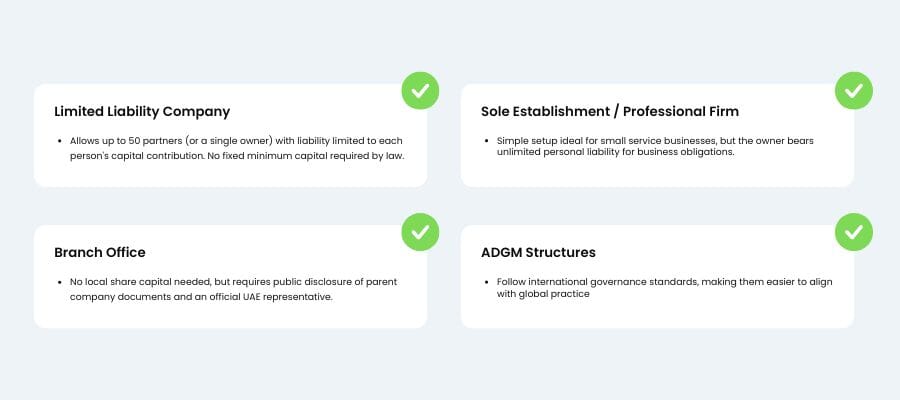
The legal shape you choose for a business in Abu Dhabi quietly defines how risk is shared and who holds real control inside the company. The most common option here is still the LLC. It allows up to fifty partners to join forces, while each person is only responsible for the amount they put in. At the same time, the rules make it possible to open an LLC in Abu Dhabi with a single owner, which suits those who prefer to keep full control without bringing in additional partners.
For smaller service-based activities, there are simpler formats. Foreigners often go with sole establishments or professional firms. These are easier to set up, but they come with a trade-off — the owner is personally responsible for business obligations. In some professions, a local service agent is required. This person does not own shares but handles communication with authorities and paperwork. This setup is common among consultants, auditors, and healthcare specialists who want a straightforward way of starting a service business in Abu Dhabi.
Large international companies usually take a different route. Instead of building something new from scratch, they open a branch linked to their existing headquarters. Because a branch is not a different legal entity, the parent company is fully responsible for what it does. The good thing is that there is no need to bring in local share funds. The process does, however, include making the parent company's papers public and naming an official representative in the UAE.
Typical features of widely used structures:
- most LLCs do not have a fixed minimum capital set by law;
- directors can be appointed from any country;
- accounting records must be maintained and stored properly;
- a registered address is required — physical or, in some cases, virtual;
- company details must be renewed and updated each year.
A different level of flexibility appears when you look at ADGM. Companies registered there can use legal tools that are not always available elsewhere. Investors can set up private limited entities, create trusts to protect assets, or build SPVs for specific deals. These structures can be adjusted depending on the goal — whether it’s a contract-based project or long-term family asset management. Funds are often used to manage succession and reduce exposure to external risks. Governance rules follow international standards quite closely, which makes structuring investments through ADGM easier to align with global practice.
Choosing the right company format in Abu Dhabi also affects how banks and tax authorities will see the business later on. If the ownership chain is layered, detailed disclosure of ultimate beneficiaries becomes unavoidable. The process of registering a company in Abu Dhabi ends with entering this information into the official register. Without it, operating legally is simply not possible. Ignoring reporting duties can result in fines or even blocked banking activity.
For larger, capital-intensive projects, another structure comes into play — the private joint-stock company. This format requires at least three founders and a more complex management system. It is often used in projects involving government participation or major institutional investors. The presence of shareholders tends to increase confidence among banks and partners, which matters when projects grow in size and visibility.
In the end, the decision to open a foreign company in Abu Dhabi should match long-term plans, not just immediate convenience. Branches work well for extending an existing brand into the region, while new LLCs give more flexibility when raising local funding or building something independent from the ground up.
Incorporation Process and Documents for Registering a Company in Abu Dhabi
In Abu Dhabi, business setup runs through centralized digital systems or, if you choose a free zone, through its own registration office. Most mainland applications go through TAMM — a single online point where different government services connect. The order of steps matters more than it seems. Delays at one stage can affect visas or tax registration later. Each action is recorded in the system, and step by step, a company profile takes shape.
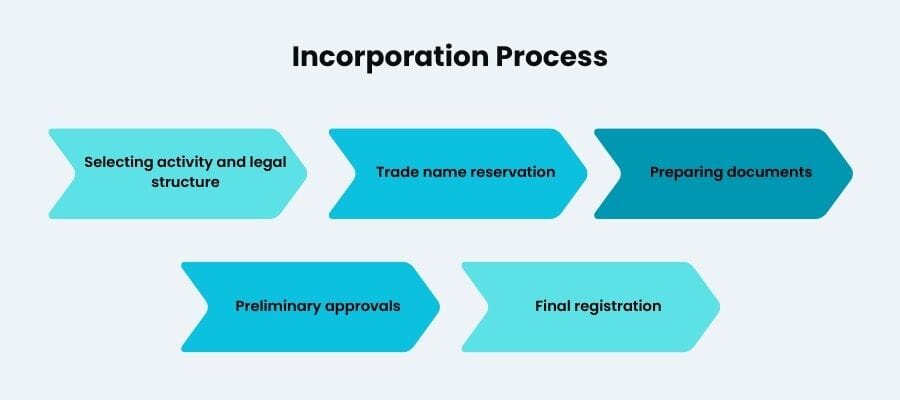
Stage 1. Selecting activity and legal structure.The process starts with choosing business activity codes from the official list. At the same time, the legal form is defined. This is where decisions about ownership are made — especially important when setting up a company in Abu Dhabi with foreign ownership. The structure should match future plans: hiring staff, opening accounts, working with partners. If the wrong activity is selected, problems usually appear later, not immediately.
Stage 2. Trade name reservation.A company cannot be registered without an approved name. The request is submitted online. The system checks if the name is already taken and whether it contains restricted words. Certain expressions, especially those linked to religion or state institutions, are not allowed. Once approved, the name is reserved for a limited time.
Stage 3. Preparing documents.At this stage, the main set of documents is collected. This includes identification of founders and draft incorporation papers. If a foreign company is involved, its documents must be legalized. These usually include incorporation certificates, internal regulations, and decisions confirming expansion. All documents from abroad must be translated into Arabic by certified translators. This step often requires careful coordination, especially when preparing documents for company registration in Abu Dhabi across different countries.
Documents required to start:
- copies of passports and ID details of shareholders and directors;
- decision or minutes confirming management appointment;
- draft Memorandum of Association (MoA) with digital signature;
- confirmation of reserved company name;
- proof of address or lease agreement.
Stage 4. Preliminary approvals.Additional authorization is required for certain business kinds. Projects involving healthcare, for instance, need to be greenlit by the health authority, while educational endeavors must be authorized by the appropriate department. This process verifies if the company satisfies the standards set by the industry. Simple examples proceed rapidly, while regulated ones take longer; the duration is activity dependent.
Stage 5. Final registration.To complete registering a company in Abu Dhabi, government fees are paid and the application goes through a final check. After approval, the system issues the license and official registration documents. At this point, the company is considered legally established. From there, it is possible to proceed with visas and tax registration.
The timeframe depends on the case. In straightforward situations, the process may take only a few days. More complex setups can take up to three weeks. Standard applications through TAMM are usually completed within 3–5 working days if all documents are ready. Fast-track options exist for those who need to open a company in Abu Dhabi quickly, but they may include additional requirements, such as confirming office space within a set period.
Another mandatory step is registering beneficial owners. This is done together with the license issuance. Without it, the company cannot fully operate. Authorities regularly check this data, and missing information can restrict access to services.
The final step is activating visa quotas. Once the company is registered, it can sponsor employees. The number of visas depends on office size and license type. After that, employment contracts must be set up in line with UAE regulations. This is where the business moves from registration to actual operations.

Want to learn more about UAE business setup services?
Business Licensing in Abu Dhabi and Choosing the Type of Economic License
Before anything else, a company in Abu Dhabi needs permission to operate. Without it, no activity is considered valid. This permit does more than just confirm registration — it sets clear limits on what the business can and cannot do. The system itself is divided into several directions: trade, services, production, tourism. Each direction comes with its own expectations, including staff qualifications and technical setup.
The nature of the business decides the type of license. Trade means a commercial permit, covering both domestic sales and exports. Knowledge-based services require a professional license. Industrial operations — anything involving production or processing — fall under a different category. Manual trades are handled through a crafts permit, while tourism and agriculture are regulated separately.
This decision has practical consequences. A factory must meet environmental standards. A consultant may need to confirm qualifications. If the activity does not match the license, the business can face restrictions or even lose its right to operate. That is why choosing a business license in Abu Dhabi should be done with attention to detail.
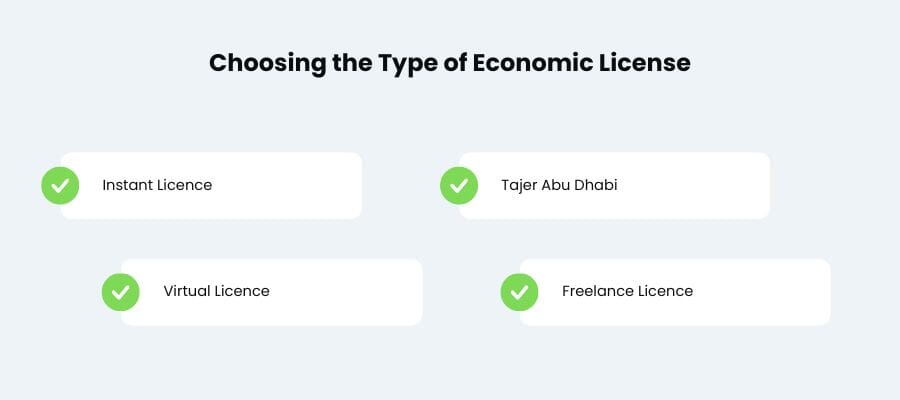
To make entry easier, simplified options exist. One of them allows small traders to operate without renting an office for several years. Another option offers a fast-track permit that can be issued almost immediately. At the early stage, not all documents are required — some can be provided later. This approach reduces initial expenses and helps those who want to launch a business in Abu Dhabi quickly without heavy preparation.
However, not every field is open without additional checks. Certain sectors require approval from specific authorities before moving forward. Energy and communication projects, for example, go through extra review. These approvals ensure that the planned activity does not conflict with national priorities. Without them, the process cannot be completed.
Main characteristics of special license formats:
|
License Type |
Office Requirement |
Suitable For |
|
Instant Licence |
Office not required at the beginning |
New projects, fast start |
|
Tajer Abu Dhabi |
No physical space for up to three years |
Small-scale trade, online sales |
|
Virtual Licence |
No residence status needed |
Remote professionals |
|
Freelance Licence |
Fixed address not required |
Independent experts |
In recent years, remote formats have become more common. Some licenses allow owners to manage business activities without being physically present in the country. These options usually apply to specific types of services, but they make cooperation with local partners much easier. For many, obtaining a business license in Abu Dhabi remotely becomes a workable solution.
Free zones such as ADGM operate under their own rules. The system there follows a different legal approach, closer to English common law. Investors can decide whether to run an active business or create a holding structure. Making this choice early helps avoid complications later, especially when dealing with taxes or financial reporting.
Taxation of a Company in Abu Dhabi and Mandatory Requirements After Registration
Once the company is officially formed, the next step is dealing with taxes. This part cannot be postponed. In Abu Dhabi, taxation follows federal rules, and every company must interact with the national tax authority. The first thing required is obtaining a tax identification number. Without it, reporting is not possible. Missing the deadline for registration usually leads to fines, and they are not symbolic.
The main tax to consider is the corporate one. It applies to profit, not revenue. The rate is 9%, but only on the part of income that goes above 375,000 dirhams. If profit stays below this level, no tax is charged. This setup gives smaller businesses space to grow without immediate pressure. When calculating taxable profit, operating costs and justified expenses are taken into account, which makes handling corporate tax in Abu Dhabi more flexible than it might seem at first glance.
There is also a support mechanism for small businesses. If annual income does not exceed 3,000,000 dirhams, the taxable base can be treated as zero under a special regime. This option is available until the end of tax periods closing in December 2026. However, it is not applied automatically — a company must request it and meet certain conditions, including residency requirements.
Main tax parameters in Abu Dhabi:
|
Tax Type |
Rate |
When it Applies |
|
Corporate tax |
9% |
Profit above 375,000 dirhams |
|
Value added tax |
5% |
Revenue above 375,000 dirhams |
|
Voluntary VAT |
5% |
Revenue above 187,500 dirhams |
|
Withholding tax |
0% |
Most payments to non-residents |
Another important element is value added tax. It works across the whole country under unified rules. A company must register once its turnover reaches 375,000 dirhams over a twelve-month period. There is also an option to register earlier, starting from 187,500 dirhams. Having a VAT number makes working with larger partners easier and allows recovery of input tax, which matters when registering for VAT in Abu Dhabi as the business grows.
Companies operating in free zones may benefit from a different approach. If they meet the conditions of a qualified entity, certain types of income can remain taxed at 0%. This is not automatic. The business must show real presence — office space, employees, actual activity within the zone. In addition, transfer pricing rules must be followed carefully.
Right after registering a company in Abu Dhabi, there is one more obligatory step — creating a register of ultimate beneficial owners. This requirement comes from government regulations and is aimed at making ownership structures transparent. Without completing this step, full operation of the company is not possible.
Opening a Corporate Bank Account in Abu Dhabi
Having a license in hand is only part of the story. It allows a company to exist, but not yet to operate financially. To open a corporate bank account in Abu Dhabi, a business must pass several layers of review inside the bank. Local institutions are cautious. They expect clear information, consistent documents, and a business model that makes sense on paper. These checks are designed to filter out risks linked to fraud or questionable transactions.
The most time-consuming part is not the paperwork itself, but the review process. Banks look closely at who stands behind the company, where the funds come from, and how money is expected to move. They often study the background of founders, the logic of the business, and the countries involved in future payments. If the company has no real office or only minimal activity, the application can slow down or even stop. Each bank has its own way of evaluating risk, so outcomes are not always predictable.
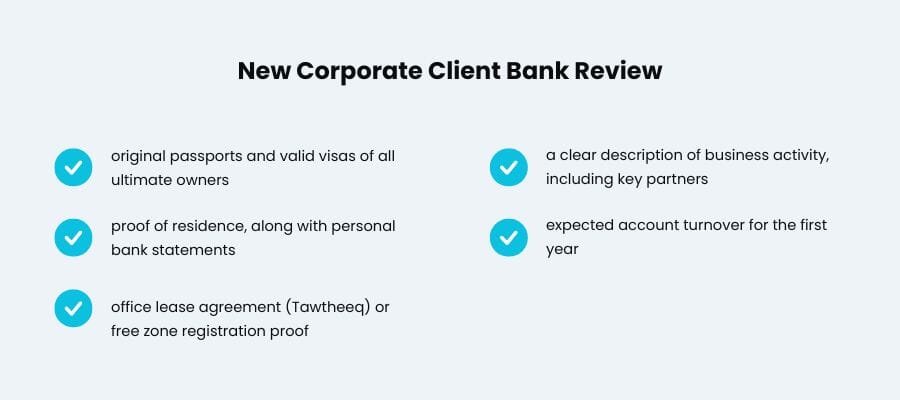
What banks usually ask for from new corporate clients:
- original passports and valid visas of all ultimate owners;
- proof of residence, along with personal bank statements;
- office lease agreement (Tawtheeq) or free zone registration proof;
- a clear description of business activity, including key partners;
- expected account turnover for the first year.
A common question is whether it is possible to open a company bank account in Abu Dhabi with foreign directors. In practice, banks tend to move faster when at least one decision-maker holds UAE residency. It simplifies verification and builds trust. Existing contracts with local clients — whether private or government — also improve the chances of approval.
The choice of bank depends on the nature of the business. Companies with frequent international transfers usually look toward larger institutions such as First Abu Dhabi Bank or Abu Dhabi Commercial Bank, where corporate tools are more developed. Others prefer Islamic banks like Abu Dhabi Islamic Bank, which follow specific financial principles.
Before submitting, all documents must be properly prepared. This includes translation and certification where required. The company charter, management appointment decision, and incorporation certificate are typical documents. Banks sometimes require more information regarding foreign connected enterprises. When establishing up corporate banking in Abu Dhabi, clear ownership structure is a must.
Building a Company in Abu Dhabi: What It Really Means
Opening a company in Abu Dhabi is often chosen for one reason — stability combined with access to a modern financial system. The environment is structured, sometimes strict, but at the same time highly digital and efficient. Administrative steps are streamlined, yet the rules themselves are taken seriously.
How well a business performs here depends heavily on the first decisions: how the structure is built, how clearly ownership is defined, and how carefully tax rules are followed. When these parts are done right, the system works smoothly. When they are ignored, problems tend to appear later — often at the worst moment.


