


 Sergey Dimitrov
  05.03.2026
 An Innovation Licence in ADGM is not just another corporate document you hang on the wall and forget about. It is a signal. A quiet but powerful statement that your idea belongs in a serious financial ecosystem. Abu Dhabi Global Market has built a reputation as a place where regulation and technology actually talk to each other. Not fight. Not ignore. Talk.
Entrepreneurs look at the Innovation Licence in ADGM when they want to test something bold without drowning in bureaucracy. FinTech founders. Web3 architects. Climate-driven engineers. HealthTech dreamers. They come here because obtaining an Innovation Licence in Abu Dhabi feels structured, but not suffocating.
ADGM understands that early-stage companies do not look like traditional corporations. They evolve fast. They pivot. They experiment. The Innovation Licence in ADGM was created exactly for that stage — when your product is alive but still growing teeth.
It gives founders space to develop, structure, and refine their solution within a regulated environment that actually expects innovation, not paperwork for the sake of paperwork.
What is an Innovation Licence in ADGM?
At its core, an Innovation Licence in ADGM is a special regulatory framework designed for companies building something new. Not trading something old. Not reselling something imported. Building.
When registering a company in ADGM under this model, you are stepping into a controlled environment created for experimentation. The regulator is not looking for polished giants. It is looking for scalable ideas with real potential and a clear technological backbone.
The Innovation Licence in ADGM allows startups to operate within a recognised jurisdiction while enjoying lighter requirements during the early development phase. It lowers initial financial pressure and creates room for structured growth. But do not confuse flexibility with softness. ADGM expects clarity. Strategy. Logic.
Obtaining an Innovation Licence in Abu Dhabi means presenting your project as something that solves a real problem using technology in a measurable way. It is innovation with a backbone.
The licence concept and the regulator's focus on FinTech, Web3, GreenTech, and HealthTech
ADGM did not design the Innovation Licence in ADGM for random startups. The focus is deliberate. The regulator actively supports projects in FinTech, Web3, GreenTech, and HealthTech because these sectors reshape economies.
In FinTech, they expect payment systems, digital lending models, blockchain settlement tools. In Web3, they look for decentralised infrastructure, tokenisation platforms, digital asset solutions. GreenTech must show measurable environmental impact. HealthTech needs technology-driven medical or wellness innovation.
The Innovation Licence in ADGM is structured around this sectoral logic. When applying, founders must demonstrate how their product fits one of these innovation clusters. Vague claims do not survive review. Concrete architecture does.
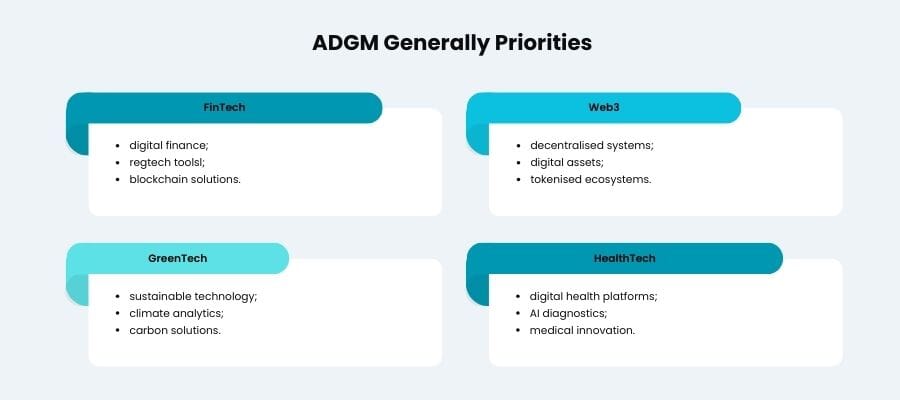
Here is how ADGM generally frames its innovation priorities:
- FinTech: digital finance, regtech tools, blockchain solutions
- Web3: decentralised systems, digital assets, tokenised ecosystems
- GreenTech: sustainable technology, climate analytics, carbon solutions
- HealthTech: digital health platforms, AI diagnostics, medical innovation
The regulator is not chasing trends. It is building an ecosystem. And the Innovation Licence in ADGM is the entry door.
What are the Tech Startup Licence and Innovation Testing Licence?
Within the broader Innovation Licence in ADGM framework, two formats usually attract attention: the Tech Startup Licence and the Innovation Testing Licence.
The Tech Startup Licence is designed for early-stage companies building scalable technology solutions. It provides reduced fees and simplified requirements during the initial phase. This option is ideal when founders are developing a product but are not yet generating stable revenue. It allows registering a startup in ADGM while keeping operational costs manageable.
The Innovation Testing Licence is slightly different. It is built for projects that need a controlled environment to test new financial or technological models before going fully commercial. Think regulatory sandbox logic. You experiment under supervision. You collect data. You refine compliance.
Choosing between these formats depends on your business model maturity. Both fall under the Innovation Licence in ADGM umbrella, but each serves a different growth stage. And selecting the correct pathway is often the first strategic decision founders must make.
Document Package and Corporate Requirements
Obtaining an Innovation Licence in ADGM is not about filling out a couple of online forms and waiting for approval. The regulator wants to see structure behind the ambition. Your idea may be brilliant, but in ADGM it must also be documented, justified, and legally framed.
When preparing documents for registering a company in ADGM, founders step into a more disciplined zone. This is where enthusiasm turns into paperwork — clear, logical, consistent paperwork.
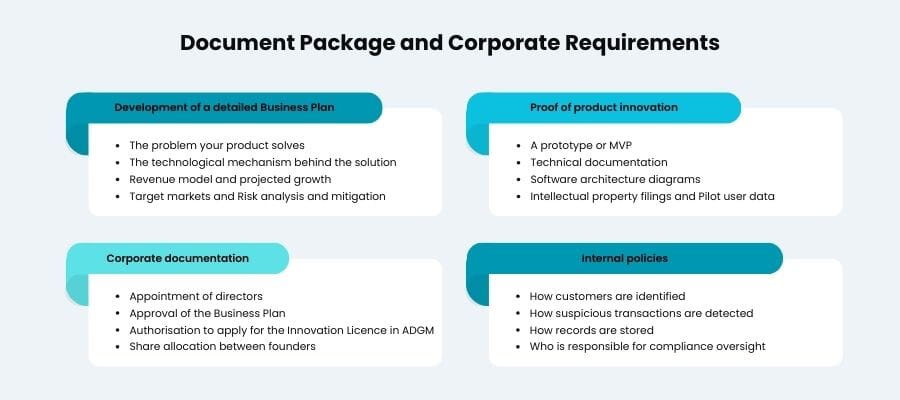
Development of a detailed Business Plan meeting strict ADGM standards
The Business Plan is not a decorative PDF. Under the Innovation Licence in ADGM framework, it becomes the backbone of your application. ADGM reviews it carefully, line by line.
They expect clarity on:
- The problem your product solves
- The technological mechanism behind the solution
- Revenue model and projected growth
- Target markets
- Risk analysis and mitigation
When applying for an Innovation Licence in ADGM, vague promises do not work. Saying “we will disrupt finance” sounds exciting, but the regulator wants architecture, not slogans.
Your Business Plan should show that you understand your sector — whether it is FinTech, Web3, GreenTech, or HealthTech — and that your technology is not theoretical. Timelines matter. Milestones matter. Financial projections must look realistic, not inflated for effect.
Obtaining an Innovation Licence in Abu Dhabi often depends on how well this document translates vision into structured execution.
Proof of product innovation
This part separates serious founders from dreamers.
ADGM will not approve an Innovation Licence in ADGM just because the company calls itself “innovative.” You must prove it. That proof can take different forms:
- A prototype or MVP
- Technical documentation
- Software architecture diagrams
- Intellectual property filings
- Pilot user data
If your product is still in development, that is acceptable. But the regulator must see genuine technological depth. Copy-paste business models rarely survive review.
When registering a startup in ADGM, founders should be ready to demonstrate how their product differs from existing solutions. What exactly is new? What exactly is improved? Where is the technical advancement?
Innovation must be visible, not decorative.
Corporate documentation: drafting Articles of Association and founders' resolutions
Now we enter the formal legal layer.
The Innovation Licence in ADGM requires proper corporate structuring from day one. Even if the company is early-stage, its constitutional documents must reflect internal governance logic.
The Articles of Association define how the company operates: who owns what, how shares are issued, how decisions are taken, and how directors are appointed or removed.
In ADGM, drafting Articles of Association is not a mechanical copy of a template. The document must align with the startup’s structure, funding expectations, and long-term strategy. If founders plan future investment rounds, share classes must be structured carefully from the beginning.
Founders’ resolutions are equally important. These documents confirm:
- Appointment of directors
- Approval of the Business Plan
- Authorisation to apply for the Innovation Licence in ADGM
- Share allocation between founders
Even at the early stage, ADGM expects corporate discipline. Informal agreements or handshake arrangements are not sufficient.
When obtaining an Innovation Licence in Abu Dhabi, clear governance reassures the regulator that the company understands responsibility. It also protects founders from internal disputes later.
Good legal drafting here prevents expensive restructuring in the future.
Internal policies: basic AML/KYC compliance requirements for tech companies
Many founders underestimate this part. They assume compliance is relevant only for banks. Not true.
If your Innovation Licence in ADGM involves financial activity, digital assets, payment tools, or user onboarding, even at a limited level, the regulator expects basic AML/KYC policies.
This does not mean building a massive compliance department. It means having documented internal procedures that explain:
- How customers are identified
- How suspicious transactions are detected
- How records are stored
- Who is responsible for compliance oversight
Even non-financial startups may need internal governance policies addressing data protection and risk control.
ADGM operates within an international financial environment. That means standards matter. When registering a company in ADGM under the Innovation Licence in ADGM regime, founders step into a regulated ecosystem that values transparency.
Clear internal policies show that innovation is paired with responsibility. And in this jurisdiction, that combination carries serious weight.
Step-by-Step Procedure for Obtaining an Innovation Licence in Abu Dhabi
Obtaining an Innovation Licence in Abu Dhabi follows a structured path, but it is not chaotic if you prepare properly. The regulator expects order, logic, and readiness.
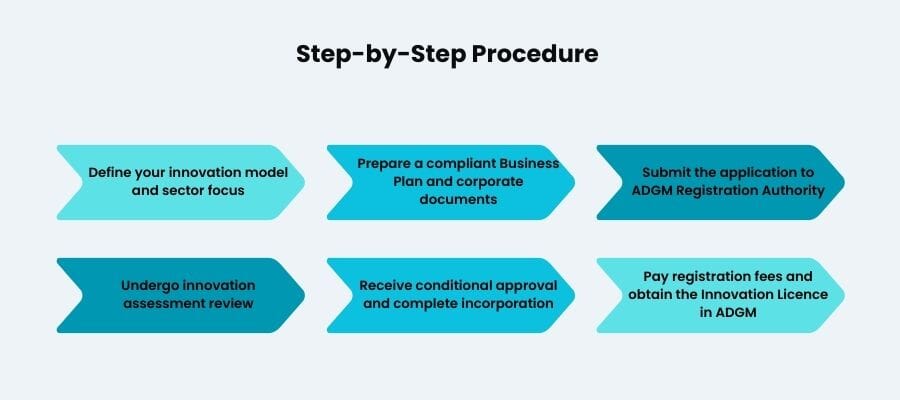
The process usually moves like this:
- Define your innovation model and sector focus.
- Prepare a compliant Business Plan and corporate documents.
- Submit the application to ADGM Registration Authority.
- Undergo innovation assessment review.
- Receive conditional approval and complete incorporation.
- Pay registration fees and obtain the Innovation Licence in ADGM.
Each step builds on the previous one. Missing details slow everything down. Precision moves things forward.

Want to learn more about UAE business setup services?
Financial Planning
An Innovation Licence in ADGM may sound flexible, but finances still matter. Founders often focus on product and forget that structure costs money. Smart financial planning makes obtaining an Innovation Licence in Abu Dhabi predictable instead of stressful.
Before registering a company in ADGM, you should calculate not only incorporation costs, but also renewal and operational expenses. Stability impresses regulators more than improvisation.
RA (Registration Authority) government fees: first-year registration costs and annual renewal expenses
The Registration Authority sets the core fees for the Innovation Licence in ADGM. These usually include:
- Company registration fee
- Licence issuance fee
- Office or flexi-desk cost
- Annual renewal fee
The first year is always more expensive due to incorporation charges. Renewal is typically lower but still mandatory. Founders should also budget for professional services and compliance support. Underestimating these numbers can disrupt early growth.
Taxation
ADGM operates within the UAE tax framework. Corporate tax rules may apply depending on activity and revenue thresholds. However, many innovation projects benefit from structured tax planning when registering a startup in ADGM. VAT considerations also arise if taxable supplies are made. Understanding taxation early protects both cash flow and long-term scalability.
Pitfalls, Risks, and Regulatory Restrictions
The Innovation Licence in ADGM opens doors — but it also comes with rules. Serious ones. Founders often focus on speed: launch fast, register quickly, start pitching. That mindset works in product development. It does not always work in regulated jurisdictions.
When obtaining an Innovation Licence in Abu Dhabi, ignoring risk factors can delay approval or complicate operations later. Understanding restrictions early saves money, time, and nerves.
Risk of application rejection at the innovation assessment stage: main mistakes of founders
The innovation assessment is not symbolic. ADGM genuinely evaluates whether your project deserves the Innovation Licence in ADGM label.
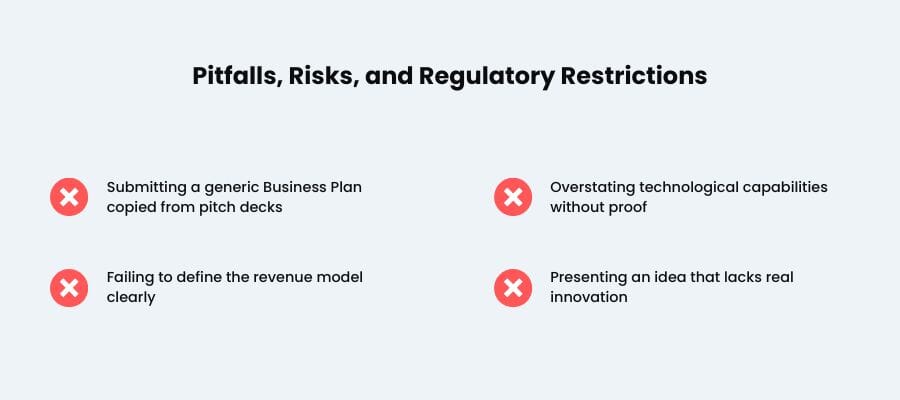
Common mistakes?
- Submitting a generic Business Plan copied from pitch decks
- Overstating technological capabilities without proof
- Failing to define the revenue model clearly
- Presenting an idea that lacks real innovation
Founders sometimes assume enthusiasm is enough. It is not. The regulator wants structure, technical clarity, and measurable development milestones. If your product looks like a simple service repackaged as “tech,” rejection becomes likely.
Territorial restrictions on commercial activity
One detail many overlook: the Innovation Licence in ADGM is issued within a financial free zone. That means your company cannot automatically operate in Mainland UAE without additional approvals.
You may register a company in ADGM, but selling directly into the Mainland market requires specific arrangements — often a local distributor or separate licensing structure.
Ignoring territorial limits can trigger penalties or compliance questions. Smart founders structure operations carefully from day one.
Difficulties in passing bank compliance for startups
Even after obtaining an Innovation Licence in Abu Dhabi, opening a corporate bank account can become a separate challenge.
Banks examine:
- Source of funds
- Founder background
- Business model transparency
- Expected transaction volume
If your startup deals with digital assets, cross-border flows, or early-stage revenue uncertainty, enhanced due diligence is common. Preparation matters here as much as during licensing.
Economic Substance Regulations (ESR) requirements
ESR rules apply to certain activities conducted within the UAE framework. If your Innovation Licence in ADGM involves relevant activities under ESR categories, you must demonstrate adequate economic presence — local management, expenditure, and operational substance.
It is not always complex, but it must be assessed properly. Ignoring ESR compliance can lead to reporting issues and administrative consequences. Innovation works best when it stands on a legally solid foundation.
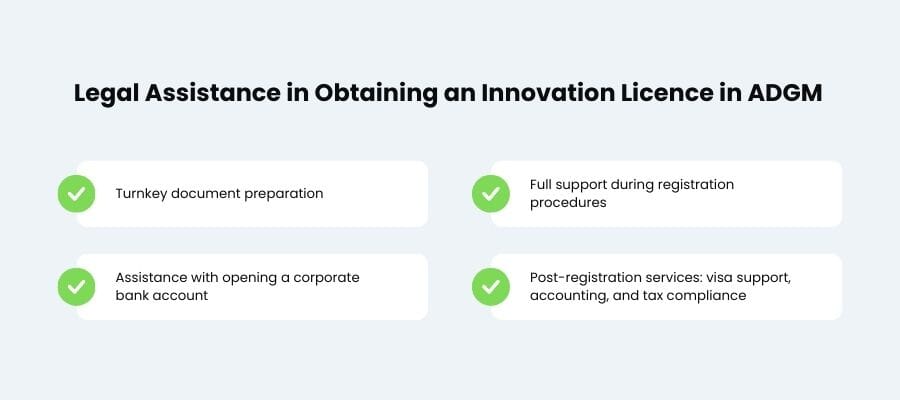
Legal Assistance in Obtaining an Innovation Licence in ADGM
Obtaining an Innovation Licence in ADGM looks manageable on paper. In reality, the smallest inconsistency can slow everything down. Founders usually underestimate one thing: regulators read between the lines. They look for logic, consistency, and alignment between documents. That is where professional legal assistance becomes more than convenience — it becomes strategy.
When registering a company in ADGM under the Innovation Licence in ADGM framework, structured guidance reduces friction and keeps the process calm, predictable, and controlled.
Initial project audit for compliance with Abu Dhabi regulators' innovation criteria
Before submitting anything, a proper audit evaluates whether the project truly meets ADGM innovation standards. This includes analysing the technological layer, revenue logic, governance structure, and regulatory positioning.
An early audit often reveals weak points: unclear monetisation, vague product differentiation, or missing compliance elements. Fixing them before filing dramatically increases approval chances.
Turnkey document preparation
Drafting for an Innovation Licence in ADGM is not about copying templates. It requires tailoring.
Legal teams prepare:
- A regulator-ready Business Plan
- Corporate documents aligned with funding strategy
- Internal compliance policies
- Supporting innovation evidence
Everything must tell the same story. Consistency builds credibility.
Full support during registration procedures
Submitting the application is only part of the journey. The Registration Authority may request clarifications, amendments, or additional explanations.
Professional support ensures timely responses, structured communication, and proper follow-up until the Innovation Licence in ADGM is formally issued.
Assistance with opening a corporate bank account
After incorporation, banking becomes the next gate. Lawyers and consultants help prepare compliance files, explain the business model to banks, and structure documentation to meet due diligence expectations.
This step often determines how smoothly operations begin.
Post-registration services: visa support, accounting, and tax compliance
Once the Innovation Licence in ADGM is active, operational compliance continues. Visa processing for founders, ongoing accounting, ESR assessment, and tax monitoring all require attention.
Strong post-registration support allows founders to focus on scaling the product — not constantly reacting to regulatory questions.


