


 Manish Kulkarni
  05.03.2026
 When founders talk about obtaining a DIFC Innovation Licence in Dubai, they’re usually not chasing prestige. They’re chasing access. Access to investors. Access to infrastructure. Access to credibility. Because in DIFC, regulation is not an obstacle — it’s architecture. It shapes the space you build in.
This licence is designed for companies that actually create something: software platforms, AI tools, fintech systems, edtech products, digital marketplaces. It’s not for trading random goods or registering a shell company. The DIFC Innovation Licence (Dubai) is for teams that build, test, scale — and can explain how.
The Essence of the Innovation Licence in DIFC
At its core, this licence exists to support technology-driven businesses inside the Dubai International Financial Centre. But it’s more than just “tech-friendly.” It’s structured to filter ideas carefully, support the serious ones, and create an ecosystem where innovation has legal ground to stand on.
Before you even submit documents, you need to understand what DIFC actually is — and why it operates differently from mainland UAE.
Features of the DIFC jurisdiction
DIFC is a financial free zone with its own legal system, its own courts, and regulations based on English common law. That alone changes the game. Investors understand it. International partners feel comfortable inside it.
Key features include:
- Independent regulator (DFSA)
- 100% foreign ownership
- No currency restrictions
- Strong data protection framework
- Clear corporate governance standards
When you are applying for a DIFC Innovation Licence (Dubai), you’re stepping into a jurisdiction that values structure and transparency. It’s not chaotic. It’s precise.
Advantages of the DIFC Innovation Hub
The Innovation Hub is where startups breathe. It provides co-working space options, networking events, access to accelerators, and proximity to financial institutions. You are not isolated — you are surrounded by fintech, AI labs, venture capital, advisory firms.
Founders often underestimate this part. But being physically and legally inside the DIFC ecosystem makes fundraising conversations different. It signals seriousness.
Obtaining a DIFC Innovation Licence in Dubai also comes with reduced licence fees compared to standard commercial setups, making it attractive for early-stage tech companies.
Startup evaluation criteria
Here’s where reality enters the room.
DIFC does not approve vague ideas. The Innovation Licence committee looks at:
- Clear technological focus
- Scalable business model
- Realistic revenue projections
- Defined target market
- Competent founding team
If your “innovation” is just a website selling generic services, approval is unlikely. But if you are developing proprietary software, AI algorithms, SaaS tools, blockchain infrastructure — the conversation changes.
The DIFC Innovation Licence (Dubai) is selective, yes. But that selectivity is exactly what gives it weight.
Document Package and Preliminary Preparation Requirements in Dubai
This is the part most founders underestimate. They think obtaining a DIFC Innovation Licence (Dubai) starts with submitting a form. It doesn’t. It starts weeks earlier — with thinking clearly, structuring the idea properly, and translating ambition into documents regulators can actually assess.
DIFC does not want decorative paperwork. It wants logic. It wants proof that the business model makes sense, that the numbers are not fantasy, and that the people behind the project are transparent. Preparing the document package for a DIFC Innovation Licence in Dubai is less about volume and more about coherence. Everything must connect: product, revenue, ownership, risk management.
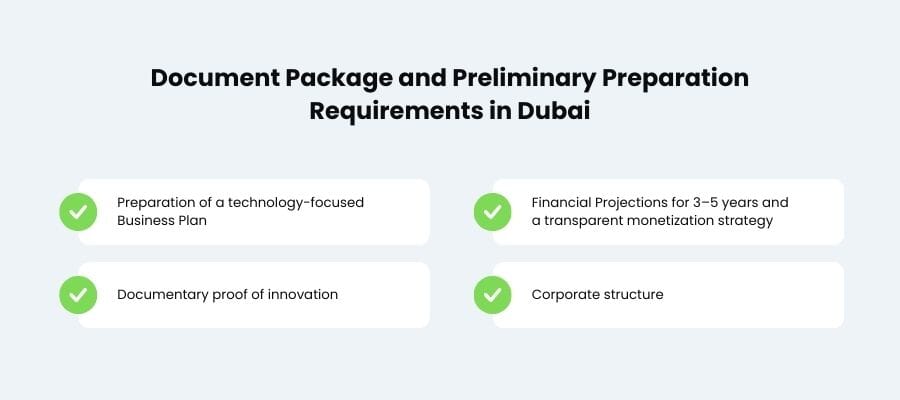
Preparation of a technology-focused Business Plan (Software, AI, EdTech, E-commerce)
The business plan is not a marketing brochure. It is a structured explanation of what you are building and why it deserves space inside DIFC.
A strong technology-focused Business Plan should clearly describe:
- The core product (SaaS platform, AI solution, fintech tool, marketplace, etc.)
- The technological component — what makes it innovative?
- Target users and geography
- Competitive landscape
- Development roadmap
- Regulatory considerations
If you are developing AI, explain the model logic. If it is e-commerce, clarify how your technology differs from standard platforms. DIFC wants to see that innovation is real, not decorative. When applying for a DIFC Innovation Licence (Dubai), vague wording is your enemy.
Financial Projections for 3–5 years and a transparent monetization strategy
Numbers tell a story. And regulators read that story carefully.
Financial projections should cover 3–5 years and include revenue forecasts, operational costs, expected growth, and funding needs. But more importantly — they must align with the business model described earlier.
Here’s what usually needs to be presented:
|
Element |
What DIFC expects to see |
|
Revenue Model |
Subscription, commission, licensing, transaction fees |
|
Cost Structure |
Staff, technology, office, compliance |
|
Growth Assumptions |
Logical and market-based, not exaggerated |
|
Break-even Point |
Realistic timeline |
A transparent monetization strategy shows that you understand how your innovation becomes income. Overly optimistic hockey-stick charts without explanation will only slow down obtaining a DIFC Innovation Licence in Dubai.
Documentary proof of innovation (Pitch Deck, working prototypes, patents)
Talk is cheap. Demonstration is powerful.
DIFC often expects documentary proof that the innovation exists beyond theory. This may include:
- A detailed Pitch Deck
- Screenshots or demo access to a working prototype
- Technical architecture diagrams
- Patent applications or IP documentation
If the product is still in early development, that’s acceptable — but there must be tangible progress. Showing that you are actively building strengthens your position significantly.
Corporate structure: disclosure of Ultimate Beneficial Owners (UBO) data and KYC forms for directors
Transparency is non-negotiable.
Every shareholder and Ultimate Beneficial Owner must be disclosed. DIFC requires KYC forms, passport copies, proof of address, and background details. If the corporate structure includes holding companies, the ownership chain must be clearly mapped.
Here is a simplified overview of what is typically required:
|
Document |
Purpose |
|
UBO Declaration |
Identifies real owners |
|
KYC Forms |
Confirms identity and compliance |
|
Corporate Documents (if applicable) |
Shows ownership chain |
|
Board Resolution |
Approves company formation |
Preparing this properly from the start saves weeks later. Because in Dubai, especially inside DIFC, clarity speeds everything up.
Step-by-Step Procedure for Obtaining a Licence in DIFC
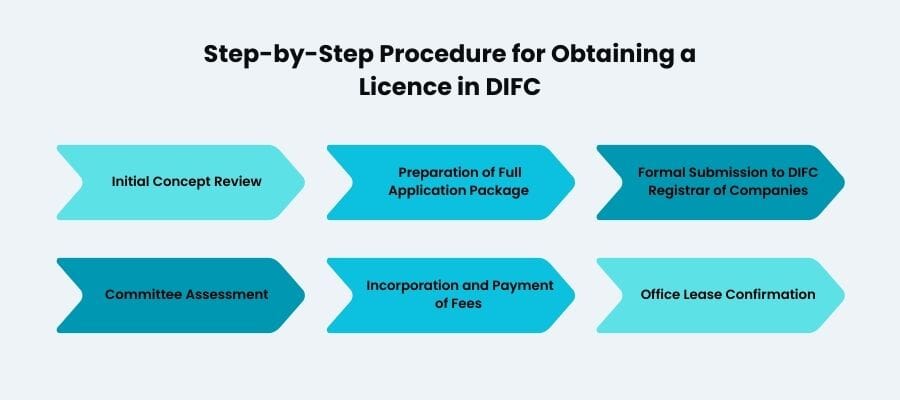
Once the documents are ready, the real movement begins. Obtaining a DIFC Innovation Licence (Dubai) follows a clear path. It is structured, predictable — but only if you approach it properly.
Here’s how the process usually unfolds:
- Initial Concept Review – You submit a short overview of your startup to the DIFC Innovation Hub. This is where they decide whether the idea fits the innovation framework.
- Preparation of Full Application Package – Business plan, financial projections, UBO disclosure, KYC forms, supporting materials.
- Formal Submission to DIFC Registrar of Companies – The application enters official review.
- Committee Assessment – The Innovation Hub committee evaluates the technological component and scalability.
- Incorporation and Payment of Fees – After approval, you register the legal entity and pay DIFC RoC fees under the innovation tariff.
- Office Lease Confirmation – Even a flexi-desk arrangement must be secured within DIFC premises.
From start to finish, obtaining a DIFC Innovation Licence in Dubai typically takes several weeks, depending on preparation quality and regulator feedback speed.
Registration Costs and Tax Regulations in DIFC
When someone starts exploring a DIFC Innovation Licence (Dubai), they usually expect two extremes: either “tax paradise” or “unbearably expensive.” Reality sits somewhere in the middle. DIFC is not cheap, but it is clean. Clean structure. Clean rules. Clean pricing.
You don’t negotiate fees over coffee. You follow published tariffs.
Transparency of expenses: registration and licensing fees (DIFC RoC Fees) under the Innovation tariff
The Innovation tariff exists for one reason — to make space for real tech startups. Without it, early-stage founders would feel the pressure immediately.
What you normally budget for:
- Incorporation fee paid to the DIFC Registrar of Companies
- Annual Innovation Licence fee
- Mandatory office solution inside DIFC (flexi-desk or physical unit)
- Data protection registration
That’s it. No mysterious “processing multipliers.” No creative add-ons invented mid-way.
DIFC RoC fees are public. Fixed. Payable directly to the authority. If you calculate properly before applying for a DIFC Innovation Licence in Dubai, you won’t face financial surprises.
The real variable is office choice. A simple desk keeps costs controlled. A private office shifts the budget significantly.
Tax burden: Corporate Tax and optimization opportunities for Free Zone residents
Now the tax part — the topic everyone pretends not to worry about.
DIFC companies fall under the UAE Corporate Tax regime. But Free Zone residents may qualify for a 0% rate on specific types of income if they meet the criteria. And that “if” matters.
You need real presence. Proper accounting. Clear separation of qualifying and non-qualifying income. Substance is not decorative paperwork — it is examined.
Smart structuring from day one makes life easier. Trying to “optimize later” usually creates friction with compliance.
A DIFC Innovation Licence (Dubai) gives access to a respected legal environment. The tax benefits are real, but only for companies that play by the rules and build their operations transparently.
Pitfalls, Risks, and Regulatory Barriers of the Jurisdiction
DIFC looks polished from the outside. Glass towers. Structured rules. Professional branding everywhere. But behind that clean surface, there are real boundaries you need to understand before obtaining a DIFC Innovation Licence (Dubai).
This jurisdiction rewards clarity and compliance. It does not tolerate improvisation. If your strategy is built on shortcuts, friction will appear quickly.
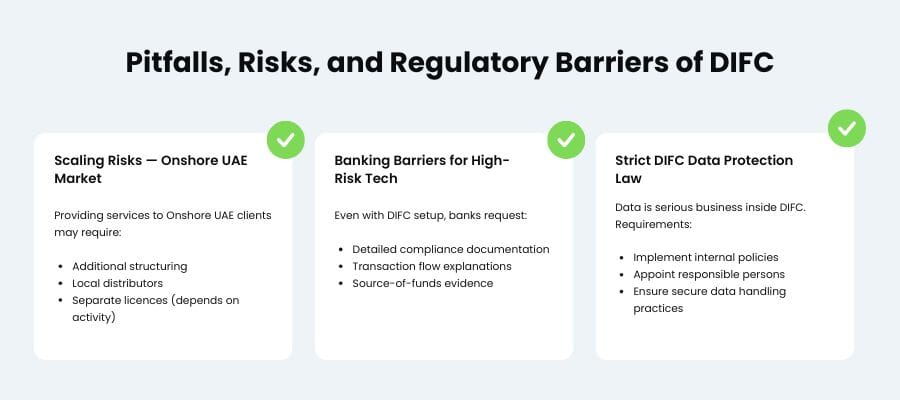
Scaling risks: nuances of providing services to clients in the local market (Onshore UAE)
One common misconception is assuming that a DIFC licence automatically allows unrestricted business across mainland UAE. It doesn’t.
Providing services to Onshore UAE clients may require additional structuring, local distributors, or separate licences depending on the activity. The Free Zone status offers advantages, but it also defines your perimeter.
If your growth model includes aggressively entering the mainland market, you need to design this from the beginning. Otherwise, scaling becomes legally complicated instead of exciting.
When planning expansion after obtaining a DIFC Innovation Licence in Dubai, regulatory geography matters as much as revenue strategy.
Banking barriers for high-risk technological sectors
Another sensitive area is banking.
Fintech, crypto-related projects, AI-based financial analytics, and payment platforms often face enhanced due diligence. Even with a DIFC setup, local and international banks may request detailed compliance documentation, transaction flow explanations, and source-of-funds evidence.
Approval is possible — but it is rarely instant.
High-risk technological sectors must prepare for longer onboarding timelines and deeper scrutiny. Strong documentation and a transparent business model significantly increase your chances of opening and maintaining a corporate account.
Strict regulations of the DIFC Data Protection Law
Data is serious business inside DIFC.
The DIFC Data Protection Law sets strict standards for collecting, storing, and processing personal data. Companies must implement internal policies, appoint responsible persons where required, and ensure secure data handling practices.
For AI platforms, SaaS providers, and e-commerce systems, compliance is not optional. Failing to align with data protection obligations can lead to penalties and reputational damage.
Obtaining a DIFC Innovation Licence (Dubai) means entering a jurisdiction where innovation is welcome — but discipline is mandatory.
Our Services for Registering an Innovation Licence in DIFC
Obtaining a DIFC Innovation Licence (Dubai) is rarely just about filling in forms. It’s about positioning. About presenting your idea in a way that regulators understand — and respect. Many founders have strong products but weak regulatory narratives. That gap is exactly where professional support makes a difference.
We don’t sell “company formation.” We build a structured path toward approval and long-term stability inside DIFC.
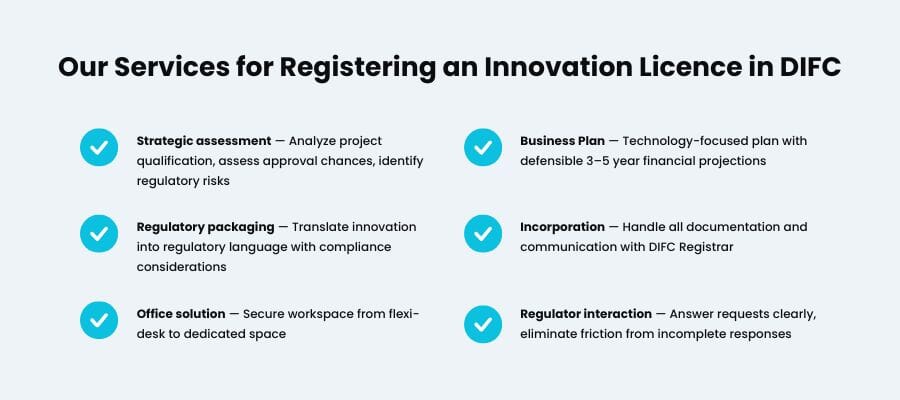
Strategic consulting and assessment of approval chances by the DIFC Innovation Hub committee
Before documents are drafted, we assess reality.
Is the project truly innovative under DIFC criteria? Does it qualify for the Innovation tariff? Are there hidden regulatory risks? We analyze the product, target market, scalability logic, and team background.
This early-stage review allows founders to understand their actual chances of approval by the DIFC Innovation Hub committee. Sometimes the strategy needs refinement. Sometimes the activity description must be narrowed. Sometimes corporate structuring needs adjustment before applying for a DIFC Innovation Licence in Dubai.
Clarity at this stage saves months later.
Development of a business plan, financial model, and proper product "packaging" to meet regulator requirements
Regulators think differently than investors. They focus on sustainability, compliance, and operational realism.
We develop:
- A technology-focused Business Plan aligned with DIFC expectations
- A structured financial model with defensible 3–5 year projections
- Revenue logic that matches market reality
- Risk disclosures and compliance considerations
Proper “packaging” does not mean exaggeration. It means translating innovation into regulatory language. Whether the startup is SaaS, AI-driven, EdTech, or E-commerce, the documentation must feel cohesive.
When obtaining a DIFC Innovation Licence (Dubai), documents are not decoration. They are the core of the decision.
End-to-end legal support: company registration, office lease, and interaction with regulators
After conceptual approval, the administrative phase begins.
We handle communication with the DIFC Registrar of Companies, prepare incorporation documents, coordinate signature procedures, and secure the appropriate office solution — from flexi-desk to dedicated space.
Interaction with regulators requires precision. Requests for clarification must be answered clearly and quickly. Delays usually come from incomplete responses or inconsistent information. Our role is to eliminate that friction.
Assistance with opening bank accounts
Banking is often more complex than licensing.
We prepare compliance-ready documentation packages for banks, including corporate structure explanations, transaction flow descriptions, and source-of-funds evidence. For high-risk tech sectors, we anticipate enhanced due diligence and prepare accordingly.
Opening a corporate account after obtaining a DIFC Innovation Licence in Dubai should not feel like a second regulatory battle. Preparation makes the difference.
Comprehensive post-registration services: visas, compliance, data protection, and intellectual property
Registration is only the beginning.
We support residency visa processing, annual compliance filings, Economic Substance requirements where applicable, and DIFC Data Protection obligations. For technology startups, intellectual property protection is also critical — trademark registration, licensing agreements, and internal IP structuring.
The goal is not simply to register a company, but to create a stable operating framework inside DIFC.
Because a DIFC Innovation Licence (Dubai) is not a trophy to display on a website. It is a foundation. And foundations need structure, clarity, and ongoing attention.
When everything is built correctly — from the first strategic discussion to post-registration compliance — the licence stops being just a regulatory status. It becomes a platform for scaling technology in one of the most structured financial environments in the region.


