


 Calen Voss
  19.02.2026
 Launching a delivery-only food brand in Dubai sounds simple until licensing, approvals, and costs enter the room. A cloud kitchen license Dubai is not just a formality; it defines where you can operate, how you sell, and which platforms will work with you. This guide is written for founders who want clarity before money moves—restaurant owners going digital, delivery-first startups, and foreign investors testing the UAE market without dining rooms and waitstaff.
Dubai treats cloud kitchens as regulated food businesses, with clear rules around location, hygiene, and compliance. Get them right, and you gain speed, scalability, and lower overhead. Get them wrong, and you face delays, rejections, or forced changes after launch. Here, you’ll see how cloud kitchens actually work in the UAE, which license you need, what approvals matter, and how costs break down in real numbers. The aim is simple: help you decide, plan, and launch with confidence—without legal jargon, guesswork, or sales noise from day one, responsibly.
What Is a Cloud Kitchen and How Does It Work in the UAE?
A cloud kitchen is a licensed kitchen that sells food without hosting guests. You don’t run a dining area. You run production. The customer never sees your space; they see your menu on an app, a website, or a QR link, place an order, and the meal leaves your door in a rider’s bag.
In the UAE, this isn’t some “creative shortcut.” It’s a normal, regulated format for an F&B operation. You register the business, rent a compliant kitchen, get the right approvals, and work within food safety rules that are checked in real life—not only on paper. Your kitchen can be a standalone unit that you lease, or a spot inside a shared facility built specifically for delivery brands. Either way, the kitchen itself matters as much as your recipes, because the approvals attach to the place where food is handled.
Here’s what the model looks like when it’s done properly:
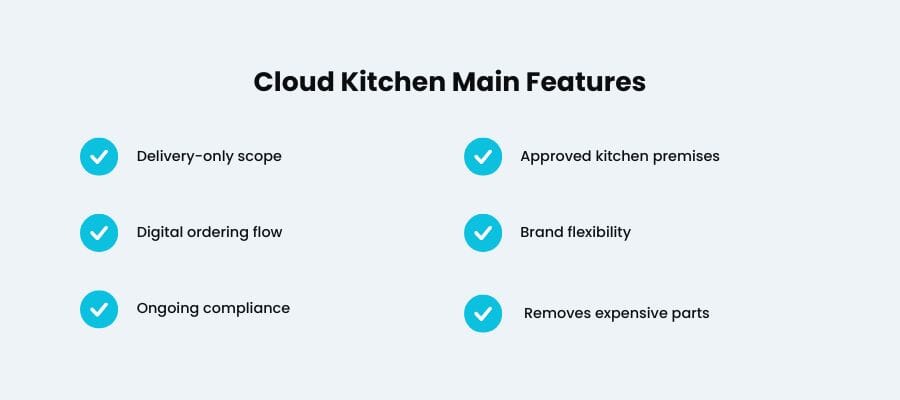
- Delivery-only scope: your license is built around production and dispatch, not dine-in
- Approved kitchen premises: the space must meet hygiene, storage, and workflow standards
- Digital ordering flow: orders arrive through delivery platforms or your own system
- Brand flexibility: more than one concept can operate from one kitchen if permitted and managed correctly
- Ongoing compliance: inspections and documentation aren’t “one-and-done”—they’re part of operations
A cloud kitchen works because it removes expensive parts of a restaurant (front-of-house, prime seating space) and replaces them with repeatable systems: prep, packaging, timing, and consistency. If you’re thinking about a cloud kitchen license Dubai, the big idea is simple: you’re building a food business that behaves like a small factory—clean, controlled, and ready to scale.
Cloud Kitchen Business in UAE: Market Overview and Trends
The cloud kitchen business in UAE didn’t appear out of nowhere. It’s a response to how people actually live here: fast schedules, heavy app usage, and a steady appetite for “deliver it, don’t drive.” Add Dubai’s commercial rent reality and you get a format that makes financial sense even before you talk about branding.
Food delivery in the UAE has matured. Customers don’t order only on lazy evenings anymore. They order between meetings, after the gym, during family movie nights, and on days when cooking feels like a chore. That demand has created space for delivery-only brands that run clean operations, hit consistent quality, and keep their costs under control.
What you’ll notice right now across the cloud kitchen in UAE landscape:
- One kitchen, several brands: operators often run multiple concepts from the same approved space, separating stock, prep, and packaging properly
- Menus designed for delivery: items are built around hold time, packaging stability, and repeatable prep—not plate aesthetics
- Smarter use of space: compact kitchens (often around 20–30 m²) can outperform bigger setups because rent and staffing stay sane
- More foreign founders: many investors test the market with delivery-first concepts before committing to a full restaurant footprint
This market rewards discipline. A good concept helps, but execution decides everything: prep speed, portion control, wastage, ratings, and platform visibility. If you’re planning a cloud kitchen license UAE journey, treat this as a serious F&B business, not a side project with a menu. The UAE market is open—but it’s not forgiving to sloppy operations.
What License Is Required for a Cloud Kitchen in Dubai?
A cloud kitchen in Dubai operates under a commercial food license issued for delivery-only activity. This is not a generic restaurant permit with a different label. The business is registered as a food establishment without dine-in rights, and the license scope is written to match that reality. When applying for a cloud kitchen license Dubai, authorities look first at what you do, not what you plan to become later. Production, storage, and delivery are the focus, and the kitchen location is tied directly to the license approval.
Unlike informal setups seen in other markets, Dubai requires the kitchen to be approved before the license is activated. The trade license, activity wording, and municipality approvals are connected from day one. This structure protects both operators and customers, but it also means shortcuts don’t survive inspections.
Cloud Kitchen Dubai License vs Traditional Restaurant License
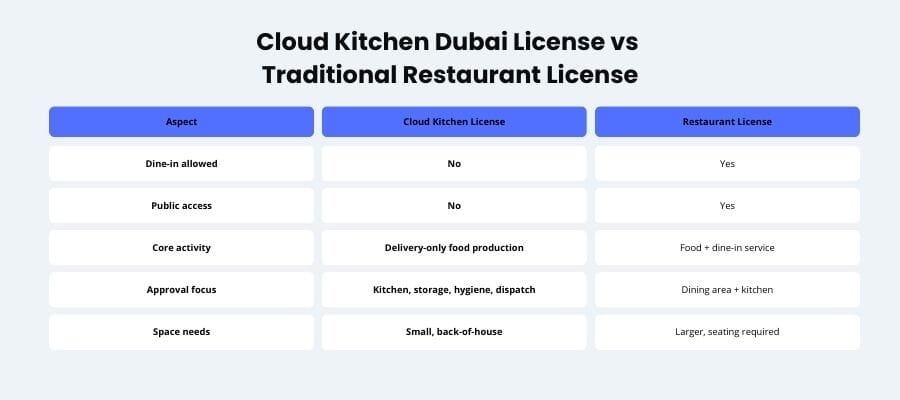
The difference between a cloud kitchen Dubai license and a traditional restaurant license is practical, not cosmetic. A restaurant license allows customer seating, front-of-house service, and public access. A cloud kitchen license does not. That single distinction changes rent expectations, layout requirements, staffing needs, and even insurance coverage.
Traditional restaurants are evaluated on dining areas, restrooms, and customer flow. Cloud kitchens are judged on storage, prep zones, temperature control, and dispatch efficiency. Costs follow the same logic: cloud kitchens avoid prime frontage and large spaces, while restaurants pay for visibility and seating. Choosing the right license from the start prevents forced changes later.
Cloud Kitchen License Dubai: Mainland vs Free Zone Options
When you pick the legal “home” for your company, you’re not choosing paperwork. You’re choosing how your operation is allowed to breathe. For a cloud kitchen license Dubai, the mainland route and the free zone route can both work—but they behave differently once you start taking real orders.
Mainland setup is the default choice for delivery-first brands that want zero friction. Your trade license is issued under Dubai’s licensing system, and your kitchen is approved as a food premises in Dubai. That combination usually plays nicely with delivery platforms, everyday customers, corporate catering requests, and expansion across the city. You’re not constantly checking whether a certain sales channel “counts” or whether an address is a problem.
Free zone registration can still be a smart move, but it’s not plug-and-play for every cloud kitchen. Some free zones support F&B-related activities, yet the cooking site often needs to be inside a compliant facility, or supported by additional approvals depending on the model. The bigger issue is practical: some delivery platforms and partners prefer mainland entities because onboarding and compliance are simpler. That doesn’t mean free zone is “bad.” It means you plan it properly—especially if you want smooth last-mile delivery.
Quick comparison, without the marketing fog:
|
Point that matters |
Mainland |
Free Zone |
|
Selling across Dubai |
Usually straightforward |
Often needs structure |
|
Platform onboarding |
Typically smooth |
Depends on setup |
|
Kitchen location rules |
Any approved premises in Dubai |
Often tied to specific facilities |
|
Expansion flexibility |
High |
Medium |
If your goal is wide delivery coverage from day one, mainland is usually the cleanest route. If your plan is more controlled—test brands, central production, specific partnerships—free zone can be workable with the right architecture.
How to Start a Cloud Kitchen in Dubai Step by Step
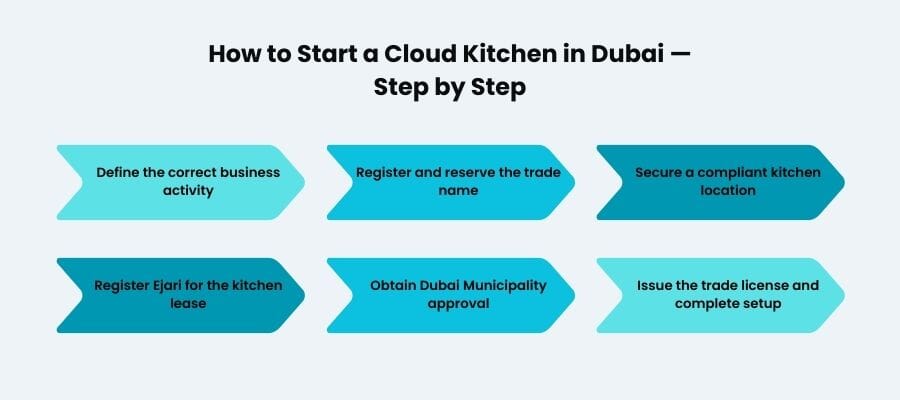
Starting a cloud kitchen in Dubai is not about “filling forms in order.” It’s about locking the right decisions early, so nothing breaks later when inspections, platforms, or payments enter the picture. The process is linear, but each step depends on the previous one being done properly. Skip that logic, and you’ll feel it in delays and revisions.
Business Activity Selection and Trade Name Registration
Everything starts with the activity description. This is where many founders make quiet mistakes. Your activity must clearly reflect a delivery-only food business, not a dine-in restaurant and not a vague trading label. The wording determines which approvals you can request and how delivery platforms classify you later.
Trade name registration comes next. Names are checked for duplication, restricted terms, and relevance to food activity. Promotional words, misleading claims, or unrelated terms can trigger rejection. Once approved, the trade name is reserved under your company file and linked to the future license. This step is fast when done right, but painful when it needs rework after submissions.

Want to learn more about UAE business setup services?
Kitchen Location, Ejari, and Municipality Approvals
Your kitchen is not just an address—it’s the core of your approval chain. You must secure a physical kitchen that fits food safety standards, whether it’s a private unit or space inside a shared facility. An Ejari (registered lease) is mandatory for mainland setups, and it must match the licensed activity.
Dubai Municipality approval follows. Inspectors look at layout, storage, workflow, ventilation, and hygiene systems. The approval is tied to the exact kitchen, not just the business name. Change the kitchen, and approvals reset.
If you want this process mapped correctly from day one—activity wording, kitchen approval, and cost planning—Consulting.ae can structure your cloud kitchen setup in Dubai without trial-and-error or wasted fees.
Cloud Kitchen License Cost in Dubai: Full Cost Breakdown
Money questions come early with a cloud kitchen, and they should. A cloud kitchen license cost in Dubai isn’t a single number you Google and accept. It’s a stack of fixed government fees plus very real operational expenses that depend on how and where you launch. When founders underestimate this stage, the business usually survives—but the margins suffer.
The good news is predictability. Dubai doesn’t hide costs. If you plan correctly, you know your baseline before the first order is cooked.
Government Fees and License Issuance Costs
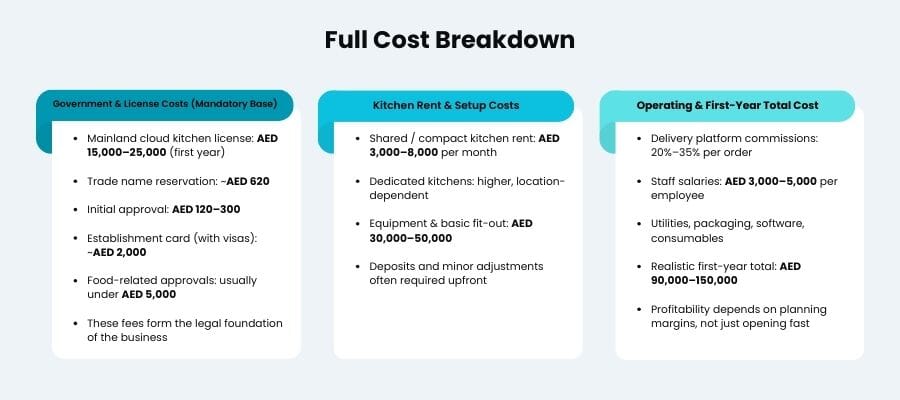
For a mainland cloud kitchen, government-related costs typically sit between AED 15,000 and AED 25,000 for the first year. This includes trade license issuance, initial approvals, and standard administrative charges. The exact figure depends on activity wording, number of shareholders, and whether visas are included at setup stage.
Additional government-linked costs may apply:
- Trade name reservation: around AED 620
- Initial approval fees: approximately AED 120–300
- Establishment card (if visas are planned): about AED 2,000
- Food-related approvals linked to the kitchen: variable, but usually under AED 5,000
These are not optional fees. They form the legal base that allows platforms, banks, and inspectors to treat your business as operational.
Cloud Kitchen Cost in Dubai: Setup, Rent, and Operations
Operational costs are where numbers spread out. Kitchen rent is the largest variable. In Dubai, a shared or compact cloud kitchen space usually rents for AED 3,000 to AED 8,000 per month, depending on location, size, and included services. Dedicated kitchens can go higher.
Setup costs include equipment, fit-out adjustments, and deposits. A lean setup often starts around AED 30,000–50,000, assuming basic appliances and no heavy construction.
Ongoing costs are easy to forget:
- Delivery platform commissions: 20%–35% per order
- Staff salaries (small team): AED 3,000–5,000 per employee
- Utilities, packaging, software, and consumables
Add it up, and a realistic first-year cloud kitchen cost in Dubai often lands between AED 90,000 and AED 150,000 for a modest operation. Planning this properly is what keeps the business profitable, not just open.
Cloud Kitchen License UAE: Key Legal and Compliance Requirements
A cloud kitchen can feel lightweight at the start—no dining room, no guests, no table reservations. The law doesn’t see it that way. Once you operate under a cloud kitchen license UAE, you’re running a food establishment, and the expectations are steady: safe handling, clean documentation, and a kitchen that matches what was approved. Treat compliance as part of the recipe, not a separate department.
- Food Safety, Hygiene, and Dubai Municipality Regulations
Dubai Municipality is the authority that sets the tone on food safety. Their focus is practical: storage temperatures, cross-contamination control, cleaning routines, pest prevention, labeling, and traceability. In other words, how food behaves in your space—every day, not only on inspection day.
You’ll need a kitchen setup that supports separation of raw and cooked items, proper ventilation, correct storage, and clear workflows. Staff involved in food handling must hold valid health cards. Logs matter too: cleaning schedules, temperature records, supplier invoices, and disposal routines. If the kitchen changes materially after approval—layout, equipment placement, storage areas—you risk a compliance headache that can slow operations.
- Delivery Platforms, POS Systems, and VAT Registration
Delivery platforms don’t onboard “ideas.” They onboard licensed businesses with clean paperwork and an approved kitchen. If your activity wording doesn’t align with delivery-only food operations, or if your kitchen approvals are incomplete, onboarding can stall even if your menu is brilliant.
A POS system isn’t a legal requirement, but try running multiple platforms without one and you’ll understand the problem in a week: mismatched orders, missing items, refund disputes, and shaky reporting. A basic system pays for itself by keeping sales, kitchen timing, and reconciliation under control.
VAT is non-negotiable once you hit the threshold. When taxable turnover reaches AED 375,000 per year, registration with the Federal Tax Authority (FTA) becomes mandatory. Plan for that early, because growing fast without VAT readiness is the kind of success that turns stressful.
Cloud Kitchen License Dubai: Turning Planning Into a Working Business
A cloud kitchen is one of the few food formats in Dubai where smart planning shows up immediately in your numbers. Get the cloud kitchen license Dubai right, choose the correct structure, and secure a compliant kitchen, and you start operating on solid ground. Miss those steps, and even a strong menu struggles under delays, revisions, and avoidable costs.
What matters most is alignment. Your license must match your activity. Your kitchen must match your approvals. Your costs must match your delivery margins. When those pieces fit, a cloud kitchen becomes flexible, scalable, and far easier to adjust than a traditional restaurant. That’s why this model attracts experienced operators, not just first-time founders.
If you’re serious about launching or restructuring a cloud kitchen business in the UAE, don’t rely on assumptions or half-answers. Consulting.ae can guide you through licensing, cost planning, approvals, and full setup—so your cloud kitchen starts operating as a business, not an experiment.


