


 Manish Kulkarni
  20.02.2026
Yes — employees can legally own or co-found a business in Dubai, even while staying employed. The catch is not dramatic, but it is real. Legality depends on where you work, what your contract says, whether your business creates a conflict of interest, and how your residence visa is sponsored. For many professionals, business ownership while employed in the UAE is possible without quitting a job, but only if the structure stays within the rules. This is why the question can an employee own a business in Dubai rarely has a simple yes or no.
Legal Basis: What UAE Law Allows Employees to Do
The law in the UAE lets workers participate in, own, or co-own businesses while they are working. This principle is rooted in UAE Federal Decree Law No. 33 of 2021, supported by Cabinet Resolution No. 1 of 2022. The law does not prohibit entrepreneurship by employees. It recognises that professionals may pursue other commercial interests.
However, the law does not override employment contracts, internal policies, or sector-specific rules. In practice, this means the state allows it, but your employer may still restrict it. Anyone planning to start a business while employed in the UAE should treat the law as a framework, not a permission slip.
Public Sector vs Private Sector Employment Restrictions
This distinction matters more than people expect.
People who work in the public sector, which includes government agencies and semi-government organizations, are often limited by the law. These might make it impossible to own a business or be in charge of something, no matter what it is. Approval requirements are stricter, and enforcement is typically clearer.
Private sector employees live in a different world. Here, employee business owner Dubai situations are mainly governed by contract terms and internal conflict-of-interest rules. Many private employers allow passive ownership, especially where the business operates in a different sector. Some require disclosure. Others require written consent.
There is no universal rule. Two employees in the same free zone, doing the same job, may face different outcomes purely because of contract wording.
Employment Contracts, Non-Compete Clauses, and Business Activities
Most restrictions hide in plain sight — inside the employment contract.
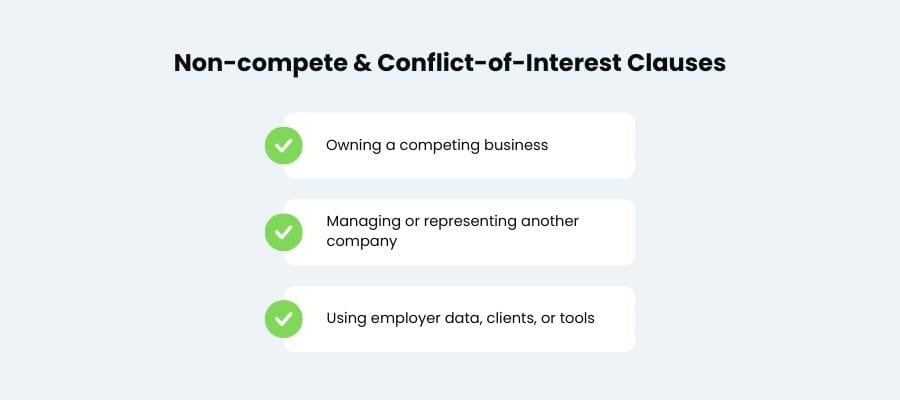
Non-compete and conflict-of-interest clauses often limit:
- Owning a competing business
- Managing or representing another company
- Using employer data, clients, or tools
What matters is overlap. If your side business competes with your employer, sells to the same clients, or uses inside knowledge, the risk rises sharply. If it operates in a clearly separate space, the risk drops.
Before acting on can employees start a business in Dubai, read the exact language. Words like directly, indirectly, commercial interest, and associated entities change everything.
Common contract checkpoints (first-half overview):
|
Item to review |
Why it matters |
|
Business activity overlap |
Triggers conflict-of-interest |
|
Management role restrictions |
Passive vs active ownership |
|
Non-compete duration |
May extend after resignation |
|
Disclosure or approval clauses |
Disclosure or approval clauses May contractually require NOC (private sector only) |
In the public sector, a No Objection Certificate (NOC) is a legal requirement. In the private sector, an NOC is not required by UAE law. Any NOC requirement in private employment comes only from the employment contract or internal company policy, not from legislation.

Want to learn more about UAE business setup services?
What Happens If the Rules Are Ignored?
Ignoring contract or NOC requirements does not usually lead to criminal penalties, but consequences are still serious.
Employment termination is the most common outcome. Disputes may follow, especially if the employer claims commercial harm. For employees whose residence visa is employer-sponsored, termination may also affect legal stay in the UAE, triggering a limited grace period to transfer or exit.
This is why employee co founder Dubai arrangements often fail not at registration, but months later — when an internal review, audit, or conflict surfaces.
Key Things to Check Before Starting a Business While Employed
Most problems are preventable. The goal is not speed, but clarity.
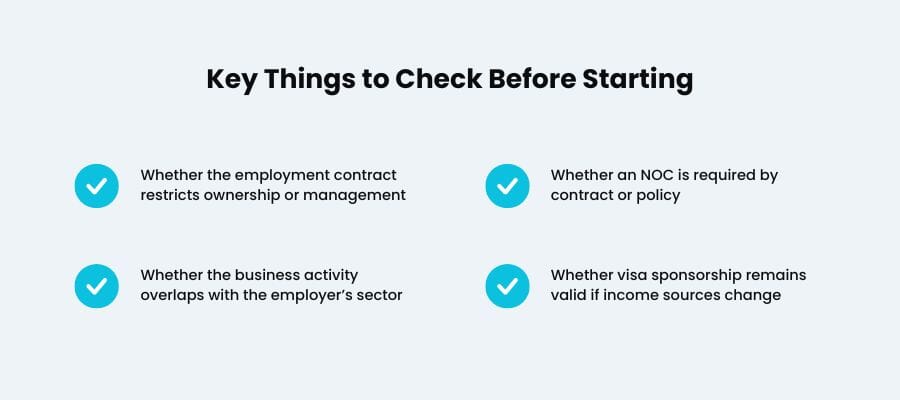
Employees considering business ownership while employed in the UAE should confirm:
- Whether the employment contract restricts ownership or management
- Whether an NOC is required by contract or policy
- Whether the business activity overlaps with the employer’s sector
- Whether visa sponsorship remains valid if income sources change
Business activity classification matters because some activities are treated as advisory, professional, or commercial, each carrying different implications. Jurisdiction choice also affects visibility and compliance expectations, even when ownership itself is allowed.
Conclusion
Being employed in Dubai does not block entrepreneurship. The law allows it. Reality filters it. For most private sector professionals, owning or co-founding a company is legally possible without resigning, provided the business stays separate, transparent, and contract-compliant. The real risk is not registration — it is assumption. Anyone asking can an employee own a business in Dubai should start by reading their contract, not a brochure.

